


In short ⚡
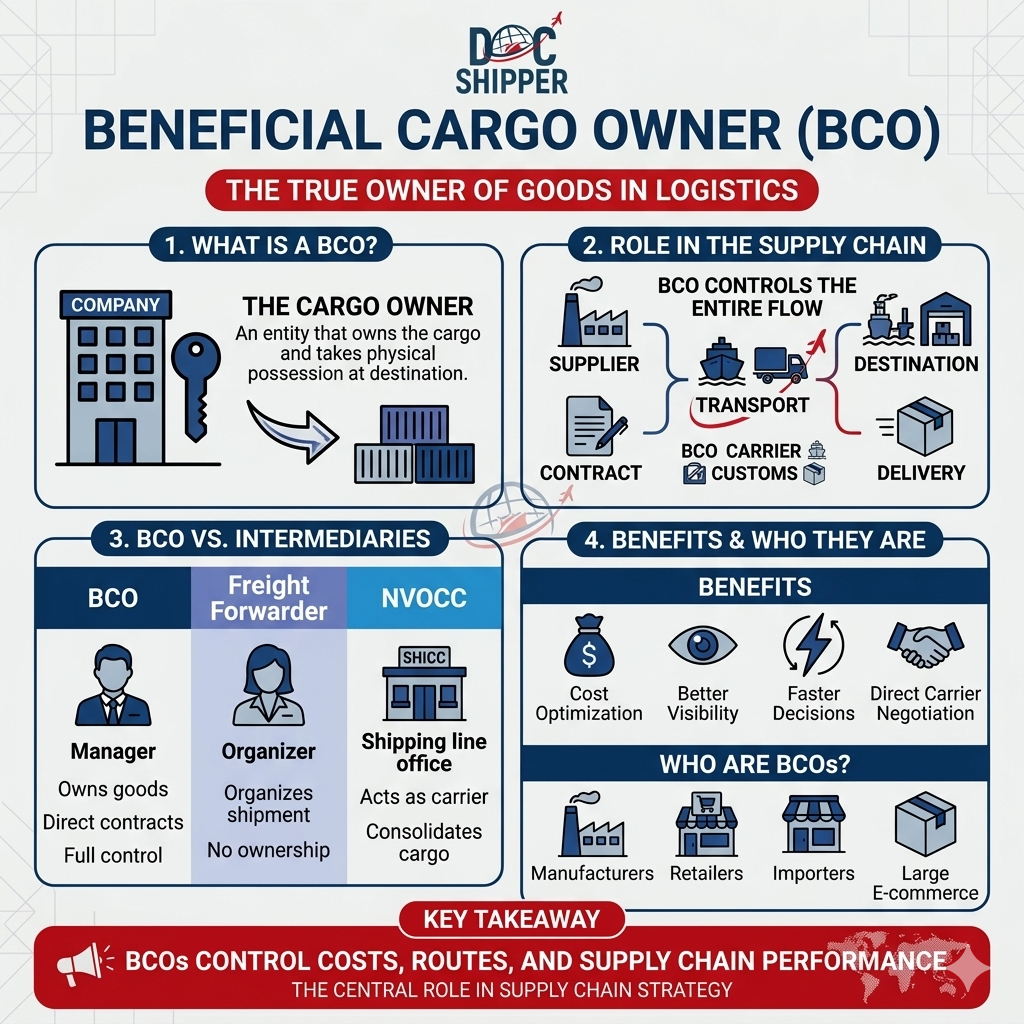
BCO (Beneficial Cargo Owner) refers to the entity that holds the financial interest and ownership rights over cargo during international shipment. Unlike freight forwarders or carriers, the BCO assumes commercial responsibility, bears transportation costs, and controls logistics decisions. This designation is crucial for customs clearance, insurance claims, and contractual liability in global trade.
Introduction
In international logistics, confusion often arises between who physically ships goods and who actually owns them. This distinction becomes critical during customs inspections, insurance disputes, or contractual disagreements. The BCO designation clarifies financial and legal ownership throughout the supply chain.
Understanding the BCO concept is essential for importers, exporters, and third-party logistics providers. It determines who bears risk, who negotiates freight rates, and who holds authority over cargo routing decisions.
Key characteristics of a Beneficial Cargo Owner:
- Financial ownership of the goods during transit
- Direct contractual relationship with carriers or NVOCCs
- Customs declarant responsibility in most jurisdictions
- Insurance claim rights in case of loss or damage
- Freight cost bearer unless otherwise specified in Incoterms
Understanding the BCO Role in Supply Chain
The BCO operates as the principal party in cargo movement, distinct from intermediaries like freight forwarders or customs brokers. This status carries specific legal and operational implications across international borders.
Customs and regulatory compliance falls primarily on the BCO. Customs authorities worldwide recognize the BCO as the importer or exporter of record, making them responsible for accurate documentation, tariff classification, and duty payment. According to EU Customs Code (Article 5), the BCO must be clearly identified in all customs declarations.
Contractual authority distinguishes BCOs from logistics intermediaries. A BCO negotiates directly with ocean carriers, airlines, or Non-Vessel Operating Common Carriers (NVOCCs). This direct relationship often yields better freight rates and service level agreements compared to third-party arrangements.
Risk and liability management centers on BCO status. Insurance policies for cargo damage or loss require proof of beneficial ownership. The BCO holds the insurable interest, meaning only they can file claims under marine cargo insurance policies governed by the Marine Insurance Act.
Incoterms implications vary based on BCO designation. Under FOB (Free On Board) terms, the seller acts as BCO until goods cross the ship’s rail, then ownership transfers. Under DDP (Delivered Duty Paid), the seller remains BCO throughout the entire journey. At DocShipper, we verify BCO status during contract setup to ensure proper risk allocation and customs compliance.
Financial settlement rights belong exclusively to the BCO. Demurrage charges, detention fees, and freight collect payments require BCO authorization. Carriers release cargo only upon BCO confirmation or their designated agent’s instruction with proper power of attorney documentation.
For authoritative guidance on BCO responsibilities in international trade, consult the International Chamber of Commerce Incoterms® rules, which define ownership transfer points and risk allocation.
Practical Scenarios & Comparative Data
Real-world application of BCO principles varies significantly across business models and trade lanes. Understanding these differences helps optimize logistics strategies and cost structures.
Comparative Analysis: BCO vs. Third-Party Shipper
| Criterion | BCO (Direct Shipper) | Freight Forwarder (Consolidator) |
|---|---|---|
| Freight Rate | Carrier contract rates (typically 15-25% lower) | Marked-up consolidation rates |
| Customs Liability | Direct responsibility as importer of record | Acts on behalf of BCO principal |
| Insurance Coverage | Full insurable interest; direct claims | Limited liability (typically $500 per package) |
| Routing Control | Full authority over vessel/flight selection | Limited to available consolidation schedules |
| Minimum Volume | Often requires full container load (FCL) | Accepts less-than-container load (LCL) |
Use Case: Electronics Manufacturer
A European electronics company imports components from Shenzhen, China. Monthly volume: 8 TEU (Twenty-foot Equivalent Units).
BCO Scenario: The manufacturer contracts directly with Maersk under a service contract. Average rate: $1,200/TEU. Total monthly cost: $9,600. The company maintains full control over shipping schedules and receives priority booking during peak season. Customs clearance occurs under their own EORI number, ensuring direct VAT recovery.
Forwarder Scenario: The same manufacturer uses a freight forwarder who consolidates multiple shippers’ cargo. Rate: $1,450/TEU (including forwarder margin). Total monthly cost: $11,600. The forwarder handles documentation but adds 5-7 days transit time due to consolidation requirements. Customs clearance occurs under forwarder’s bond, requiring additional coordination.
Annual savings as BCO: ($11,600 – $9,600) × 12 = $24,000, plus improved transit time and operational control.
DocShipper Platform
Optimize Your Global Logistics with Cutting-Edge Solutions
Enhance efficiency, cut costs, and gain 24/7 visibility 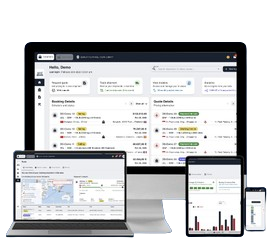 over your entire supply chain.
- Cut your shipping costs and maximize your margins
- Manage sourcing, freight, & customs on one platform
- Get real-time tracking and analytics
Key Decision Factors for BCO Status
- Shipment volume: BCO status becomes cost-effective above 4-6 containers monthly
- Trade lane consistency: Regular routes justify direct carrier contracts
- Customs expertise: In-house compliance teams maximize BCO benefits
- Cash flow capacity: BCOs must prepay freight or establish carrier credit
- Risk tolerance: Direct liability requires robust insurance programs
At DocShipper, we analyze client shipping patterns to determine optimal BCO vs. third-party arrangements, ensuring maximum cost efficiency while maintaining compliance standards.
Conclusion
The BCO designation fundamentally shapes logistics cost structures, legal responsibilities, and operational control in international trade. Companies with sufficient volume and internal expertise benefit significantly from direct carrier relationships, while smaller shippers often require freight forwarder consolidation services.
Need guidance on optimizing your BCO strategy or managing complex international shipments? Contact DocShipper for expert consultation tailored to your supply chain requirements.
📚 Quiz
Test Your Knowledge: BCO (Beneficial Cargo Owner)
Q1 — What best defines a Beneficial Cargo Owner (BCO) in international logistics?
Q2 — A freight forwarder consolidates cargo for multiple clients and issues house bills of lading. Under what condition can this freight forwarder also be considered a BCO?
Q3 — A European manufacturer ships goods from China under FOB (Free On Board) Incoterms. Who holds BCO status during the ocean transit leg?
🎯 Your Result
📞 Free Quote in 24hFAQ | BCO (Beneficial Cargo Owner): Definition, Role & Practical Examples
A BCO owns the cargo and bears financial risk, while a freight forwarder acts as an intermediary arranging transportation on behalf of the BCO. The BCO holds the bill of lading as consignee or shipper, whereas forwarders typically issue house bills of lading.
Yes, when a freight forwarder purchases goods and resells them, they become the BCO for that transaction. This occurs in trade finance arrangements or when forwarders act as trading companies rather than pure logistics providers.
BCOs are typically listed as the importer or exporter of record on customs declarations, making them legally responsible for accurate classification, valuation, and duty payment. Customs authorities hold BCOs accountable for compliance violations.
BCOs hold insurable interest in cargo, allowing them to purchase comprehensive marine insurance and file direct claims. Non-BCO parties have limited recovery rights, typically capped at carrier liability limits of $500 per package under Carriage of Goods by Sea Act (COGSA).
Generally yes, especially for consistent volumes above 4-6 containers monthly. Carriers offer contract rates to BCOs that are typically 15-25% lower than forwarder consolidation rates, though this requires minimum volume commitments.
Most ocean carriers require 40-100 TEU annually for service contracts, though this varies by trade lane. Air cargo BCO agreements typically start at 50-100 tons annually. Smaller shippers access BCO benefits through co-loading groups or NVOCC contracts.
Incoterms define the point where BCO responsibility transfers between buyer and seller. Under EXW, the buyer becomes BCO immediately. Under DDP, the seller remains BCO until final delivery. The BCO at any given moment bears freight costs and risk for that leg.
No, only one party holds beneficial ownership at any given time. However, BCO status can transfer during transit based on Incoterms. For example, under FOB, the seller is BCO until loading, then the buyer assumes BCO status for ocean transit.
The original bill of lading listing the party as shipper or consignee serves as primary evidence. Commercial invoices, letters of credit, and purchase orders further establish beneficial ownership. Customs may require additional proof like warehouse receipts or insurance certificates.
Carriers bill demurrage (port storage) and detention (container usage) directly to the BCO listed on the bill of lading. Only the BCO or their authorized agent can negotiate waivers or extensions. Third parties cannot dispute these charges without BCO power of attorney.
Yes, BCOs can claim direct VAT/GST recovery on import duties in most jurisdictions, avoiding the cash flow delays of third-party customs clearance. BCOs also deduct freight costs directly as business expenses rather than through marked-up forwarder invoices.
Incorrect BCO designation can cause customs holds, insurance claim denials, and cargo release delays. Carriers may refuse delivery until proper BCO documentation is provided. Amendments require original bill of lading surrender and can incur fees of $100-300 per correction.
Need Help with
Logistics or Sourcing ?
First, we secure the right products from the right suppliers at the right price by managing the sourcing process from start to finish. Then, we simplify your shipping experience - from pickup to final delivery - ensuring any product, anywhere, is delivered at highly competitive prices.


Fill the Form
Prefer email? Send us your inquiry, and we’ll get back to you as soon as possible.
Contact us




