


In short ⚡
A bilateral agreement is a legally binding arrangement between two countries or parties that establishes mutual rights, obligations, and benefits in areas such as trade, customs, or transport. These agreements simplify cross-border operations by reducing tariffs, streamlining customs procedures, and harmonizing regulatory standards. In international logistics, bilateral agreements directly impact shipping costs, transit times, and compliance requirements for importers and exporters.
Introduction
Many businesses struggle with unexpected customs delays, duplicate taxation, or rejected certifications when shipping internationally. The root cause often lies in misunderstanding which bilateral agreement applies to their shipment route.
Bilateral agreements form the backbone of modern international trade. They define the legal framework that governs everything from tariff rates to certificate recognition between two nations. For logistics professionals, understanding these agreements means the difference between smooth customs clearance and costly detention charges.
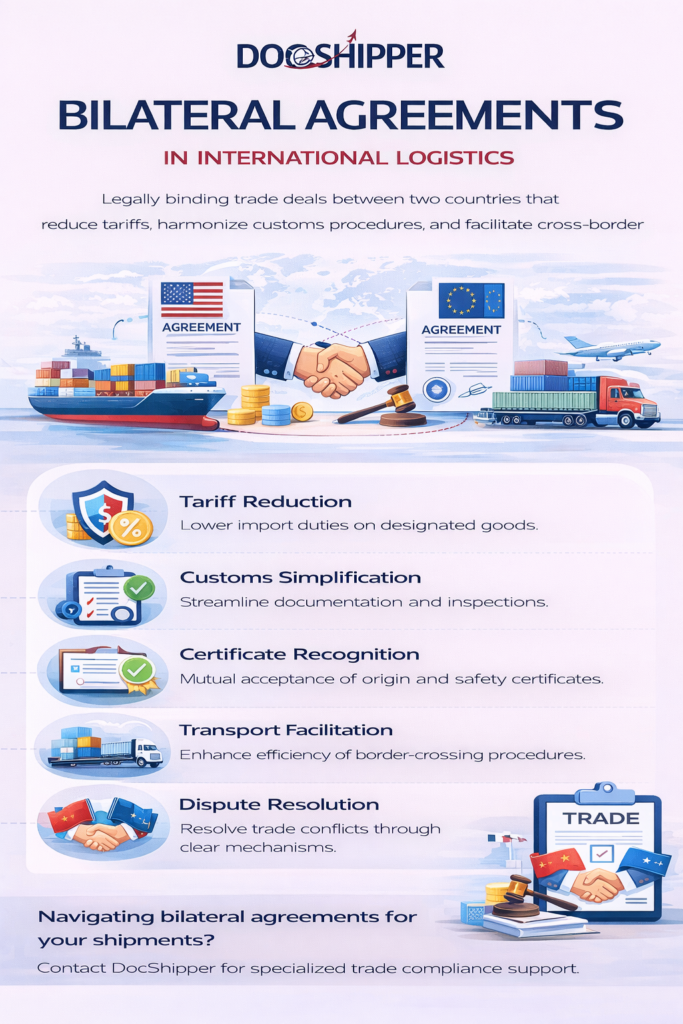
- Tariff reduction: Lower or eliminate import duties on specific goods categories
- Customs simplification: Harmonize documentation requirements and inspection procedures
- Certificate recognition: Mutual acceptance of origin certificates, sanitary permits, and quality standards
- Transport facilitation: Streamline border crossings and transit procedures for carriers
- Dispute resolution: Establish clear mechanisms for handling trade conflicts or interpretation differences
Mechanisms & Legal Implications
Bilateral agreements operate through reciprocal commitments where both parties grant equivalent advantages. Unlike multilateral frameworks, these agreements allow tailored solutions addressing specific trade patterns between two nations.
The most favored nation (MFN) principle requires that any advantage granted to one partner must extend to all WTO members, unless covered by a formal trade agreement exception. Bilateral agreements exploit this exception to create preferential treatment zones.
Rules of origin determine which goods qualify for preferential treatment. These rules typically require substantial transformation in the exporting country, often defined by value-added thresholds (35-50%) or specific manufacturing processes. At DocShipper, we systematically verify origin documentation against bilateral agreement requirements to prevent customs rejections and ensure clients benefit from applicable duty reductions.
Regulatory harmonization clauses align technical standards, safety requirements, and certification procedures. This reduces testing costs and accelerates market entry. For example, agreements may establish mutual recognition of conformity assessment bodies, allowing a single certification to satisfy both countries’ requirements.
The dispute settlement mechanism provides structured procedures when disagreements arise over interpretation or implementation. Most agreements establish joint committees that meet regularly to address issues before they escalate to formal arbitration. According to the World Trade Organization, bilateral dispute mechanisms resolve 70% of conflicts without formal proceedings, maintaining stable trade relationships.
Practical Examples & Data
Understanding bilateral agreements through real-world applications reveals their practical impact on logistics operations and cost structures.
Comparative Analysis: With vs. Without Bilateral Agreement
| Factor | Without Agreement | With Bilateral Agreement | Savings/Impact |
|---|---|---|---|
| Import Duty (Electronics) | 8-12% MFN rate | 0-3% preferential rate | $5,000-$9,000 per $100k shipment |
| Customs Clearance Time | 5-7 days | 1-2 days | 4-5 days faster |
| Certificate Requirements | Separate testing in both countries | Single certification accepted | $2,000-$5,000 testing cost reduction |
| Documentation Pages | 15-20 documents | 8-10 documents | 50% administrative reduction |
| Rejection Risk | 12-18% of shipments | 3-5% of shipments | 70% risk reduction |
Use Case: EU-South Korea Free Trade Agreement
A French automotive parts manufacturer exports €500,000 worth of components monthly to South Korea. Before the EU-Korea FTA (implemented 2011), the company faced:
- Duty burden: 8% tariff = €40,000 monthly ($43,000)
- Compliance costs: Separate Korean certification = €15,000 annually
- Clearance delays: Average 6 days, causing production line disruptions
After bilateral agreement implementation:
- Zero tariff: Annual savings of €480,000 ($520,000)
- Mutual recognition: EU certification accepted, eliminating duplicate testing
- Fast-track clearance: Reduced to 24-48 hours with preferential documentation
- Cumulative ROI: Total annual benefit exceeds €500,000 ($540,000)
DocShipper Platform
Cut logistics costs. Not corners.
See exactly where your logistics costs are bleeding — and how to fix it. Book your expert demo.

Key Data Points on Bilateral Agreements
- Global coverage: Over 350 bilateral trade agreements currently in force worldwide
- Tariff impact: Average duty reduction of 65-90% on covered goods categories
- Processing speed: Bilateral agreement shipments clear customs 3-4x faster than standard procedures
- Utilization rate: Only 60-70% of eligible businesses actively claim bilateral agreement benefits due to documentation complexity
- Compliance requirement: 95%+ of preferential claims require certificate of origin issued within 12 months of export
Conclusion
Bilateral agreements represent critical competitive advantages in international logistics, delivering measurable cost reductions and operational efficiencies. Proper utilization requires expert knowledge of documentation requirements and origin rules.
Need assistance navigating bilateral agreement requirements for your shipments? Contact DocShipper for specialized customs compliance support.
📚 Quiz
Bilateral Agreement
Q1 — What best defines a bilateral agreement in international trade?
Q2 — A common misconception is that bilateral agreements automatically eliminate all import duties on every product. What is the correct interpretation?
Q3 — A French exporter ships automotive parts to South Korea and wants to benefit from the EU-Korea FTA preferential duty rate. Which document is essential to prove eligibility?
🎯 Your Result
📞 Free Quote in 24hFAQ | Bilateral Agreement: Definition, Types & Practical Examples
Bilateral agreements involve two countries creating specific terms tailored to their trade relationship, while multilateral agreements involve three or more nations establishing broader frameworks. Bilateral deals typically offer deeper integration but narrower geographic scope.
Check the origin country, destination country, and product HS code. Customs authorities publish lists of applicable agreements and covered goods. Professional freight forwarders maintain updated databases of agreement coverage.
The primary document is a Certificate of Origin (CO) issued by authorized chambers of commerce or government agencies. Some agreements accept supplier declarations or exporter self-certification for low-value shipments under specific thresholds.
Most countries allow retroactive claims within 12 months of importation if you can provide valid origin documentation. However, procedures vary significantly by country, and some impose strict time limits or administrative fees.
No. Agreements typically exclude sensitive sectors like agriculture, textiles, or strategic materials. Each agreement contains annexes listing covered and excluded HS codes. Coverage expands gradually through periodic reviews.
Goods revert to standard MFN duty rates. Customs may also impose penalties for fraudulent origin claims. Proper documentation and transparent sourcing records are essential to avoid compliance issues.
Bilateral trade agreements primarily address customs duties, not consumption taxes. VAT/GST typically applies regardless of preferential tariff status, though some agreements include provisions for simplified VAT procedures.
No. Agreements contain termination clauses and review periods (typically 5-10 years). Either party can renegotiate terms or withdraw with advance notice, though this rarely occurs due to economic interdependence.
Absolutely. While documentation requirements remain identical, the proportional savings are often greater for smaller shipments. Some agreements offer simplified procedures for SMEs or low-value consignments under €1,000-€6,000.
Modern bilateral agreements increasingly cover services trade, including logistics, consulting, and digital services. However, implementation varies widely, with goods provisions typically more developed than services chapters.
Customs union members (like the EU) negotiate as a single entity. Individual member states cannot establish separate bilateral agreements on tariffs, though they may sign cooperation agreements on non-tariff matters.
Chambers of commerce issue certificates of origin and provide verification services. They maintain records of exporters, validate manufacturing processes, and serve as liaison points between businesses and customs authorities for agreement-related inquiries.
Need Help with
Logistics or Sourcing ?
First, we secure the right products from the right suppliers at the right price by managing the sourcing process from start to finish. Then, we simplify your shipping experience - from pickup to final delivery - ensuring any product, anywhere, is delivered at highly competitive prices.


Fill the Form
Prefer email? Send us your inquiry, and we’ll get back to you as soon as possible.
Contact us




