


In short ⚡
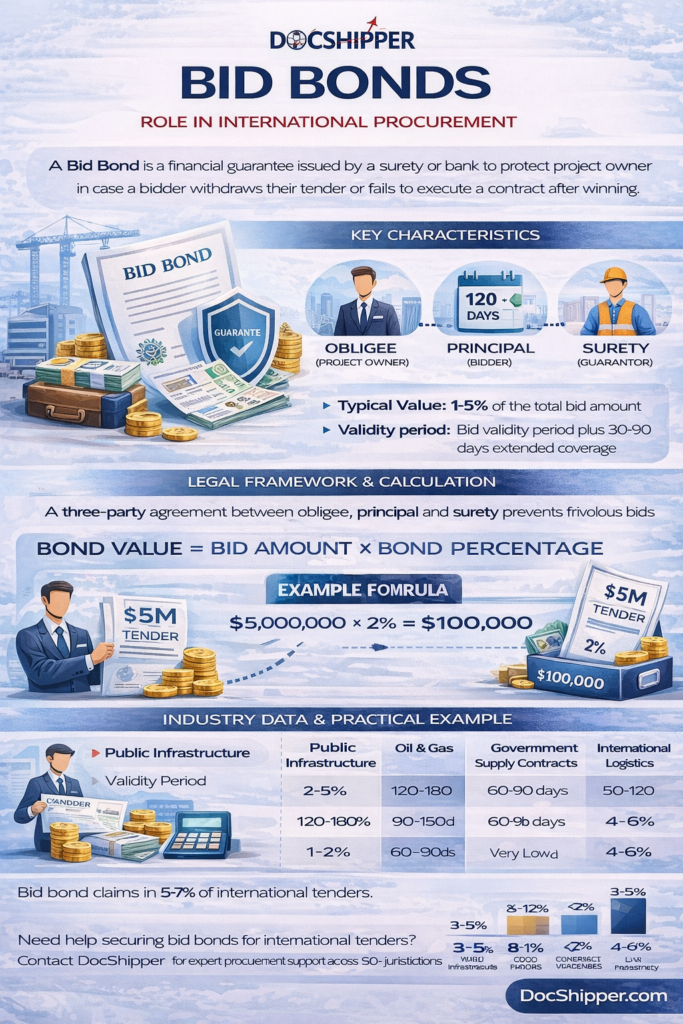
A Bid Bond is a financial guarantee issued by a surety or bank to protect the project owner (obligee) in case a bidder withdraws their tender or fails to execute a contract after winning. It ensures serious participation in procurement processes and compensates for re-tendering costs if the winning bidder defaults.
Introduction
In international trade and construction projects, bid bonds prevent one critical risk: frivolous bidding. Without this safeguard, companies could submit low-ball offers with no intention to deliver, disrupting procurement cycles and inflating costs.
The bid bond serves as a pre-qualification filter. It confirms the bidder’s financial capacity and commitment before contract award. This instrument is mandatory in public tenders worldwide and increasingly required in private sector projects involving complex logistics or infrastructure.
Key characteristics include:
- Typical value: 1% to 5% of the total bid amount
- Validity period: Matches the tender validity plus 30-90 days
- Claim triggers: Bid withdrawal, refusal to sign contract, or failure to provide performance bond
- Issuing entities: Banks, insurance companies, or specialized surety providers
- Non-refundable: The premium paid to obtain the bond is not recoverable
In-Depth Analysis & Legal Framework
The bid bond operates within a triangular relationship: the principal (bidder), the obligee (project owner), and the surety (guarantor). Unlike cash deposits, bid bonds do not immobilize working capital, making them essential for companies bidding on multiple simultaneous projects.
Legal enforceability varies by jurisdiction. Under UNCITRAL Model Procurement Law, bid bonds must be unconditional and payable on first demand. The World Bank Procurement Regulations mandate specific bond formats for projects exceeding $10 million, standardizing clauses across borders.
The calculation methodology follows this formula: Bond Value = Bid Amount × Bond Percentage. For a $5 million tender with a 2% requirement, the bond equals $100,000. The premium cost (0.5%-3% of bond value annually) depends on the bidder’s creditworthiness and project risk profile.
Three critical compliance points govern bid bonds:
- Format requirements: Must reference tender number, project description, and exact expiry date
- Amendment clauses: Extensions require surety consent and may incur additional fees
- Claim procedures: Obligee must submit written notice within the validity period, citing specific default conditions
At DocShipper, we verify bid bond authenticity and alignment with tender specifications before submission, preventing disqualifications due to non-conforming guarantees. Our compliance team cross-checks bond wording against local procurement regulations in 50+ countries.
Practical Examples & Data
Real-world applications demonstrate how bid bonds function across industries. The following comparative table illustrates typical requirements by sector:
| Sector | Bond Percentage | Validity Period | Claim Frequency |
|---|---|---|---|
| Public Infrastructure | 2-5% | 120-180 days | Low (3-5%) |
| Oil & Gas | 1-3% | 90-150 days | Medium (8-12%) |
| Government Supply Contracts | 1-2% | 60-90 days | Very Low (<2%) |
| International Logistics | 2-4% | 90-120 days | Low (4-6%) |
Use Case: A European logistics provider bids on a $3 million contract to manage warehousing operations in Southeast Asia. The tender requires a 3% bid bond valid for 120 days.
- Bond amount: $3,000,000 × 3% = $90,000
- Premium cost: $90,000 × 1.5% = $1,350 (assuming good credit rating)
- Outcome: The company wins the contract and provides a performance bond within 14 days. The bid bond is released after contract signing.
- Alternative scenario: If the company withdraws its bid, the obligee claims the full $90,000 to cover re-tendering expenses.
Data from the International Chamber of Commerce shows that bid bond claims occur in approximately 5-7% of international tenders, with the highest rates in emerging markets where bidder pre-qualification is less rigorous. Projects exceeding $50 million see claim rates drop to 2-3% due to stricter vetting processes.
Conclusion
The bid bond remains the cornerstone of fair procurement, balancing opportunity access with accountability. Proper structuring prevents capital lock-up while safeguarding project owners against bid manipulation.
Need assistance securing compliant bid bonds for international tenders? Contact DocShipper for expert guidance on surety requirements across 50+ jurisdictions.
📚 Quiz
Test Your Knowledge: Bid Bond
Q1 — What is the primary purpose of a Bid Bond?
Q2 — A company loses a tender it bid on with a Bid Bond. What happens to the premium it paid to obtain the bond?
Q3 — A European logistics firm wins a $3 million contract requiring a 3% Bid Bond. After winning, it refuses to provide the required Performance Bond. What is the most likely consequence?
🎯 Your Result
📞 Free Quote in 24hFAQ | Bid Bond: Definition, Calculation & Practical Examples
You must request an extension from the surety before expiry. Most sureties allow one extension with additional premium charges. Failure to extend may result in bid disqualification.
Yes, if the tender documents explicitly allow it. Bank guarantees and bid bonds serve identical functions but may have different issuance processes and costs depending on the institution.
Premium rates range from 0.5% to 3% of the bond value annually, based on your company's financial strength, project risk, and surety relationship. High-risk projects may incur higher premiums.
Typically: audited financial statements (2-3 years), tender documents, company registration, proof of technical capacity, and a completed surety application form. Requirements vary by surety provider.
The bond itself is released without cost if you lose the tender. However, the premium paid to obtain the bond is non-refundable regardless of the outcome.
No. Each bid bond is project-specific and references unique tender details. You must obtain separate bonds for each tender you participate in.
Common triggers include: withdrawing your bid before expiry, refusing to sign the contract after winning, or failing to provide the required performance bond within the stipulated timeframe.
For established clients with good credit, 2-5 business days. First-time applicants may require 7-14 days due to financial due diligence and credit assessments by the surety.
Increasingly yes, especially for large-scale infrastructure or supply contracts. While not legally mandated like public tenders, private owners use them to filter serious bidders and reduce procurement risks.
A bid bond guarantees you'll accept the contract if awarded. A performance bond guarantees you'll complete the contract as specified. The bid bond is replaced by the performance bond after contract signing.
Yes, but at higher premium rates (2-3% vs. 0.5-1% for established firms). Some sureties accept collateral or parent company guarantees to offset limited financial track records.
No. They only cover pre-contract defaults (bid withdrawal, refusal to sign, or failure to provide performance bond). Post-contract issues are covered by performance and payment bonds.
Need Help with
Logistics or Sourcing ?
First, we secure the right products from the right suppliers at the right price by managing the sourcing process from start to finish. Then, we simplify your shipping experience - from pickup to final delivery - ensuring any product, anywhere, is delivered at highly competitive prices.


Fill the Form
Prefer email? Send us your inquiry, and we’ll get back to you as soon as possible.
Contact us




