


In short ⚡
Bill of Materials (BOM) Explosion is a manufacturing and logistics process that breaks down a finished product into its individual components, subassemblies, and raw materials across multiple hierarchical levels. This systematic decomposition enables precise material planning, inventory control, and production scheduling throughout the supply chain.Introduction
Importers and manufacturers frequently struggle with accurate material forecasting, leading to production delays or excess inventory. The BOM explosion process solves this challenge by providing complete visibility into component requirements at every production stage.
In international logistics and manufacturing operations, understanding BOM explosion is essential for customs valuation, landed cost calculation, and supplier coordination. This methodology directly impacts lead times, working capital efficiency, and regulatory compliance.
- Multi-level decomposition: Breaks products into parent-child component relationships
- Quantity multiplication: Calculates total material needs across all assembly levels
- Lead time aggregation: Identifies critical path components for procurement planning
- Cost rollup capability: Enables accurate product costing from raw material to finished goods
- Change impact analysis: Tracks how component modifications affect entire product structures
Technical Framework & Implementation
BOM explosion operates through recursive algorithms that traverse hierarchical product structures. Each parent item references child components with specific quantities, creating a tree structure that extends from finished goods to purchased materials.
The process distinguishes between single-level explosion (immediate children only) and multi-level explosion (complete decomposition to raw materials). Manufacturing systems use the latter for Material Requirements Planning (MRP), calculating gross requirements by multiplying parent demand through each level.
Phantom assemblies represent a critical consideration—these are subassemblies that exist in the BOM but are never stocked, being assembled and immediately consumed. The explosion logic must handle these transparently, passing requirements directly to their components.
According to ISO 16792:2015 standards for technical product documentation, BOM structures must maintain referential integrity and version control. This ensures that explosions reflect the correct product configuration for specific production runs or customer orders.
At DocShipper, we integrate BOM explosion data into customs documentation preparation, ensuring that HS code classification and origin determination account for all component materials. This prevents costly reclassifications during import clearance.
Practical Examples & Data Analysis
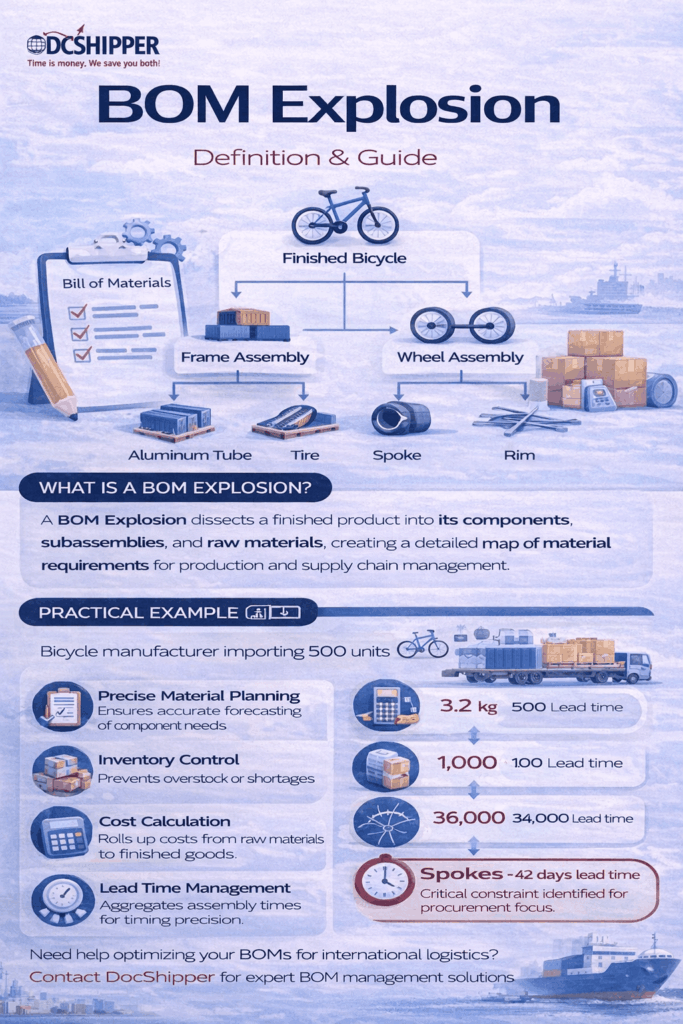
Consider a bicycle manufacturer importing 500 units. The BOM explosion reveals the complete component requirement:
| Level | Component | Qty per Parent | Total Required | Lead Time (days) |
|---|---|---|---|---|
| 0 | Finished Bicycle | 1 | 500 | – |
| 1 | Frame Assembly | 1 | 500 | 21 |
| 1 | Wheel Assembly | 2 | 1,000 | 14 |
| 2 | Aluminum Tube (frame) | 3.2 kg | 1,600 kg | 35 |
| 2 | Tire | 1 | 1,000 | 28 |
| 2 | Spoke | 36 | 36,000 | 42 |
The explosion immediately reveals that spokes become the critical constraint with a 42-day lead time. Without this analysis, procurement might focus on frames (shorter lead time), causing production delays when spoke inventory depletes.
Customs valuation scenario: A European importer declares a bicycle at €350 FOB. Customs authorities perform their own BOM explosion, discovering that aluminum tubes alone cost €85, tires €22 each, and labor rates suggest undervaluation. The explosion-based cost reconstruction triggers a valuation adjustment to €420 per unit, plus penalties.
Key operational insights from BOM explosion data:
- Working capital optimization: Identifies high-value components requiring supplier financing arrangements
- Supplier diversification: Reveals single-source dependencies at deep BOM levels
- Freight consolidation: Groups components by origin country for optimized shipping
- Quality control allocation: Prioritizes inspection resources on components with highest failure impact
- Regulatory compliance: Ensures all materials meet destination country standards (RoHS, REACH, etc.)
Conclusion
BOM explosion transforms abstract product structures into actionable procurement and logistics intelligence. Mastering this process enables importers to anticipate material needs, optimize inventory investment, and navigate customs procedures with precision.
Need assistance structuring your BOMs for international supply chain efficiency? Contact DocShipper for expert guidance on logistics optimization and compliance strategy.
📚 Quizz
Test Your Knowledge: Bill of Materials (BOM) Explosion
1. What does a BOM Explosion fundamentally do in a manufacturing or logistics context?
2. A subassembly exists in the BOM structure but is never physically stocked — it is assembled and immediately consumed. What is this called, and how does BOM explosion handle it?
3. A bicycle manufacturer is importing 500 units. After running a BOM explosion, which component should procurement prioritize first to avoid production delays?
🎯 Your Result
📞 Free Quote in 24hFAQ | Bill of Materials (BOM) Explosion: Definition, Calculation & Practical Examples
BOM explosion breaks a finished product down into components (top-down), while BOM implosion identifies all finished products that use a specific component (bottom-up). Implosion is critical for change management and obsolescence planning.
Customs authorities may use BOM explosion to verify declared values by reconstructing product costs from component prices. Significant discrepancies between declared value and exploded component costs can trigger audits or valuation adjustments.
Yes, through modular BOMs or variant management. Systems create multiple explosion paths based on configuration rules, calculating different material requirements for each product variant while maintaining a single master structure.
A phantom BOM represents a subassembly that exists logically but is never physically stocked. During explosion, the system "sees through" the phantom, passing requirements directly to its child components without creating intermediate inventory records.
Update BOMs immediately when engineering changes occur. Leading manufacturers implement Engineering Change Order (ECO) processes with effective dates, ensuring explosions reflect the correct configuration for each production batch or customer order.
Advanced explosion algorithms incorporate scrap factors at each level. If a machining operation has 5% scrap, the system increases gross requirements accordingly, ensuring sufficient material availability despite expected losses.
By revealing all component origins, explosion enables Regional Value Content (RVC) calculations required for preferential duty treatment under FTAs. Systems can automatically flag when non-originating content exceeds agreement thresholds.
Explosion data feeds obsolescence analysis, showing which finished products are affected when a component reaches end-of-life. This enables proactive last-time-buy decisions and redesign planning before supply disruptions occur.
Yes, exploded BOMs provide detailed commodity data for shipping documentation, dangerous goods declarations, and packing list generation. Integration ensures consistency between manufacturing data and logistics execution.
Configure-to-order (CTO) systems perform real-time explosion based on customer selections. The system generates a unique BOM instance for each order, exploding only the configured options rather than all possible variants.
Deeper BOMs (more levels) increase supply chain complexity and vulnerability. Each additional level adds lead time and introduces new failure points. Explosion analysis helps quantify this risk by mapping complete dependency chains.
By exploding BOMs to raw material level and linking to environmental databases, companies calculate total product carbon footprint, recyclable content percentage, and conflict mineral exposure—essential for ESG compliance and customer transparency requirements.
Need Help with
Logistics or Sourcing ?
First, we secure the right products from the right suppliers at the right price by managing the sourcing process from start to finish. Then, we simplify your shipping experience - from pickup to final delivery - ensuring any product, anywhere, is delivered at highly competitive prices.


Fill the Form
Prefer email? Send us your inquiry, and we’ll get back to you as soon as possible.
Contact us




