


In short ⚡
Bonded transit is a customs procedure allowing goods to move between two points within a customs territory—or through multiple countries—without immediate payment of duties or taxes. The merchandise remains under customs supervision until reaching its final destination, where formal clearance occurs.Introduction
International traders frequently face a critical dilemma: how to move goods through intermediate territories without triggering immediate tax liabilities or complex clearance procedures. Bonded transit solves this challenge by creating a customs-supervised corridor that suspends duty collection until the cargo reaches its declared endpoint.
This mechanism proves essential in global supply chains, particularly when shipments cross multiple jurisdictions or require temporary storage before final distribution. Misunderstanding bonded transit rules can result in unexpected detention, penalties, or cargo seizure.
Key characteristics of bonded transit include:
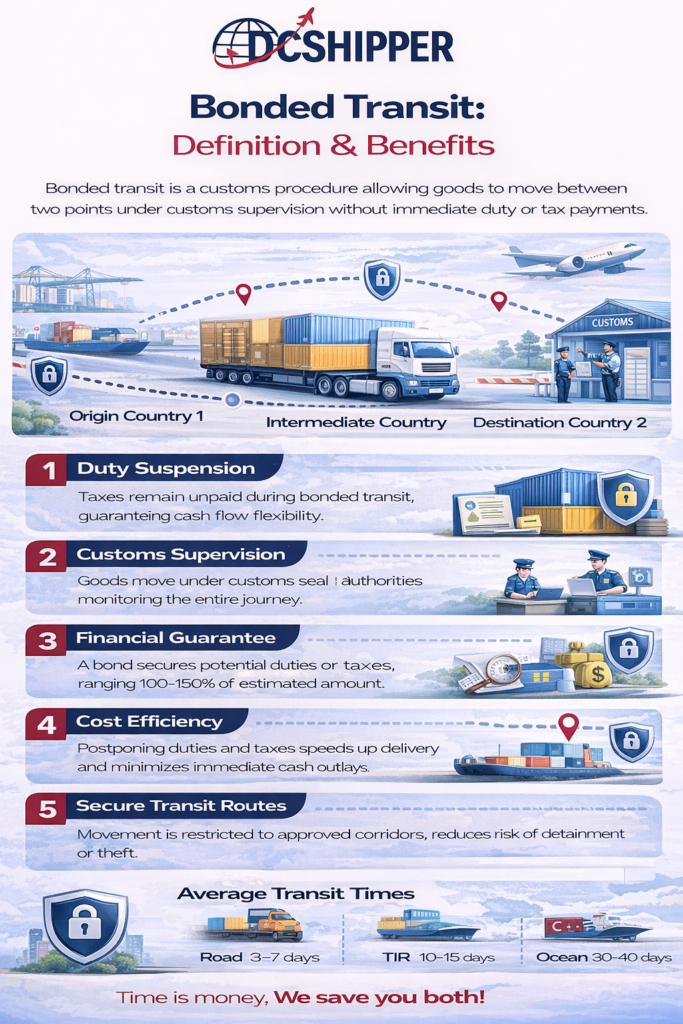
- Duty suspension: Taxes remain unpaid during movement under customs seal or electronic monitoring
- Customs supervision: Authorities track cargo via transit declarations, seals, or GPS systems
- Time limits: Strict deadlines apply—typically 30 to 90 days depending on jurisdiction
- Financial guarantee: Bonds or deposits secure potential duty amounts if goods disappear
- Approved routes: Movement must follow designated corridors and checkpoints
In-Depth Analysis & Regulatory Framework
Bonded transit operates under two primary models: internal transit (within a single customs territory like the EU) and international transit (crossing sovereign borders under conventions like TIR or ATA Carnet). The European Union’s Union Transit system exemplifies internal procedures, while the TIR Convention governs cross-border movements involving non-EU countries.
The legal foundation rests on the principle of customs debt suspension. When a transit declaration is lodged, the importer or carrier assumes responsibility for delivering goods intact to the destination customs office. Authorities may require a comprehensive guarantee—either individual (per shipment) or general (covering multiple operations)—calculated as a percentage of potential duties, typically 100% to 150%.
Three critical compliance elements govern bonded transit:
- Transit declaration: Electronic submission (e.g., NCTS in the EU) containing HS codes, value, route, and seal numbers
- Physical seals: Tamper-evident devices applied to containers or vehicles, verified at entry and exit points
- Discharge proof: Destination office confirms arrival and issues electronic discharge to release the guarantee
Violations trigger severe consequences. If goods deviate from the approved route, the guarantee is forfeited and duties become immediately payable. In cases of theft or loss, the carrier must prove the incident occurred beyond their control—otherwise, full liability applies. EU customs authorities maintain strict audit trails to prevent fraud.
At DocShipper, we systematically verify transit eligibility before shipment departure. Our compliance team ensures all seals, guarantees, and electronic declarations align with destination country requirements, preventing costly delays or penalty assessments during customs inspections.
Concrete Examples & Operational Data
Understanding bonded transit requires examining real-world scenarios where duty suspension delivers tangible cost savings and operational flexibility. Consider three common use cases:
Comparative Scenario Analysis
| Scenario | Transit Type | Duty Exposure | Processing Time | Key Benefit |
|---|---|---|---|---|
| Chinese electronics to Poland via Rotterdam | EU Union Transit (T1) | €45,000 suspended | 5-7 days | No Dutch import VAT payment |
| Turkish textiles to UK via France | TIR Convention | £28,000 suspended | 3-4 days | Single guarantee covers 6 countries |
| US machinery to Germany via Antwerp | T2 (Union goods) | €0 (already cleared) | 2-3 days | Proof of Union status maintained |
| Brazilian coffee to Switzerland via Marseille | Common Transit (CTC) | CHF 12,000 suspended | 4-6 days | Avoids French customs clearance |
Practical Use Case: Electronics Redistribution
A UK importer receives 500 laptops from Shenzhen valued at £200,000. The shipment arrives in Hamburg but final destination is Manchester. Without bonded transit:
- German import VAT (19%): £38,000 payable immediately
- UK import procedures: Separate clearance adding 3-5 days
- Cash flow impact: £38,000 tied up for 30-45 days until VAT reclaim
Using T1 transit procedure:
- Hamburg customs issues transit document with 7-day validity
- Carrier posts £40,000 guarantee (covers duties + contingency)
- Goods move sealed to Manchester customs office
- UK duties (£32,000) paid only upon arrival—German VAT avoided entirely
- Guarantee released within 48 hours of discharge confirmation
Financial outcome: £38,000 cash flow preserved, 5-day faster delivery, single clearance point. The £500 transit declaration fee and guarantee cost prove negligible compared to dual-clearance expenses.
Operational Data Points
- Average transit duration: 3-7 days for road transport within EU; 10-15 days for TIR movements across Asia-Europe corridors
- Guarantee costs: 0.5%-2% of duty value annually for general guarantees; individual guarantees often waived for AEO-certified traders
- Seal verification points: Minimum 2 (departure/arrival); high-risk routes may require 4-6 intermediate checks
- Non-compliance rate: EU statistics show 0.8% of transit operations result in irregularities, primarily due to seal damage or route deviations
- Electronic processing: 98% of EU transit declarations now submitted via NCTS, reducing manual errors by 73% since 2020
Conclusion
Bonded transit remains indispensable for optimizing cross-border logistics, enabling duty-free movement while maintaining customs control. Mastering its procedural nuances directly impacts cash flow, delivery speed, and regulatory compliance.
Need expert guidance on transit procedures for your shipments? Contact DocShipper for tailored customs solutions that eliminate administrative burdens and accelerate your supply chain.
📚 Quiz
Test Your Knowledge: Bonded Transit
Q1 — What does bonded transit primarily allow importers and carriers to do?
Q2 — A common misconception about bonded transit is that no financial guarantee is required. What does the regulation actually state?
Q3 — A UK importer's shipment of laptops arrives in Hamburg but the final destination is Manchester. Which outcome correctly describes the benefit of using a T1 bonded transit procedure?
🎯 Your Result
📞 Free Quote in 24hFAQ | Bonded Transit: Definition, Calculation & Concrete Examples
Need Help with
Logistics or Sourcing ?
First, we secure the right products from the right suppliers at the right price by managing the sourcing process from start to finish. Then, we simplify your shipping experience - from pickup to final delivery - ensuring any product, anywhere, is delivered at highly competitive prices.


Fill the Form
Prefer email? Send us your inquiry, and we’ll get back to you as soon as possible.
Contact us




