


In short ⚡
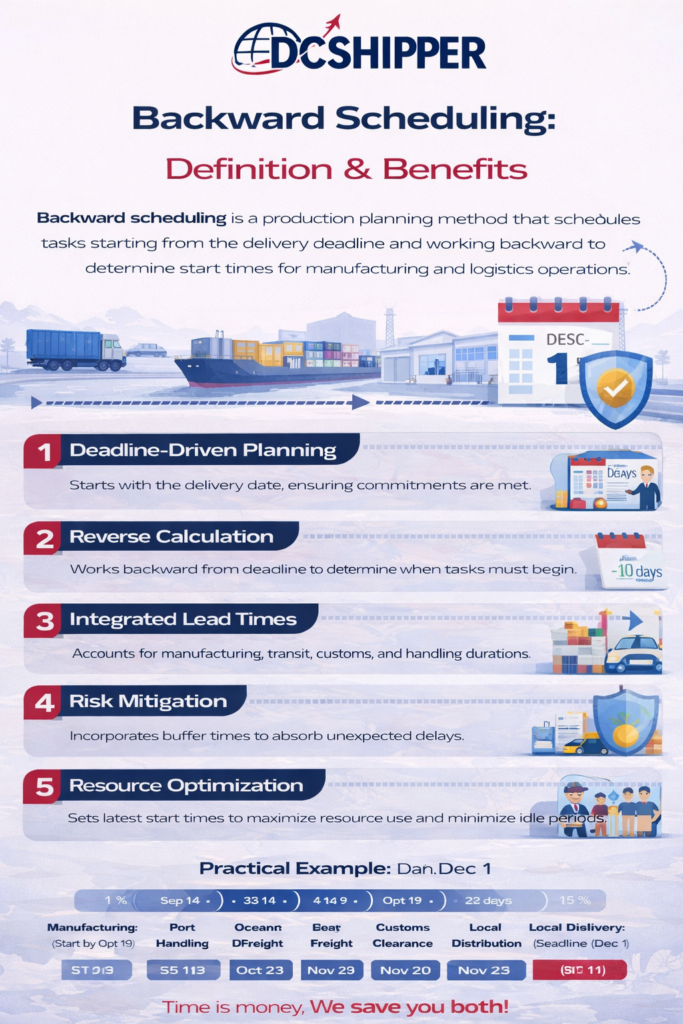
Backward scheduling is a production planning method that starts from the delivery deadline and works backward to determine when each manufacturing or logistics operation must begin. This technique ensures on-time delivery by calculating the latest possible start date for each task while accounting for lead times, transit durations, and processing periods.
Introduction
Many importers face a common challenge: products arriving late because production started too late. This problem stems from poor scheduling coordination between manufacturing, shipping, and customs clearance.
Backward scheduling addresses this issue by reversing the traditional planning approach. Instead of asking “when can we start?”, it asks “when must we finish?” This methodology is essential in international logistics where delivery deadlines are contractual obligations.
Key characteristics of backward scheduling include:
- Deadline-driven planning that prioritizes customer commitments
- Reverse chronological calculation from delivery date to production start
- Integration of all lead times: manufacturing, transit, customs, and handling
- Risk mitigation through buffer time allocation at critical stages
- Resource optimization by identifying the latest acceptable start dates
Deepening & Expertise
Backward scheduling operates on a fundamental principle: every operation has a fixed duration and a mandatory completion time. The scheduler subtracts each task’s duration from the deadline, working backward through the supply chain.
The calculation sequence typically follows this structure: final delivery date minus local distribution time minus customs clearance minus international transit minus port handling minus manufacturing lead time. Each subtraction reveals when the previous operation must be completed.
This method requires precise lead time data for accuracy. Manufacturing times vary by product complexity, shipping durations depend on routes and modes, and customs clearance fluctuates based on documentation completeness. At DocShipper, we maintain a database of average lead times across different trade lanes to ensure realistic backward scheduling calculations.
The critical path becomes immediately visible with backward scheduling. Any delay in a critical operation automatically pushes the entire timeline forward, making it impossible to meet the deadline without intervention. This visibility enables proactive decision-making.
Legal and contractual implications are significant. Incoterms agreements often specify delivery dates that trigger penalty clauses if missed. Backward scheduling provides documented evidence of when production must commence to fulfill contractual obligations, as outlined in ICC Incoterms 2020 guidelines.
The methodology also incorporates buffer management. Strategic buffers are placed before bottleneck operations or high-risk stages like customs clearance. These buffers absorb unexpected delays without compromising the final deadline. DocShipper systematically includes buffer periods in our backward schedules, particularly for first-time importers navigating complex regulatory environments.
Concrete Examples & Data
Consider a European retailer ordering consumer electronics from China with a firm delivery deadline of December 1st for holiday sales. The backward scheduling calculation reveals the entire timeline:
| Operation | Duration | Completion Date | Start Date |
|---|---|---|---|
| Final Delivery | – | Dec 1 | – |
| Local Distribution | 3 days | Nov 28 | Nov 25 |
| Customs Clearance | 5 days | Nov 25 | Nov 20 |
| Sea Freight | 28 days | Nov 20 | Oct 23 |
| Port Handling & Loading | 4 days | Oct 23 | Oct 19 |
| Manufacturing | 35 days | Oct 19 | Sep 14 |
This calculation reveals that production must begin no later than September 14th to meet the December 1st deadline. Any delay beyond this date requires either expedited shipping (increasing costs by 200-400%) or missing the deadline entirely.
Industry data shows significant variance in scheduling accuracy. A 2023 logistics study found that companies using backward scheduling achieved 87% on-time delivery rates compared to 64% for those using forward scheduling methods. The difference stems from deadline-focused planning rather than capacity-focused planning.
Another practical scenario involves pharmaceutical imports requiring temperature-controlled logistics. A backward schedule for a September 30th hospital delivery includes:
- Air freight from India: 5 days (faster than sea due to temperature sensitivity)
- Priority customs clearance: 2 days (health products receive expedited processing)
- Cold chain distribution: 1 day (specialized handling)
- Manufacturing and quality control: 45 days (regulatory compliance testing)
- Required production start: August 8th latest
The tighter timeline reflects the non-negotiable nature of healthcare delivery deadlines. Buffer time is reduced but quality control duration cannot be compressed due to regulatory requirements.
Conclusion
Backward scheduling transforms logistics planning from reactive to proactive by anchoring every decision to the delivery deadline. This methodology reduces late deliveries, optimizes resource allocation, and provides clear accountability across the supply chain.
Need assistance implementing backward scheduling for your international shipments? Contact DocShipper for expert guidance on timeline optimization and logistics coordination.
📚 Quiz
Test Your Knowledge: Backward Scheduling
Q1 — What is the defining principle of backward scheduling?
Q2 — A common misconception about backward scheduling is that it eliminates the need for buffer time. What does it actually do?
Q3 — A European retailer needs consumer electronics delivered from China by December 1st. Sea freight takes 28 days, customs clearance 5 days, port handling 4 days, local distribution 3 days, and manufacturing 35 days. Using backward scheduling, when must production start at the latest?
🎯 Your Result
📞 Free Quote in 24hFAQ | Backward Scheduling: Definition, Calculation & Concrete Examples
Forward scheduling starts from the earliest possible production date and calculates when delivery will occur. Backward scheduling starts from the required delivery date and calculates when production must begin. Backward scheduling prioritizes deadlines while forward scheduling prioritizes resource availability.
Use backward scheduling when delivery deadlines are contractually binding, for seasonal products with fixed launch dates, when penalty clauses apply for late delivery, or when coordinating with retail cycles. Forward scheduling works better for make-to-stock production without strict deadlines.
Buffer time typically ranges from 10-20% of each operation's duration. Add larger buffers before high-risk stages like customs clearance (3-5 days) or first-time supplier manufacturing (15-25% extra). Historical data from similar shipments provides the most accurate buffer calculations.
You have three options: negotiate a later delivery date with the customer, use expedited shipping methods to compress transit time, or find a supplier with shorter manufacturing lead times. Air freight can reduce shipping from 28 days to 5-7 days but costs significantly more.
Yes, but each product requires its own backward calculation based on its specific lead time. The final shipping date is determined by the product with the longest total lead time. All other products must be ready by this date to consolidate the shipment efficiently.
Lead times should be accurate within ±2 days for operations under 10 days and ±5 days for operations over 30 days. Using average lead times from the past 6-12 months provides reasonable accuracy. Update your lead time database quarterly to reflect changing conditions.
Professional backward scheduling must exclude non-working days. Manufacturing facilities typically operate Monday-Friday, customs offices close on national holidays, and shipping schedules vary by carrier. Always use business days, not calendar days, in calculations.
Enterprise Resource Planning (ERP) systems like SAP and Oracle include backward scheduling modules. Transportation Management Systems (TMS) such as Freightos and Flexport offer scheduling features. Many freight forwarders also provide proprietary scheduling calculators for their clients.
Build customs buffer time into the schedule based on historical clearance times for your product category and destination country. High-risk products (food, chemicals, electronics) require 5-7 day buffers. Low-risk products need 2-3 days. Pre-clearance documentation reduces actual clearance time significantly.
Yes, by identifying the latest acceptable start date, backward scheduling prevents premature production that ties up capital in inventory. It also enables optimal shipping mode selection—you can use slower, cheaper ocean freight if the timeline permits rather than defaulting to expensive air freight.
The critical path is the sequence of operations where any delay directly impacts the final delivery date. These operations have zero slack time. Non-critical operations have buffer time and can be delayed slightly without affecting the deadline. Focus monitoring efforts on critical path operations.
Add 30-50% extra time to port handling and customs clearance during peak periods (November-December for consumer goods, August-September for back-to-school). Shipping capacity becomes constrained, so book vessel space 6-8 weeks in advance rather than the standard 3-4 weeks.
Need Help with
Logistics or Sourcing ?
First, we secure the right products from the right suppliers at the right price by managing the sourcing process from start to finish. Then, we simplify your shipping experience - from pickup to final delivery - ensuring any product, anywhere, is delivered at highly competitive prices.


Fill the Form
Prefer email? Send us your inquiry, and we’ll get back to you as soon as possible.
Contact us




