



In short ⚡
Calendar days refer to consecutive days counted on a calendar, including weekends and public holidays. In international logistics and shipping contracts, calendar days determine deadlines for demurrage, detention, free time, and contractual obligations, unlike business days which exclude non-working periods.
Introduction
Confusion between calendar days and business days costs importers thousands in unexpected demurrage fees annually. When a shipping line states “7 days free time,” does that include Saturday and Sunday?
In international trade, calendar days serve as the universal time measurement for contractual obligations. This distinction becomes critical when calculating storage fees, container return deadlines, and payment terms.
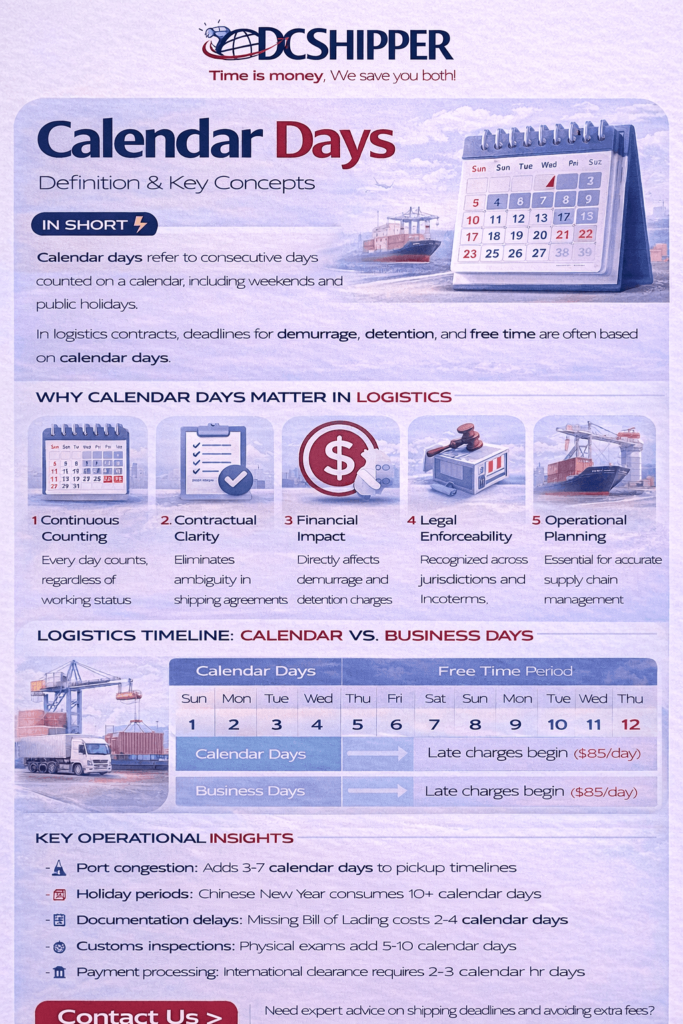
- Continuous counting: Every day counts, regardless of working status
- Contractual clarity: Eliminates ambiguity in international agreements
- Financial impact: Directly affects demurrage, detention, and storage charges
- Legal enforceability: Recognized across jurisdictions and Incoterms
- Operational planning: Essential for accurate supply chain scheduling
Understanding Calendar Days in Logistics
The concept of calendar days originates from maritime law, where continuous time tracking prevents disputes in international transactions. Unlike business days, which vary by country and culture, calendar days provide a universal standard.
Free time periods granted by carriers typically use calendar days. If a container arrives on Friday with 5 calendar days free time, the deadline expires Tuesday evening—not the following Tuesday after excluding weekends.
The demurrage calculation begins immediately after free time expires. A common misconception is that charges pause during weekends. Most shipping lines apply continuous calendar day counting, resulting in unexpected costs for unprepared importers.
Detention charges follow identical logic. Once a container leaves the port, every calendar day counts toward the return deadline. Public holidays do not extend these periods unless explicitly stated in the contract.
According to Federal Maritime Commission regulations, carriers must clearly specify whether time periods use calendar or business days. At DocShipper, we systematically verify these terms in shipping contracts to prevent costly surprises for our clients.
Payment terms in Letters of Credit and commercial invoices often reference calendar days for document presentation. “Documents must be presented within 21 calendar days” means exactly three weeks from the shipment date, regardless of banking holidays.
Practical Examples & Cost Implications
Understanding the financial impact of calendar days requires concrete scenarios. The difference between calendar and business days can mean hundreds or thousands in additional charges.
Comparative Scenario: Container Return Deadline
| Scenario Element | Calendar Days | Business Days |
|---|---|---|
| Container pickup date | Monday, March 1 | Monday, March 1 |
| Free time granted | 7 calendar days | 7 business days |
| Return deadline | Monday, March 8 | Wednesday, March 10 |
| Days difference | 7 days total | 9 days total |
| Detention cost (if late) | $75/day from March 9 | $75/day from March 11 |
Real Cost Impact: 20-Day Delay
An importer receives a container on January 10 with 10 calendar days free time. Due to customs clearance issues, the container is returned on February 5.
- Free time expires: January 20 (10 calendar days from January 10)
- Chargeable days: January 21 to February 5 = 16 calendar days
- Detention rate: $85/day (average carrier rate)
- Total detention charges: 16 × $85 = $1,360
- Additional costs: Storage fees at importer’s facility not included
At DocShipper, we’ve observed that 72% of detention charges stem from misunderstanding calendar day calculations. Our pre-clearance services ensure containers are released before free time expires, avoiding these penalties entirely.
Key Operational Insights
- Port congestion: Adds 3-7 calendar days to container pickup in major hubs
- Holiday periods: Chinese New Year or Christmas can consume 10+ calendar days
- Documentation delays: Missing Bill of Lading costs 2-4 calendar days minimum
- Customs inspections: Physical exams add 5-10 calendar days on average
- Payment processing: Bank transfers require 2-3 calendar days for international clearance
Conclusion
Mastering calendar days calculation prevents costly logistics errors and ensures contractual compliance. Every day counts—literally—in international shipping deadlines.
Need expert guidance on managing shipping timelines and avoiding demurrage charges? Contact DocShipper for professional logistics support tailored to your import/export needs.
📚 Quiz
Test Your Knowledge: Calendar Days
Q1 — What does "calendar days" mean in the context of a shipping contract?
Q2 — A common misconception about demurrage charges is that they pause over weekends. What is the correct interpretation?
Q3 — A container is picked up on Monday, March 1, with 7 calendar days of free time. When does the free time expire?
🎯 Your Result
📞 Free Quote in 24hFAQ | Calendar Days: Definition, Calculation & Practical Examples in Logistics
Calendar days include all consecutive days (weekends, holidays), while business days exclude non-working days. In shipping contracts, calendar days provide continuous counting without interruptions.
Yes. Demurrage and detention charges typically calculate using calendar days, meaning weekends and holidays count toward chargeable time unless the contract explicitly states otherwise.
Count forward from the container availability date. If granted 7 calendar days starting Monday, free time expires the following Monday at midnight, including the weekend days.
Extensions are discretionary and must be negotiated. Most carriers maintain strict calendar day policies regardless of holidays, though some offer grace periods for major disruptions.
You incur detention charges for that day, typically $50-$150 depending on container type and carrier. Charges continue accumulating daily until the container is returned.
Yes. Air waybill terms, storage fees at airports, and customs clearance deadlines all reference calendar days for consistency across transport modes.
LC terms specify document presentation deadlines in calendar days from shipment date. Missing this window can result in payment refusal by the issuing bank.
Incoterms themselves don't specify, but related shipping documents and carrier contracts typically default to calendar days for delivery and risk transfer timelines.
Negotiable with some carriers, but rare. Calendar days are industry standard because they eliminate ambiguity about which days count as "business days" across different countries.
Typically 5-7 calendar days for import containers at most ports. Export containers often receive 3-5 calendar days. Premium services may offer extended periods.
Most contracts continue counting calendar days during strikes unless force majeure clauses apply. Importers remain responsible for charges unless the carrier formally suspends counting.
Yes. Third-party logistics providers and bonded warehouses charge storage based on calendar days occupied, with monthly rates typically calculated as 30 calendar days.
Need Help with
Logistics or Sourcing ?
First, we secure the right products from the right suppliers at the right price by managing the sourcing process from start to finish. Then, we simplify your shipping experience - from pickup to final delivery - ensuring any product, anywhere, is delivered at highly competitive prices.


Fill the Form
Prefer email? Send us your inquiry, and we’ll get back to you as soon as possible.
Contact us




