


In short ⚡
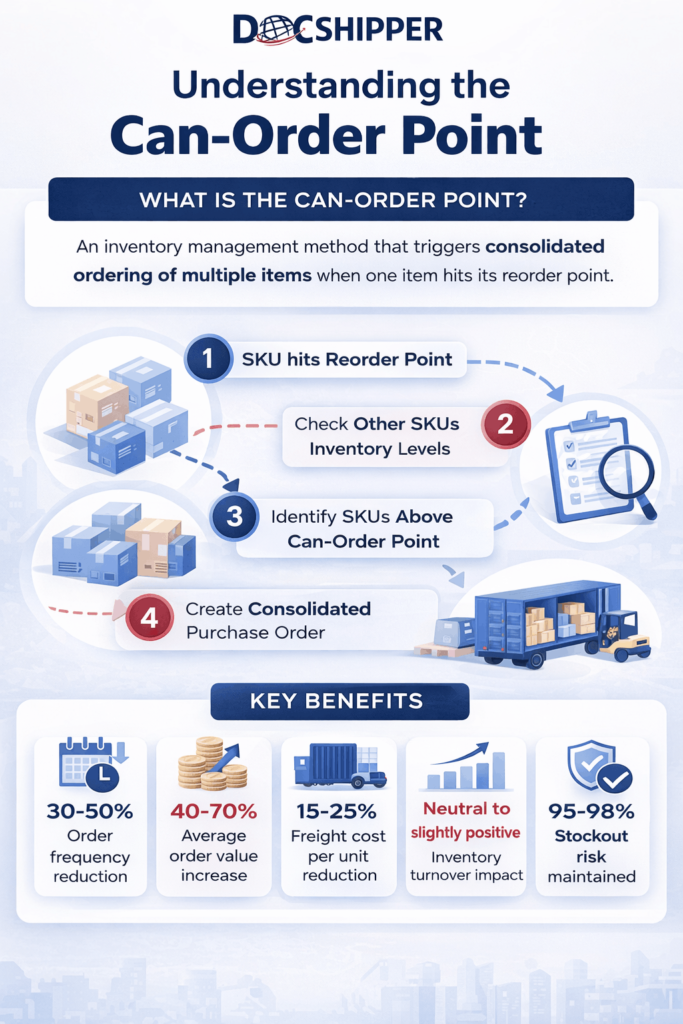
The Can-Order Point is an inventory management threshold that triggers simultaneous ordering of multiple items when one item reaches its reorder point, optimizing order consolidation and reducing procurement costs in supply chain operations.
Introduction
Managing inventory across multiple SKUs presents a critical challenge: should each item be ordered independently, or can orders be consolidated? The Can-Order Point addresses this dilemma by creating intelligent ordering windows that balance inventory holding costs against procurement efficiency.
In international logistics, where shipping costs, minimum order quantities, and lead times significantly impact profitability, the Can-Order Point becomes essential for optimizing purchasing strategies. This methodology proves particularly valuable when dealing with suppliers offering volume discounts or when managing container shipments where consolidation directly affects per-unit transportation costs.
- Cost reduction: Minimizes ordering frequency and associated administrative expenses
- Freight optimization: Maximizes container utilization and reduces per-unit shipping costs
- Supplier relations: Enables negotiation leverage through consolidated purchasing volumes
- Inventory synchronization: Aligns replenishment cycles across related product families
- Administrative efficiency: Reduces procurement workload by grouping purchase orders
Mechanisms & Strategic Implementation
The Can-Order Point operates within a dual-threshold system. Each inventory item maintains both a reorder point (the level triggering mandatory replenishment) and a can-order point (a higher threshold indicating the item can be included in an order triggered by another SKU). This creates an ordering window between these two levels where opportunistic consolidation occurs.
Mathematically, the can-order point typically sits above the reorder point by an amount covering one or two ordering cycles. The calculation formula follows: Can-Order Point = Reorder Point + (Average Daily Demand × Order Interval). This ensures items approaching their reorder point can join existing orders without risking stockouts.
The decision logic operates as follows: When any item reaches its reorder point, the system evaluates all items currently between their reorder and can-order points. These items are added to the purchase order, creating a consolidated shipment. This mechanism proves particularly effective when managing products from the same supplier or geographic origin.
From a regulatory perspective, customs authorities recognize consolidated shipments under harmonized commodity codes. According to World Customs Organization guidelines, proper documentation of multi-item shipments requires detailed packing lists distinguishing individual SKUs while maintaining shipment integrity for clearance purposes.
At DocShipper, we implement can-order point strategies for clients managing diverse product portfolios, ensuring optimal container loading while maintaining compliance with international shipping regulations and minimizing demurrage risks at destination ports.
The system parameters require careful calibration. Order intervals must balance carrying costs against ordering costs. Holding costs (warehousing, insurance, capital tied up) typically range from 15-30% annually, while ordering costs include freight, customs clearance, and administrative processing—often $500-$2,000 per international shipment depending on origin and volume.
Practical Examples & Data Analysis
Consider a European electronics retailer sourcing components from China managing five related SKUs with the following parameters:
| SKU | Daily Demand | Lead Time (days) | Reorder Point | Can-Order Point | Current Stock |
|---|---|---|---|---|---|
| A-101 | 50 units | 30 | 1,500 | 2,000 | 1,480 |
| B-202 | 30 units | 30 | 900 | 1,200 | 1,150 |
| C-303 | 20 units | 30 | 600 | 800 | 620 |
| D-404 | 40 units | 30 | 1,200 | 1,600 | 2,100 |
| E-505 | 25 units | 30 | 750 | 1,000 | 950 |
Scenario Analysis: SKU A-101 reaches its reorder point (current stock 1,480 < reorder point 1,500). The system evaluates all other SKUs. SKUs B-202, C-303, and E-505 are between their reorder and can-order points, qualifying for inclusion. SKU D-404 remains above its can-order point and is excluded.
Cost Comparison: Ordering individually would generate four separate shipments over the next 10 days at $800 per shipment = $3,200. Consolidating into one shipment costs $1,400 (larger volume), yielding $1,800 savings (56% reduction) while maintaining adequate inventory levels across all items.
Container Utilization Case: A furniture importer sources from Vietnam using 40-foot containers (67 CBM capacity). Without can-order logic, partial shipments averaged 45 CBM utilization (67% efficiency). Implementing can-order points increased average utilization to 62 CBM (92% efficiency), reducing annual container costs by $47,000 across 18 shipments.
Key Performance Indicators:
- Order frequency reduction: Typically 30-50% fewer purchase orders annually
- Average order value increase: 40-70% higher per-order spending through consolidation
- Freight cost per unit: 15-25% reduction through improved load factors
- Inventory turnover impact: Neutral to slightly positive when properly calibrated
- Stockout risk: Maintained at target service levels (typically 95-98%)
DocShipper leverages can-order point methodologies when coordinating multi-product shipments for clients, particularly when managing LCL (Less than Container Load) consolidations where combining orders from multiple suppliers into single containers generates substantial cost advantages while maintaining inventory service levels.
Conclusion
The Can-Order Point represents a sophisticated inventory management approach that transforms procurement from reactive individual ordering to strategic consolidation. By creating intelligent ordering windows, businesses reduce costs while maintaining service levels—critical advantages in competitive international markets.
Need expert guidance implementing can-order point strategies in your supply chain? Contact DocShipper for customized inventory optimization solutions tailored to your international logistics requirements.
📚 Quiz
Test Your Knowledge: Can-Order Point
Q1. What does the Can-Order Point represent in inventory management?
Q2. A common misconception about the Can-Order Point is that it increases total costs due to higher inventory levels. What does the data actually show?
Q3. In the scenario where SKU A-101 reaches its reorder point, which of the following correctly describes which other SKUs should be added to the consolidated order?
🎯 Your Result
📞 Free Quote in 24hFAQ | Can-Order Point: Definition, Calculation & Real-World Examples
The reorder point triggers mandatory replenishment when reached, while the can-order point creates an optional ordering window—items between these thresholds can join orders triggered by other SKUs, enabling consolidation without risking stockouts.
Can-order point = Reorder Point + (Average Daily Demand × Typical Order Interval). The interval typically equals the time between natural ordering cycles, usually 7-14 days for international shipments, adjusted based on supplier lead times and ordering costs.
Marginal increases in average inventory levels (5-15%) are typically offset by 20-40% reductions in ordering and freight costs. The net financial impact is usually positive when properly calibrated to balance these competing factors.
Retailers, distributors, and manufacturers managing diverse product portfolios from common suppliers benefit significantly—particularly those importing goods where freight consolidation yields substantial savings, such as electronics, apparel, furniture, and industrial components.
Can-order points complement JIT by enabling micro-consolidation within tight delivery windows. However, pure JIT environments with single-unit flows may not benefit; the methodology suits operations balancing efficiency with reasonable inventory buffers.
High demand variability requires wider gaps between reorder and can-order points to maintain service levels. Safety stock calculations must account for variability across all consolidated items to prevent stockouts during the extended ordering window.
Advanced ERP systems (SAP, Oracle, Microsoft Dynamics) and specialized inventory management platforms (NetSuite, Fishbowl, DEAR Inventory) offer can-order point modules. Custom implementations may be required for specific consolidation rules and supplier constraints.
MOQs create floor constraints that can-order logic must respect. Systems should evaluate whether adding opportunistic items helps meet MOQs more efficiently, or whether triggering items should wait for natural consolidation opportunities to optimize total order economics.
Geographic proximity enables tighter can-order windows due to shorter lead times. Items from the same origin (factory, port, region) are ideal consolidation candidates, while mixing distant sources may negate freight savings through complex routing requirements.
Quarterly reviews suit most operations, with immediate adjustments triggered by significant demand pattern changes, supplier lead time variations, or freight cost fluctuations. Seasonal businesses may require monthly recalibration during peak periods.
Yes—consolidating shipments reduces total transportation events, improving vehicle utilization and lowering per-unit emissions. Studies show 15-30% carbon footprint reductions when optimized consolidation replaces frequent partial shipments, supporting sustainability objectives.
Setting can-order points too close to reorder points (insufficient consolidation window), ignoring product compatibility in mixed shipments, failing to account for supplier-specific constraints, and neglecting to update parameters as demand patterns evolve—all undermine system effectiveness.
Need Help with
Logistics or Sourcing ?
First, we secure the right products from the right suppliers at the right price by managing the sourcing process from start to finish. Then, we simplify your shipping experience - from pickup to final delivery - ensuring any product, anywhere, is delivered at highly competitive prices.


Fill the Form
Prefer email? Send us your inquiry, and we’ll get back to you as soon as possible.
Contact us




