


In short ⚡
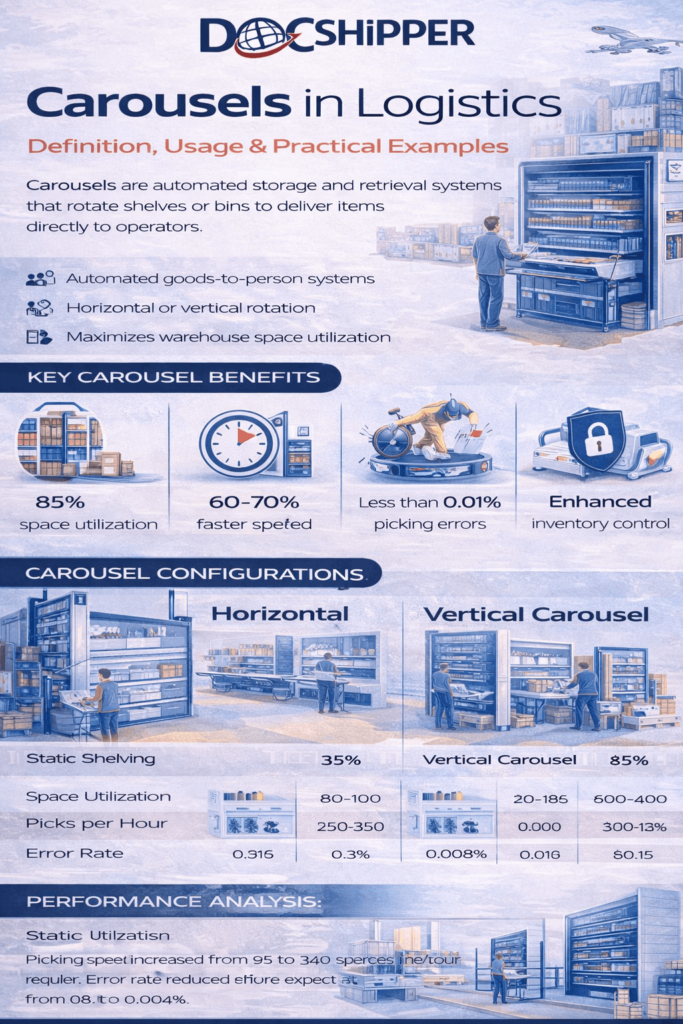
A carousel is an automated storage and retrieval system (AS/RS) that rotates shelves or bins vertically or horizontally to deliver items directly to operators. This technology maximizes space utilization, accelerates order picking, and reduces manual handling errors in warehouses, distribution centers, and manufacturing facilities.
Introduction
Warehouse managers constantly face a critical challenge: how to store more inventory in limited space while maintaining fast, accurate retrieval times. Traditional static shelving forces workers to walk long distances, climb ladders, and manually search for items—wasting time and increasing error rates.
The carousel system solves this by bringing products directly to the operator rather than requiring operators to travel through the warehouse. This “goods-to-person” approach has become essential in modern supply chain operations, particularly for e-commerce fulfillment, pharmaceutical distribution, and automotive parts management.
Key characteristics of carousel systems include:
- Vertical or horizontal rotation: Shelves move automatically to present items at ergonomic picking height
- Space efficiency: Utilizes up to 85% of available cubic space versus 30-40% for static shelving
- Picking speed: Reduces retrieval time by 60-70% compared to manual walk-and-pick methods
- Accuracy improvement: Integrated light-directed picking reduces errors to less than 0.01%
- Inventory control: Real-time tracking through warehouse management system (WMS) integration
Technical Mechanisms & Operational Benefits
Carousel systems operate on two primary configurations: vertical carousels (rotating on a vertical axis like a Ferris wheel) and horizontal carousels (rotating horizontally like a dry-cleaning rack). Both types use computer-controlled motors to position the correct shelf or bin at the operator workstation.
The batch picking optimization capability represents a major operational advantage. Advanced WMS software sequences retrieval orders so the carousel presents multiple items for different orders during a single rotation cycle. This batching reduces idle time and can increase throughput by 40% compared to single-order processing.
Ergonomic design eliminates the physical strain associated with traditional warehousing. Items always arrive at waist height, removing the need for bending, reaching, or climbing. This reduces workplace injuries and allows operators to maintain consistent productivity throughout their shifts. At DocShipper, we implement carousel solutions for clients handling high-value electronics and pharmaceuticals where precision and speed are non-negotiable.
The security and access control features provide critical inventory protection. Carousels can be fully enclosed with individual user authentication, creating an audit trail for every transaction. This makes them ideal for controlled substances, high-theft items, or components requiring traceability for regulatory compliance (see FDA Drug Supply Chain Security Act).
Energy efficiency has improved dramatically with modern carousel technology. Variable-frequency drives adjust motor speed based on load weight and distance, while regenerative braking captures energy during deceleration. These systems consume 60-75% less electricity than conveyor-based alternatives while maintaining higher throughput rates.
Practical Applications & Performance Data
Understanding carousel performance requires examining real-world implementations across different industries. The following comparative analysis demonstrates how carousel systems deliver measurable improvements in operational metrics:
| Storage Method | Space Utilization | Picks per Hour | Error Rate | Labor Cost per Pick |
|---|---|---|---|---|
| Static Shelving | 35% | 80-100 | 0.3% | $0.45 |
| Horizontal Carousel | 75% | 250-350 | 0.008% | $0.18 |
| Vertical Carousel | 85% | 300-400 | 0.005% | $0.15 |
Case Study: Pharmaceutical Distribution Center
A mid-sized pharmaceutical distributor replaced 12,000 square feet of static shelving with six vertical carousels occupying just 3,500 square feet. The implementation delivered:
- 71% reduction in floor space requirements
- Picking speed increase from 95 to 340 lines per hour per operator
- Error rate reduction from 0.28% to 0.004%
- 18-month ROI through labor savings and space recapture
- Full compliance with FDA serialization requirements through integrated tracking
Automotive Parts Scenario: A parts supplier handling 45,000 SKUs implemented a pod system of horizontal carousels with light-directed picking. Order fulfillment time dropped from 8 minutes to 2.3 minutes per order, while inventory accuracy improved to 99.97%. DocShipper frequently recommends carousel solutions for clients in the automotive aftermarket where part proliferation and fast delivery windows create operational pressure.
Cost Analysis: Initial investment for a vertical carousel system ranges from $75,000 to $150,000 depending on height and capacity. Horizontal carousels typically cost $50,000 to $100,000 per unit. When calculating ROI, factor in labor savings ($25,000-$40,000 annually per carousel), space cost avoidance ($15-$30 per square foot annually), and error reduction (typically saving 2-3% of order value).
Conclusion
Carousel technology transforms warehouse operations by maximizing space utilization, accelerating picking speed, and virtually eliminating errors. For businesses managing high-SKU-count inventories or facing space constraints, carousels deliver measurable ROI through labor efficiency and inventory accuracy improvements.
Need expert guidance on implementing carousel systems in your supply chain? Contact DocShipper for a customized warehouse optimization assessment.
📚 Quiz
Test Your Knowledge: Carousel Systems
1. What is the core principle behind a carousel system in warehouse logistics?
2. A warehouse manager claims that a carousel system and traditional static shelving offer roughly the same space utilization. Is this correct?
3. A pharmaceutical distributor needs to store controlled substances with full traceability, strict access control, and regulatory compliance. Which storage solution is most appropriate?
🎯 Your Result
📞 Free Quote in 24hFAQ | Carousel: Definition, Usage & Practical Examples in Logistics
Vertical carousels rotate on a vertical axis (like a Ferris wheel) and maximize ceiling height, ideal for small-footprint applications. Horizontal carousels rotate horizontally (like a dry-cleaning rack) and work better for heavier items or wider products.
Carousels typically reduce floor space requirements by 50-75% compared to static shelving while storing the same inventory volume. They utilize vertical space and eliminate aisles, achieving 75-85% cubic space utilization.
Most carousel installations achieve ROI within 12-24 months through labor savings, space cost avoidance, and error reduction. High-volume operations with expensive labor may see payback in under 12 months.
Yes, modern carousels feature standard API connections and support protocols like REST, SOAP, and direct database integration. They work seamlessly with WMS platforms from Manhattan Associates, SAP, Oracle, and others.
Horizontal carousels typically handle 500-1,000 pounds per carrier, while vertical carousels support 500-2,000 pounds per tray depending on configuration. Heavy-duty models can accommodate up to 3,000 pounds per level.
Carousel rotation speeds range from 50 to 120 feet per minute. Optimal speed depends on item weight, operator reaction time, and pick confirmation method. Systems automatically adjust speed based on load and safety parameters.
Routine maintenance includes quarterly lubrication of drive chains, annual inspection of motors and bearings, and periodic recalibration of positioning sensors. Most systems require 4-6 hours of maintenance annually with 99%+ uptime.
Yes, specialized carousel models operate reliably in temperatures from -20°F to 120°F. Cold storage versions feature sealed motors, heated control panels, and materials resistant to condensation and thermal cycling.
Carousels eliminate travel and search time while integrating with light-directed or voice-directed picking systems. The system presents the correct location automatically, and operators confirm picks via barcode scan or button press, reducing errors to under 0.01%.
Yes, carousels designed for hazardous materials feature explosion-proof motors, static-dissipative materials, and integrated ventilation. They meet OSHA, NFPA, and EPA requirements for storing flammable, corrosive, or toxic substances.
Quality carousel systems operate reliably for 15-25 years with proper maintenance. Mechanical components like chains and bearings may require replacement every 10-15 years, while control systems can be upgraded as technology evolves.
Carousel WMS integration enables perpetual inventory counting by rotating bins to operators during slow periods. Systems can perform complete cycle counts without interrupting order fulfillment, maintaining 99.9%+ inventory accuracy.
Need Help with
Logistics or Sourcing ?
First, we secure the right products from the right suppliers at the right price by managing the sourcing process from start to finish. Then, we simplify your shipping experience - from pickup to final delivery - ensuring any product, anywhere, is delivered at highly competitive prices.


Fill the Form
Prefer email? Send us your inquiry, and we’ll get back to you as soon as possible.
Contact us




