


In short ⚡
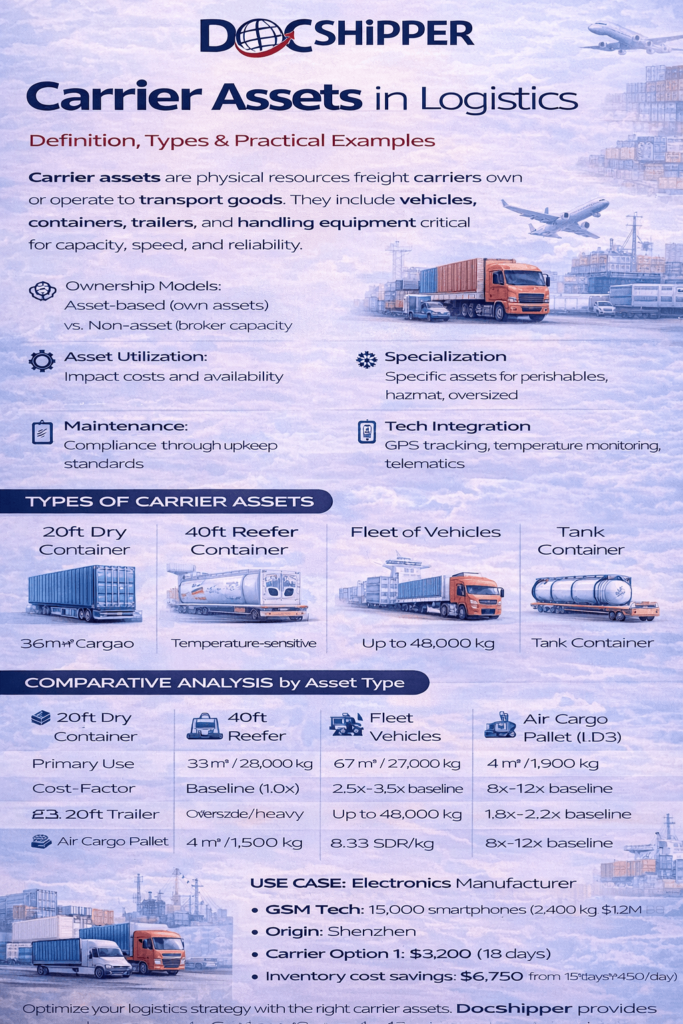
Carrier assets are physical resources owned or operated by freight carriers to transport goods, including vehicles (trucks, ships, aircraft), containers, trailers, and handling equipment. These assets form the operational backbone of logistics networks, directly impacting capacity, delivery speed, and service reliability in international trade.
Introduction
Many importers struggle to understand why shipping quotes vary dramatically between carriers offering seemingly identical routes. The answer lies in carrier assets — the physical infrastructure that determines a carrier’s operational capacity, service quality, and pricing structure.
In international freight, carrier assets represent the tangible resources enabling goods movement across borders. From container vessels to refrigerated trailers, these assets dictate whether your shipment arrives on time, intact, and cost-effectively.
- Ownership models: Asset-based carriers own equipment; non-asset carriers broker capacity
- Asset utilization: Efficiency rates directly impact freight costs and availability
- Specialization: Certain assets handle specific cargo types (perishables, hazmat, oversized)
- Maintenance standards: Asset condition affects compliance and insurance requirements
- Technology integration: Modern assets include GPS tracking, temperature monitoring, and telematics
Understanding Carrier Assets in Modern Logistics
Carrier assets fall into two primary categories: transportation equipment (vehicles, vessels, aircraft) and handling infrastructure (containers, pallets, lifting equipment). Asset-based carriers maintain full control over their fleet, enabling predictable service but requiring substantial capital investment.
The distinction between owned assets and leased assets significantly impacts operational flexibility. Owned assets provide long-term cost advantages and brand consistency, while leased equipment offers scalability during peak seasons without permanent capital commitment.
Asset interoperability determines how efficiently goods transfer between transport modes. ISO-standardized containers revolutionized global trade precisely because they function as universal carrier assets across ships, trains, and trucks. This standardization reduces handling time and damage risk at transshipment points.
Regulatory compliance shapes asset specifications. IMO regulations mandate specific container safety features, while IATA standards govern air cargo unit load devices (ULDs). At DocShipper, we verify that carrier assets meet all applicable safety and customs standards before booking, preventing costly delays at border crossings.
Technology integration transforms traditional assets into smart logistics tools. Modern refrigerated containers transmit real-time temperature data, while GPS-enabled trailers provide continuous location updates. These capabilities enable proactive exception management rather than reactive problem-solving.
For authoritative carrier asset standards, consult the ISO Technical Committee 104 on freight containers, which establishes global specifications ensuring asset compatibility across international supply chains.
Asset Types & Comparative Analysis
Different carrier assets serve distinct logistics requirements. Understanding these differences enables informed carrier selection based on cargo characteristics, budget constraints, and delivery urgency.
| Asset Type | Primary Use | Capacity Range | Cost Factor |
|---|---|---|---|
| 20ft Dry Container | General cargo, non-perishable goods | 33 m³ / 28,000 kg | Baseline (1.0x) |
| 40ft Reefer Container | Temperature-controlled cargo | 67 m³ / 27,000 kg | 2.5x–3.5x baseline |
| Flatbed Trailer | Oversized/heavy machinery | Up to 48,000 kg | 1.8x–2.2x baseline |
| Air Cargo Pallet (LD3) | High-value/urgent shipments | 4 m³ / 1,500 kg | 8x–12x baseline |
| Tank Container (ISO) | Liquid bulk (chemicals, oils) | 21,000–26,000 liters | 2.0x–2.8x baseline |
Use Case: Electronics Manufacturer
A company shipping 15,000 smartphones (total weight: 2,400 kg, value: $1.2M) from Shenzhen to Rotterdam faces asset selection decisions. Standard 20ft containers cost $3,200 but offer 18-day transit. Air freight using LD3 pallets costs $28,000 but delivers in 3 days. The manufacturer calculates inventory carrying costs at $450/day, making the $8,100 savings (15 days × $450) plus reduced theft risk justify air freight despite 8.75x higher base cost.
Asset utilization rates reveal carrier efficiency. Industry benchmarks show:
- Ocean carriers: 85–92% container utilization on major routes
- Trucking fleets: 75–80% loaded miles (20–25% empty repositioning)
- Air cargo: 65–70% capacity utilization due to weight/volume constraints
- Rail intermodal: 88–93% asset efficiency on dedicated corridors
At DocShipper, we analyze carrier asset availability across 190+ routes to secure optimal equipment for your specific cargo profile, ensuring neither overpayment for unnecessary features nor underspecification risking damage.
Conclusion
Carrier assets form the physical foundation of global trade, directly influencing cost, speed, and reliability. Understanding asset types, ownership models, and utilization metrics enables strategic carrier selection aligned with your operational priorities.
Need expert guidance on carrier asset selection for your next shipment? Contact DocShipper for tailored logistics solutions matching your cargo requirements with optimal carrier resources.
📚 Quiz
Test Your Knowledge: Carrier Assets
Q1 — What are carrier assets in the context of international freight logistics?
Q2 — A freight broker who contracts with multiple equipment owners but owns no vehicles or containers is best described as:
Q3 — An electronics manufacturer needs to ship $1.2M worth of smartphones from Shenzhen to Rotterdam in 3 days. Based on carrier asset characteristics, which option is most appropriate?
🎯 Your Result
📞 Free Quote in 24hFAQ | Carrier Assets: Definition, Types & Practical Examples
Asset-based carriers own their transportation equipment, providing direct control over service quality but requiring higher capital investment. Non-asset carriers (freight brokers) contract with multiple equipment owners, offering flexibility and wider network access but less operational control.
Asset condition and certification directly impact insurance premiums. Well-maintained, certified equipment (ISO containers, DOT-compliant trucks) typically qualifies for lower cargo insurance rates, while older or non-certified assets may require additional coverage or face policy exclusions.
Reefer containers include refrigeration units, insulation, and power systems requiring continuous electricity supply. Operational costs include fuel for generators, maintenance of cooling equipment, and pre-trip inspections. These factors typically add 150–250% to standard container rates.
Most carriers allow equipment type requests (dry van, flatbed, reefer) but not specific unit assignment. High-value or specialized cargo may justify dedicated equipment contracts where you control asset selection, though this significantly increases costs.
Asset shortages during peak periods (pre-Chinese New Year, holiday seasons) cause rate spikes and booking delays. Experienced freight forwarders maintain carrier relationships and equipment allocations, securing priority access when capacity tightens.
Newer assets (under 5 years) typically feature better tracking technology and lower breakdown rates. However, well-maintained older equipment can perform equally reliably. Request carrier asset age profiles when service consistency is critical.
ISO standards govern container dimensions and strength requirements globally. However, trucking equipment, rail gauges, and pallet sizes vary by region. European pallets (1200×800mm) differ from North American standards (1219×1016mm), affecting asset compatibility in multimodal shipments.
Hazmat shipments require certified equipment meeting IMDG (sea), IATA (air), or ADR/49CFR (road) standards. This includes placarding systems, specialized containment, and driver certifications. Non-compliant assets face immediate detention and fines.
Assets with integrated technology (e-seals, GPS tracking) enable faster customs processing through trusted trader programs like C-TPAT or AEO. Smart containers transmitting real-time data reduce physical inspection requirements at borders.
Yes. Newer vessels with fuel-efficient engines, electric trucks, or rail intermodal assets significantly lower emissions per ton-kilometer. Many carriers now publish asset-level carbon intensity data, enabling environmentally conscious equipment selection.
Ocean containers: 12–15 years; commercial trucks: 8–12 years; aircraft: 20–25 years; rail cars: 30–40 years. Carriers typically retire assets when maintenance costs exceed 60% of replacement value or when regulatory changes mandate upgrades.
Request carrier safety ratings (DOT scores, vessel PSC records), ask about average fleet age, and check for ISO certifications. Reputable freight forwarders conduct carrier asset audits as part of their vetting process, ensuring equipment meets quality standards.
Need Help with
Logistics or Sourcing ?
First, we secure the right products from the right suppliers at the right price by managing the sourcing process from start to finish. Then, we simplify your shipping experience - from pickup to final delivery - ensuring any product, anywhere, is delivered at highly competitive prices.


Fill the Form
Prefer email? Send us your inquiry, and we’ll get back to you as soon as possible.
Contact us




