


In short ⚡
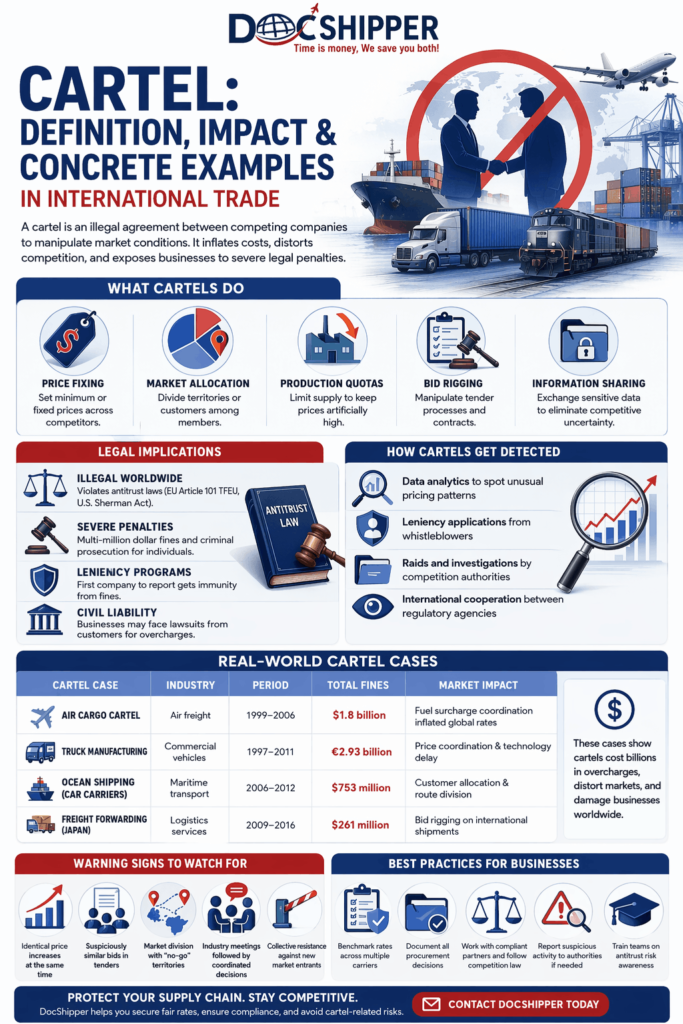
A cartel is an illegal agreement between competing companies to manipulate market conditions by fixing prices, limiting production, or dividing markets. In international logistics and trade, cartels distort competition, inflate shipping costs, and expose businesses to severe legal penalties including multi-million dollar fines and criminal prosecution under antitrust laws.
Introduction
Why do shipping rates suddenly spike across all carriers simultaneously? Why do certain routes remain inexplicably expensive despite market capacity? These anomalies often signal cartel activity—one of the most damaging yet hidden threats in global supply chains.
Cartels undermine the fundamental principles of free trade. They create artificial scarcity, inflate operational costs, and damage the competitive landscape that businesses rely on for fair pricing. Understanding cartel mechanics is essential for import/export professionals to recognize warning signs and protect their operations.
- Price fixing: Coordinated agreements to set minimum or fixed prices across competitors
- Market allocation: Division of territories or customers among cartel members
- Production quotas: Artificial limitation of supply to maintain elevated prices
- Bid rigging: Coordinated manipulation of tender processes and contract awards
- Information sharing: Exchange of confidential commercial data to eliminate competitive uncertainty
Mechanisms & Legal Implications
Cartels operate through secret agreements that violate competition laws in virtually every jurisdiction. In the European Union, Article 101 of the Treaty on the Functioning of the European Union (TFEU) explicitly prohibits anti-competitive agreements. The U.S. Sherman Antitrust Act treats cartel participation as a criminal offense punishable by imprisonment.
The detection mechanisms have evolved significantly. Competition authorities now employ leniency programs where the first company to report cartel activity receives immunity from fines. The European Commission’s leniency program has uncovered dozens of major cartels since 1996, recovering billions in penalties.
In international logistics, cartels most frequently emerge in shipping conferences and freight forwarding networks. Historical examples include ocean carrier alliances that coordinated fuel surcharges, air cargo carriers that fixed security fees, and trucking companies that divided regional markets. At DocShipper, we continuously monitor rate patterns across multiple carriers to identify potential anti-competitive behavior and ensure our clients receive genuinely competitive pricing.
The enforcement landscape has intensified dramatically. The European Commission imposed €1.47 billion in fines on truck manufacturers in 2016 for coordinating prices and delaying emission technology. U.S. authorities prosecuted air cargo executives, resulting in both corporate fines exceeding $1.8 billion and individual prison sentences.
For businesses, the implications extend beyond direct financial harm. Companies that unknowingly participate in cartel-affected transactions may face civil liability from downstream customers. Procurement departments must implement robust compliance programs, conduct regular market analysis, and maintain documentation proving competitive sourcing practices. Reference: European Commission Competition Policy
Concrete Examples & Data
Real-world cartel cases in logistics demonstrate the scale and impact of anti-competitive behavior. The following comparative analysis illustrates documented cases and their consequences:
| Cartel Case | Industry | Period | Total Fines | Market Impact |
|---|---|---|---|---|
| Air Cargo Cartel | Air freight | 1999-2006 | $1.8 billion | Fuel surcharge coordination affecting global rates |
| Truck Manufacturing | Commercial vehicles | 1997-2011 | €2.93 billion | Price coordination and technology delay |
| Ocean Shipping (Car Carriers) | Maritime transport | 2006-2012 | $753 million | Customer allocation and route division |
| Freight Forwarding (Japan) | Logistics services | 2009-2016 | $261 million | Bid rigging on international shipments |
Use Case: Air Cargo Surcharge Coordination
Between 1999 and 2006, major international airlines coordinated fuel and security surcharges on air cargo shipments. A typical shipment from Europe to Asia that should have cost $4,500 was artificially inflated to $6,200—a 38% overcharge. For a medium-sized importer shipping 200 containers annually, this translated to $340,000 in excess costs over the cartel period. Following investigations by EU, U.S., and Asian authorities, affected shippers filed class-action lawsuits recovering partial damages, though many small businesses never recouped their losses.
Warning signs that may indicate cartel activity:
- Identical price increases announced simultaneously by competitors
- Suspiciously similar bid submissions in tender processes
- Unexplained market division where competitors avoid certain territories
- Industry meetings followed by coordinated business decisions
- Resistance to new market entrants through collective action
Conclusion
Cartels represent a critical risk in international logistics, inflating costs and distorting market dynamics. Vigilant procurement practices, competitive benchmarking, and awareness of regulatory frameworks are essential defenses against anti-competitive practices.
Need guidance on ensuring competitive sourcing and compliance in your supply chain? Contact DocShipper for expert consultation on logistics procurement and risk management.
📚 Quiz
Test Your Knowledge: Cartel
1. Which of the following best defines a cartel in international trade?
2. A company discovers it has been unknowingly purchasing freight services at cartel-inflated prices. Which statement is correct regarding its legal exposure?
3. A procurement manager notices that three competing freight forwarders submitted nearly identical bids on a tender, and that all three raised their surcharges by the same amount on the same day. Which scenario best describes this situation?
🎯 Your Result
📞 Free Personalized QuoteFAQ | Cartel: Definition, Impact & Concrete Examples in International Trade
Legal alliances compete on service quality and innovation while maintaining independent pricing. Cartels illegally coordinate prices, production, or market division to eliminate competition and harm consumers through artificial market manipulation.
Authorities use leniency programs, market monitoring algorithms, whistleblower reports, and analysis of suspicious pricing patterns. Digital communication forensics and dawn raids on company premises are common investigative tools in cartel prosecutions.
Direct penalties target cartel participants, not customers. However, businesses may face civil liability from their own customers and must demonstrate due diligence in procurement. Documented competitive bidding processes provide legal protection.
Leniency programs grant immunity or reduced fines to the first cartel member that reports the illegal activity and cooperates with authorities. This creates incentives for cartels to collapse as members race to confess first.
Major cartel investigations span 3-7 years from initial suspicion to final penalties. The European Commission's truck cartel case lasted from 2011 investigation to 2016 decision. Complex international cases involving multiple jurisdictions take longer.
Traditional shipping conferences operated legally under antitrust exemptions, but most jurisdictions have eliminated these exemptions. Modern vessel-sharing agreements must demonstrate pro-competitive benefits and avoid price-fixing to remain legal under competition law.
Maintain competitive bid records, independent price negotiations, market analysis reports, and compliance training documentation. Written policies prohibiting anti-competitive conduct and regular procurement audits demonstrate good-faith competitive sourcing practices.
Yes. The United States prosecutes cartel participation as a criminal offense with prison sentences up to 10 years. The UK introduced criminal sanctions in 2002. Many jurisdictions now hold individual executives personally accountable beyond corporate fines.
SMEs suffer disproportionately from cartel overcharges as they lack negotiating power and market intelligence of larger competitors. A 15-20% freight cost inflation can eliminate profit margins entirely, making price-sensitive products uncompetitive in destination markets.
Bid rigging occurs when competitors coordinate tender responses, taking turns winning contracts or submitting deliberately high bids to ensure a predetermined winner. This deprives buyers of genuine competition and inflates procurement costs significantly.
Contact competition authorities confidentially: the European Commission's whistleblower tool, the U.S. Department of Justice Antitrust Division, or national competition authorities. Many jurisdictions offer financial rewards and legal protection for cartel whistleblowers.
Digital freight platforms increase price transparency and competition, making cartel coordination more difficult. However, algorithmic pricing systems can inadvertently facilitate tacit collusion if competitors use similar pricing software, creating new regulatory challenges.
Need Help with
Logistics or Sourcing ?
First, we secure the right products from the right suppliers at the right price by managing the sourcing process from start to finish. Then, we simplify your shipping experience - from pickup to final delivery - ensuring any product, anywhere, is delivered at highly competitive prices.


Fill the Form
Prefer email? Send us your inquiry, and we’ll get back to you as soon as possible.
Contact us




