


In short ⚡
Cash Against Documents (CAD) is an international trade payment method where the exporter releases shipping documents to the buyer only upon receipt of full payment. This mechanism protects sellers by ensuring payment before the buyer can claim goods, while offering buyers document verification before releasing funds.
Introduction
Many exporters face a common dilemma: how to secure payment without delaying shipment or losing competitive advantage. Releasing goods before receiving funds exposes sellers to non-payment risks, while demanding advance payment may deter buyers.
Cash Against Documents addresses this challenge by creating a middle-ground payment structure. The exporter ships goods but retains control over shipping documents until the importer pays. This method is particularly relevant in markets where trust is limited but letters of credit seem excessive.
Key characteristics of CAD transactions include:
- Documents transferred through banking channels for security
- Payment required before document release (no credit period)
- Applicable to sea, air, and land freight shipments
- Lower cost compared to documentary credits
- Seller retains ownership until payment confirmation
Understanding CAD mechanics is essential for businesses navigating international trade finance. It balances risk mitigation with operational efficiency, making it a preferred option for established trading relationships requiring payment security.
Payment Mechanism & Legal Framework
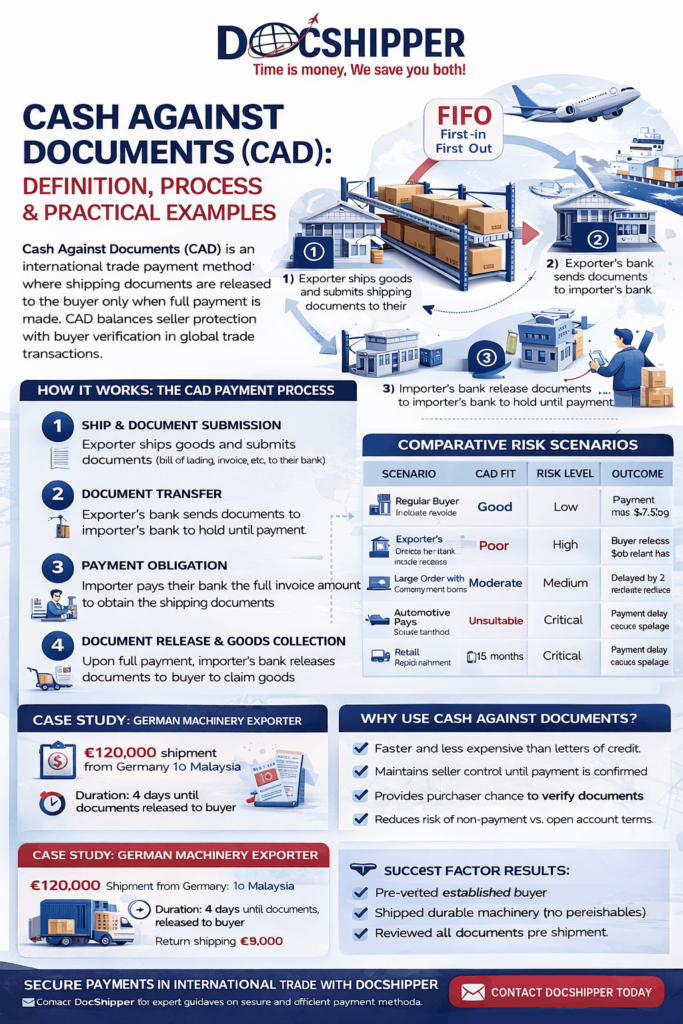
The CAD process follows a structured sequence involving multiple parties. After loading goods, the exporter obtains shipping documents (bill of lading, commercial invoice, packing list, certificate of origin). These documents are sent to the exporter’s bank with instructions to release them only against payment.
The presenting bank in the buyer’s country notifies the importer of document arrival. Payment must be made immediately—no credit terms apply. Once funds clear, the bank releases documents enabling the buyer to claim goods from the carrier. This mechanism differs fundamentally from Documents Against Acceptance (DAA), where buyers receive documents against a promise to pay later.
Legal governance falls under the Uniform Rules for Collections (URC 522), published by the International Chamber of Commerce. These rules standardize bank responsibilities, document handling procedures, and liability limitations. According to ICC guidelines, banks act as intermediaries without assuming payment obligation—they facilitate document exchange but don’t guarantee buyer payment.
Critical considerations include:
- Title retention: The bill of lading remains the exporter’s property until payment clears
- Bank liability: Banks verify document appearance, not accuracy or authenticity
- Jurisdiction matters: Enforcement depends on the buyer’s country legal system
- Currency risk: Exchange rate fluctuations between shipment and payment affect final proceeds
- Dispute resolution: Disagreements over document discrepancies can delay payment indefinitely
At DocShipper, we systematically verify document completeness before initiating CAD transactions to prevent rejection by presenting banks. Our compliance team ensures all required certificates and endorsements meet destination country requirements, reducing payment delays caused by documentation errors.
The main risk for exporters remains buyer refusal to pay. If the importer declines documents, goods may remain stranded at destination. The exporter must then arrange return shipment (expensive) or find alternative buyers locally. Unlike letters of credit, CAD offers no bank payment guarantee—it merely controls document flow.
Practical Examples & Risk Scenarios
Understanding CAD through real-world applications reveals its strengths and limitations. Consider these comparative scenarios illustrating when CAD works effectively versus situations requiring alternative payment methods.
| Scenario | CAD Suitability | Risk Level | Outcome |
|---|---|---|---|
| Established buyer, stable country, $50K shipment | High suitability | Low | Payment received within 5 days of document presentation |
| New buyer, political instability, $200K shipment | Low suitability | High | Buyer refuses payment; goods returned at $15K cost |
| Repeat customer, currency restrictions, $80K order | Medium suitability | Medium | Payment delayed 3 weeks due to forex approval process |
| Perishable goods, tight delivery deadline, $30K value | Very low suitability | Critical | Goods spoiled during payment negotiation; total loss |
Use Case: European Machinery Exporter to Southeast Asia
A German manufacturer ships €120,000 worth of industrial equipment to a Malaysian buyer. Using CAD terms, the exporter’s bank sends documents to a Kuala Lumpur bank. The buyer inspects document copies and discovers a minor discrepancy in the packing list (quantity mismatch).
The buyer refuses immediate payment, demanding corrected documents. The exporter must either:
- Courier corrected originals (5-7 days delay, €200 cost)
- Authorize document release with price reduction negotiation
- Instruct the carrier to return goods (€8,000 cost)
This case illustrates why document accuracy is paramount in CAD transactions. Unlike letters of credit with strict compliance requirements, CAD relies on buyer goodwill to accept minor discrepancies. DocShipper’s pre-shipment document review would have identified this error, preventing the dispute.
Key data points for CAD evaluation:
- Average payment timeline: 7-14 days from document presentation in stable markets
- Refusal rate: Approximately 3-8% depending on buyer relationship strength
- Cost comparison: Bank charges typically 0.15-0.25% of invoice value versus 0.75-1.5% for LCs
- Success factors: Prior trading history reduces risk by 60-70%
- Geographic considerations: Countries with forex controls show 40% higher payment delays
When structuring CAD terms, exporters should assess buyer creditworthiness through trade references and financial statements. For orders exceeding $100,000 or involving new relationships, combining CAD with trade credit insurance provides additional protection. This hybrid approach maintains cost efficiency while mitigating non-payment risk.
Conclusion
Cash Against Documents serves as a practical payment solution for international trade transactions requiring seller protection without the complexity of letters of credit. Success depends on accurate documentation, buyer reliability assessment, and understanding jurisdictional risks.
Need expert guidance on structuring secure payment terms for your international shipments? Contact DocShipper for comprehensive trade finance and logistics support.
📚 Quiz
Test Your Knowledge: Cash Against Documents (CAD)
1. What is the core principle of Cash Against Documents (CAD)?
2. Under CAD terms, what is the bank's responsibility regarding payment?
3. A European exporter is shipping perishable goods worth $30,000 to a first-time buyer in a country with foreign exchange controls. Which statement best describes the suitability of CAD for this transaction?
🎯 Your Result
📞 Free Quote in 24hFAQ | Cash Against Documents (CAD): Definition, Process & Practical Examples
CAD (Cash Against Documents) requires payment before document release through banks, while COD (Cash On Delivery) involves payment directly to the carrier upon goods delivery. CAD provides better seller control as buyers cannot access goods without paying first.
No. Buyers cannot physically inspect goods before payment in CAD transactions. They can only review document copies. Physical inspection requires document possession, which is released only after payment clears.
The exporter retains document ownership and can instruct the carrier to return goods, store them, or sell to alternative buyers. However, the exporter bears storage, demurrage, and return shipping costs.
No. Banks act as intermediaries facilitating document exchange. They don't guarantee payment or verify document authenticity—only that documents appear consistent with instructions. Seller assumes buyer credit risk.
Standard documents include bill of lading, commercial invoice, packing list, certificate of origin, and insurance certificate. Specific requirements vary by destination country regulations and buyer requests.
Payment usually occurs within 5-14 business days in stable markets. Delays extend in countries with foreign exchange controls or banking system inefficiencies. Buyer disputes over document discrepancies can prolong this indefinitely.
CAD carries higher risk with new buyers lacking trading history. For first transactions, consider letters of credit, advance payment, or CAD combined with trade credit insurance to mitigate non-payment risk.
Banks charge 0.15-0.30% of invoice value for document handling, plus fixed fees ($50-150) for collection services. Total costs are significantly lower than documentary credit fees (0.75-1.5%).
Yes. Hybrid arrangements like 30% advance payment plus 70% CAD are common. This reduces seller risk while demonstrating buyer commitment. The advance payment portion typically covers production costs.
CAD provides more seller protection than open account (goods shipped before payment). Open account offers buyers better cash flow but exposes exporters to full non-payment risk. CAD balances these concerns through document control.
Contact the buyer immediately to negotiate acceptance of discrepancies or arrange corrected document couriering. Maintain communication with the presenting bank regarding buyer intentions. Consider authorized price reductions to facilitate payment release.
Acceptance varies by country and bank. Some jurisdictions recognize electronic bills of lading and digital signatures under frameworks like eUCP. However, many banks still require original paper documents, particularly in developing markets.
Need Help with
Logistics or Sourcing ?
First, we secure the right products from the right suppliers at the right price by managing the sourcing process from start to finish. Then, we simplify your shipping experience - from pickup to final delivery - ensuring any product, anywhere, is delivered at highly competitive prices.


Fill the Form
Prefer email? Send us your inquiry, and we’ll get back to you as soon as possible.
Contact us




