


In short ⚡
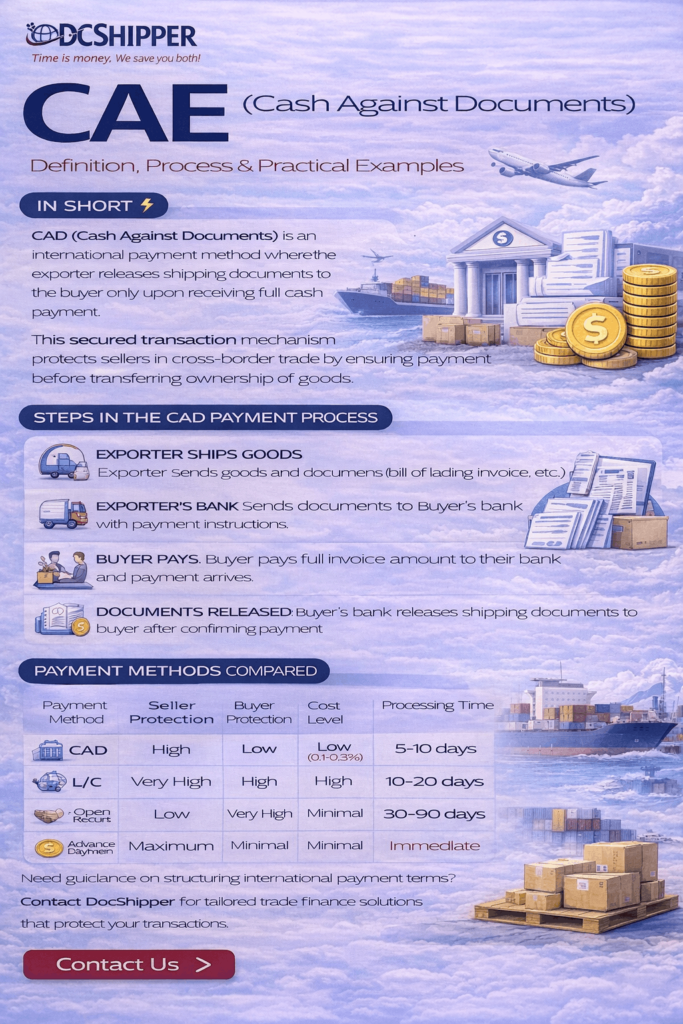
CAD (Cash Against Documents) is an international payment method where the exporter releases shipping documents to the buyer only upon receiving full cash payment. This secured transaction mechanism protects sellers in cross-border trade by ensuring payment before transferring ownership of goods.
Introduction
Many exporters face a critical dilemma: how to secure payment before relinquishing control of shipped goods? The risk of non-payment in international transactions creates significant financial exposure, particularly when dealing with new buyers or unstable markets.
CAD addresses this challenge by establishing a clear payment-before-release protocol. This method proves essential in global supply chains where trust remains limited and legal recourse proves costly. Understanding CAD mechanics helps businesses mitigate payment risks while maintaining operational efficiency.
- Payment security: Exporter retains document control until receiving funds
- Bank intermediation: Financial institutions facilitate document exchange
- Documentary control: Bill of lading release only after cash verification
- Trade finance alternative: Lower cost than letters of credit
- Risk mitigation: Reduces non-payment exposure in international trade
CAD Mechanism & Legal Framework
The CAD process follows a structured documentary sequence. The exporter ships goods and sends original shipping documents to their bank with instructions to release them only upon payment receipt. These documents typically include the bill of lading, commercial invoice, packing list, and certificate of origin.
The exporter’s bank forwards documents to the buyer’s bank, which notifies the importer of arrival. The importer must pay the full invoice amount before receiving documents necessary to claim goods from customs. This creates a natural enforcement mechanism—without documents, the buyer cannot take possession of merchandise.
Under ICC Uniform Rules for Collections (URC 522), CAD falls under “documents against payment” (D/P) collections. Banks act as intermediaries but assume no payment obligation, unlike letters of credit. This distinction significantly reduces transaction costs while maintaining documentary control.
Legal protections vary by jurisdiction. The Hague-Visby Rules govern bill of lading transfers, while the UNCITRAL Model Law provides framework for electronic document exchange. At DocShipper, we systematically verify document authenticity and compliance with destination country requirements to prevent customs delays that could jeopardize payment timing.
Critical risk factors include buyer insolvency after shipment and goods abandonment at destination ports. If the buyer refuses payment, the exporter faces storage fees and re-export costs. Currency fluctuations between shipment and payment dates create additional exposure, particularly in volatile markets.
For authoritative guidance on international payment terms, consult the ICC Incoterms® rules, which define responsibilities in documentary transactions.
Practical Examples & Payment Method Comparisons
Consider a French textile exporter shipping €50,000 worth of fabric to a Turkish buyer. Under CAD terms, the exporter ships goods via container and sends the original bill of lading to their Paris bank. The bank forwards documents to the buyer’s Istanbul bank with payment instructions.
The Turkish importer receives notification when the container arrives. To clear customs and retrieve goods, they must pay €50,000 to their bank, which transfers funds to the French bank. Only after payment confirmation does the exporter’s bank release the bill of lading. This entire process typically takes 5 to 10 business days after vessel arrival.
Payment Method Comparison Table
| Payment Method | Seller Protection | Buyer Protection | Cost Level | Processing Time |
|---|---|---|---|---|
| CAD (Cash Against Documents) | High | Low | Low (0.1-0.3%) | 5-10 days |
| Letter of Credit (L/C) | Very High | High | High (1-3%) | 10-20 days |
| Open Account | Low | Very High | Minimal | 30-90 days |
| Advance Payment | Maximum | Minimal | Minimal | Immediate |
Real-World Scenario: Electronics Export
A German electronics manufacturer exports €120,000 worth of components to a Brazilian distributor. Using CAD terms protects against currency devaluation during the 25-day ocean transit. The Brazilian real depreciates 4% during shipment, but the exporter receives payment in euros immediately upon document presentation, avoiding currency loss.
Key transaction milestones:
- Day 0: Container departs Hamburg port
- Day 25: Vessel arrives Santos port, Brazil
- Day 27: Buyer’s bank notifies importer of document arrival
- Day 29: Importer pays €120,000, receives bill of lading
- Day 31: Customs clearance completed, goods released
Without CAD protection, the exporter would face a €4,800 currency loss if payment occurred 30 days after arrival under open account terms. DocShipper helps clients structure payment terms that balance competitive positioning with financial protection.
Conclusion
CAD provides exporters with documentary control and payment assurance while maintaining cost efficiency compared to letters of credit. This method suits established trade relationships requiring moderate risk protection without excessive banking fees.
Need expert guidance on structuring international payment terms? Contact DocShipper for customized trade finance solutions that protect your interests while maintaining buyer relationships.
📚 Quiz
Test Your Knowledge: CAD (Cash Against Documents)
Q1 — What is the core principle of CAD (Cash Against Documents) in international trade?
Q2 — Under CAD terms, what payment obligation do the banks involved actually assume?
Q3 — A German exporter ships €120,000 of electronics to Brazil. The Brazilian real depreciates 4% during the 25-day ocean transit. How does CAD protect the exporter in this scenario?
🎯 Your Result
📞 Free Quote in 24hFAQ | CAD (Cash Against Documents): Definition, Process & Practical Examples
Typical CAD transactions require original bill of lading, commercial invoice, packing list, certificate of origin, and insurance certificate. Additional documents depend on product type and destination country regulations.
CAD releases documents upon payment through banks before goods delivery, while COD involves direct payment to the carrier upon physical delivery. CAD provides stronger seller protection through banking intermediation.
The seller retains document ownership and can arrange re-export, sell goods locally, or negotiate revised payment terms. However, the seller bears storage fees and potential demurrage charges during this period.
Yes, CAD works with air waybills, though control is weaker since air waybills are non-negotiable documents. Sellers should request "notify party" designation to maintain some documentary leverage.
Banks typically charge 0.1% to 0.3% of invoice value for documentary collection services, significantly lower than the 1% to 3% charged for letters of credit.
CAD provides moderate protection but carries higher risk than letters of credit when dealing with unknown buyers. Credit insurance or smaller trial shipments are recommended for new relationships.
From document submission to payment receipt, CAD transactions typically require 5 to 10 business days, depending on banking efficiency and buyer responsiveness in the destination country.
Yes, sellers can structure split document releases tied to milestone payments, though this increases complexity. Clear payment schedules must be established in the sales contract.
Disputes fall under the governing law specified in the sales contract. ICC Uniform Rules for Collections (URC 522) provide procedural framework, but banks assume no payment liability.
CAD shortens the payment cycle compared to open account terms, reducing currency exposure. However, fluctuations during transit remain a risk unless forward contracts hedge the exposure.
Increasingly, banks accept electronic bills of lading and digital documents under frameworks like UNCITRAL Model Law on Electronic Transferable Records, though adoption varies by country.
CAD is prevalent in textile, electronics, machinery, and commodity trades where transaction values justify documentary control but relationships are too new for open account terms.
Need Help with
Logistics or Sourcing ?
First, we secure the right products from the right suppliers at the right price by managing the sourcing process from start to finish. Then, we simplify your shipping experience - from pickup to final delivery - ensuring any product, anywhere, is delivered at highly competitive prices.


Fill the Form
Prefer email? Send us your inquiry, and we’ll get back to you as soon as possible.
Contact us




