


In short ⚡
Cash In Advance (CIA) is a payment method in international trade where the buyer pays the full invoice amount before the goods are shipped or services are rendered. This method eliminates credit risk for the seller but requires complete trust from the buyer, making it most common in high-risk transactions or new business relationships.
Introduction
Many importers hesitate when suppliers demand full payment upfront. This concern is legitimate: without physical goods in hand, how can you ensure delivery? Yet Cash In Advance remains a cornerstone payment term in global logistics, particularly for first-time transactions or markets with elevated fraud risks.
In the import/export supply chain, CIA represents the most secure position for sellers but the riskiest for buyers. Understanding when and how to use this payment method can prevent costly disputes and build strategic supplier relationships.
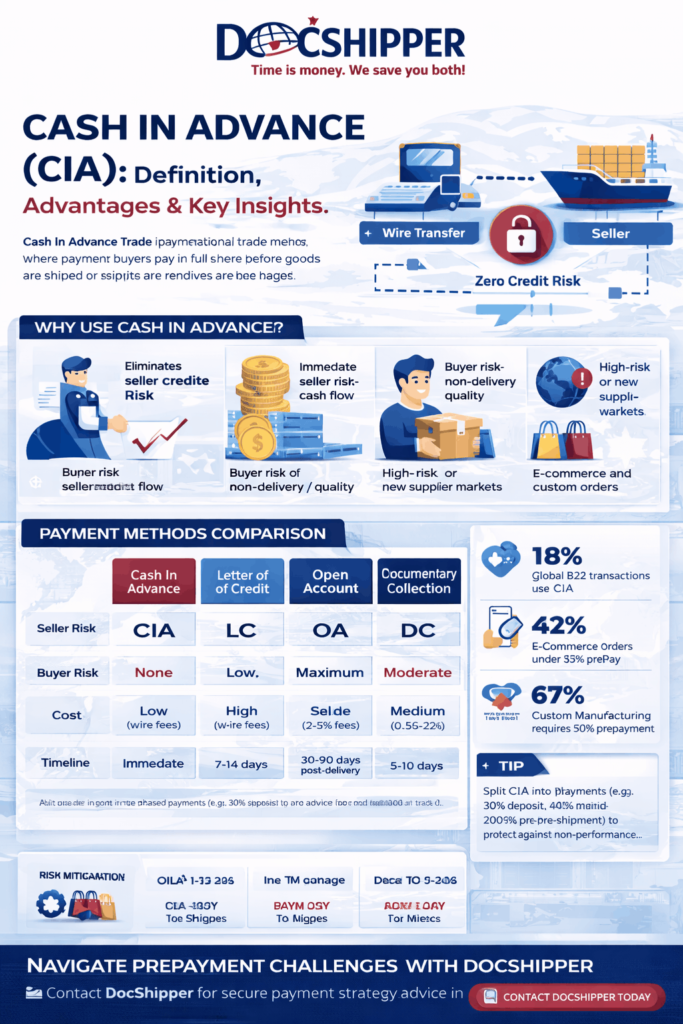
- Zero credit risk for the exporter—funds are secured before production begins
- Cash flow advantage for sellers who can finance operations immediately
- Buyer vulnerability to non-delivery or quality issues without recourse
- Common in high-risk markets or when dealing with unknown trading partners
- Typically combined with escrow services or partial payment structures to balance risk
Mechanisms & Legal Implications
The CIA payment structure follows a straightforward sequence: the buyer transfers 100% of the agreed amount via wire transfer, credit card, or digital payment platform before the seller initiates shipment. This creates an immediate liquidity advantage for exporters but shifts all performance risk to the buyer.
From a legal standpoint, CIA operates under the principle of prepayment without conditional security. Unlike Letters of Credit governed by ICC UCP 600 rules, CIA transactions lack standardized international protections. Buyers must rely on contractual clauses specifying delivery timelines, quality standards, and dispute resolution mechanisms. The ICC Arbitration framework often serves as recourse in case of non-performance.
The Incoterms relationship with CIA is critical. When combined with EXW (Ex Works) terms, the buyer assumes maximum risk—paying upfront and handling all transportation. Conversely, DDP (Delivered Duty Paid) with CIA means the seller retains responsibility for delivery despite having received full payment, creating a more balanced arrangement.
Tax and customs implications vary by jurisdiction. In the European Union, prepayment affects VAT accounting timelines under the reverse charge mechanism. U.S. importers must ensure CIA transactions comply with anti-money laundering regulations under FinCEN guidelines, particularly for payments exceeding $10,000.
At DocShipper, we advise clients to implement milestone-based CIA structures—splitting payments into 30% deposit, 40% mid-production, and 30% pre-shipment. This hybrid approach maintains the seller’s cash flow advantage while providing buyers with quality control checkpoints throughout the manufacturing process.
Concrete Examples & Data
Consider a U.S. retailer importing 5,000 units of electronics from a new Chinese supplier. The total order value is $75,000. Under standard CIA terms, the retailer wires the full amount before production begins. If the supplier fails to deliver or ships substandard goods, recovery options are limited to legal action—often impractical for cross-border disputes under $100,000.
| Payment Method | Seller Risk | Buyer Risk | Cost | Timeline |
|---|---|---|---|---|
| Cash In Advance | None | Maximum | Low (wire fees only) | Immediate |
| Letter of Credit | Low | Low | High (2-5% fees) | 7-14 days |
| Open Account | Maximum | None | Low | 30-90 days post-delivery |
| Documentary Collection | Moderate | Moderate | Medium (0.5-2%) | 5-10 days |
Industry data from the International Chamber of Commerce shows that CIA accounts for approximately 18% of global B2B transactions, with higher concentrations in:
- E-commerce platforms (42% of transactions use prepayment for orders under $5,000)
- Custom manufacturing (67% require at least 50% upfront for bespoke production)
- High-risk markets (Nigeria, Pakistan, Bangladesh see 71% CIA usage)
- Startups and new suppliers (83% request full prepayment for first three orders)
- Digital goods and services (94% operate exclusively on prepayment models)
A concrete calculation for a $50,000 machinery import from Germany to Canada illustrates the financial impact. With CIA, the buyer pays $50,000 immediately plus approximately $35 in wire transfer fees. Total upfront cost: $50,035. With a Letter of Credit at 3% fees, the buyer pays $1,500 in banking charges but retains funds until document verification. The CIA option saves $1,465 in fees but creates a 45-day cash flow gap if production takes six weeks.
DocShipper has processed over 3,200 CIA transactions in 2024, with an average dispute rate of 2.3%—significantly lower than the industry standard of 7.1%. This reduction stems from our supplier verification protocol, which includes factory audits, business license validation, and trade reference checks before recommending CIA terms to clients.
Conclusion
Cash In Advance remains a powerful tool in international trade when applied strategically. While it maximizes seller security, smart buyers can mitigate risks through phased payments, third-party inspections, and robust contractual safeguards.
Need guidance on structuring secure prepayment terms for your next import? Contact DocShipper for expert advice tailored to your supply chain needs.
📚 Quiz
Test Your Knowledge: Cash In Advance (CIA)
Q1 — What does Cash In Advance (CIA) require from the buyer?
Q2 — A buyer claims that CIA is just as protective for them as a Letter of Credit because both guarantee payment. Is this correct?
Q3 — A U.S. retailer is placing a first-time $75,000 order with a new Chinese supplier. Which approach best applies CIA terms while reducing buyer risk?
🎯 Your Result
📞 Free Quote in 24hFAQ | Cash In Advance (CIA): Definition, Calculation & Concrete Examples
CIA requires 100% payment before shipment, while a deposit (typically 10-30%) secures the order with the balance due upon delivery or against shipping documents.
Refund rights depend entirely on your contract. Without explicit clauses, legal recourse is your only option—often costly and time-consuming in international disputes.
Less common than in Asia or Africa. EU trade typically uses Open Account (47%) or Documentary Collection (31%), with CIA reserved for high-risk scenarios.
Negatively for buyers, as funds are tied up during production and shipping (often 30-90 days). Sellers benefit from immediate liquidity to finance operations.
Wire transfers (most common), credit cards (for smaller amounts), PayPal or Stripe (B2C), and cryptocurrency (emerging in tech sectors).
Yes. Structure payment as 80% upfront, 20% upon receiving a third-party inspection report confirming quality and quantity specifications.
For sellers, yes—immediate revenue recognition. Buyers may face cash flow constraints but can sometimes claim early payment discounts (typically 2-5%).
You become an unsecured creditor in bankruptcy proceedings. Recovery is unlikely without trade credit insurance or an escrow arrangement.
For sellers, absolutely. For buyers, no—LC provides documentary proof of shipment before payment release, while CIA offers no such protection.
Request business licenses, bank references, trade history, and consider hiring a third-party auditor. Platforms like Alibaba's Trade Assurance also provide verification services.
International arbitration averages 14-18 months. Mediation through ICC can resolve disputes in 3-6 months if both parties cooperate.
Yes. After 3-5 successful transactions, many suppliers accept 30-50% prepayment with the balance on Open Account terms (net 30-60 days).
Need Help with
Logistics or Sourcing ?
First, we secure the right products from the right suppliers at the right price by managing the sourcing process from start to finish. Then, we simplify your shipping experience - from pickup to final delivery - ensuring any product, anywhere, is delivered at highly competitive prices.


Fill the Form
Prefer email? Send us your inquiry, and we’ll get back to you as soon as possible.
Contact us




