


In short ⚡
Cash-to-Cash Cycle Time is a financial metric measuring the number of days between paying suppliers for inventory and receiving payment from customers. This working capital efficiency indicator reveals how quickly a company converts investments in inventory back into cash, directly impacting liquidity and operational performance in international trade.
Introduction
Many importers struggle with cash flow despite healthy profit margins. The culprit? Poor understanding of the Cash-to-Cash Cycle Time.
In international logistics, this metric becomes critical. Extended shipping times, customs delays, and payment terms can lock up capital for months. Companies that optimize this cycle gain competitive advantages through improved liquidity and reduced financing costs.
- Days Inventory Outstanding (DIO): Time inventory sits before sale
- Days Sales Outstanding (DSO): Time to collect customer payments
- Days Payable Outstanding (DPO): Time before paying suppliers
- Working Capital Impact: Direct correlation with financing needs
- Supply Chain Velocity: Speed of cash conversion through operations
In-Depth Analysis & Expert Insights
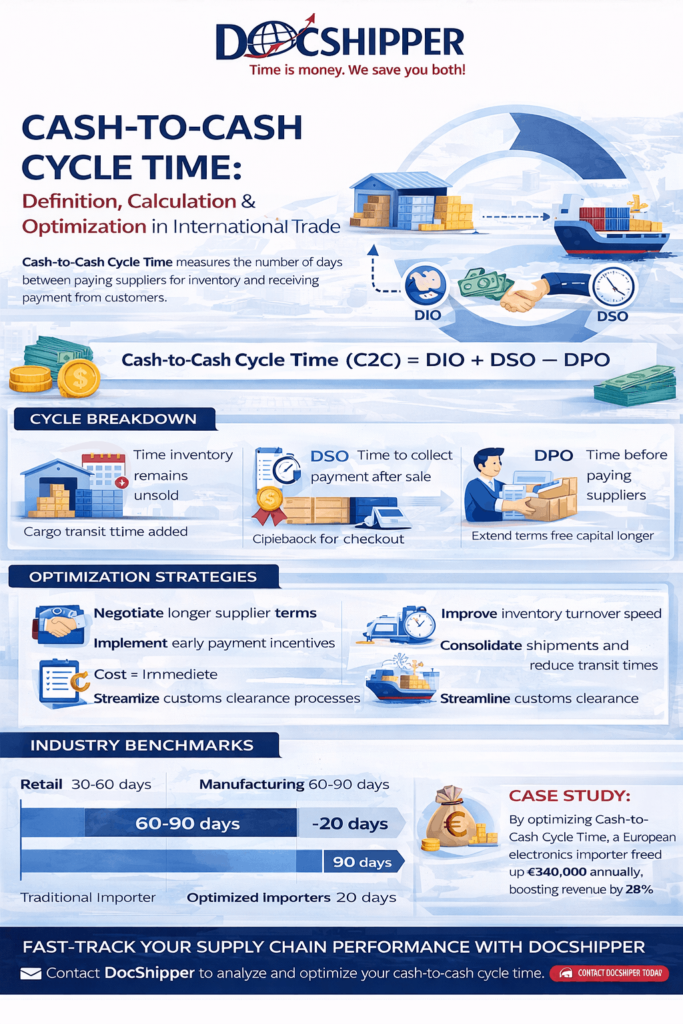
The Cash-to-Cash Cycle Time formula is straightforward: C2C = DIO + DSO – DPO. However, international trade introduces complexity that domestic operations rarely face.
Days Inventory Outstanding extends significantly in cross-border scenarios. A 30-day sea freight from Asia to Europe means inventory remains unproductive during transit. Smart importers calculate DIO from the moment goods leave the supplier’s warehouse, not when they arrive at destination.
Days Sales Outstanding varies by market and payment culture. European B2B transactions typically operate on 30-60 day terms, while emerging markets may require 90+ days. Letter of Credit terms add 5-15 days to collection cycles.
Days Payable Outstanding represents negotiation leverage. Extending supplier payment terms improves C2C, but excessive delays damage relationships. According to the World Trade Organization, 80-90% of global trade relies on trade finance, making payment timing critical.
At DocShipper, we analyze clients’ C2C cycles during onboarding. We’ve observed importers reduce cycle time by 20-40% through optimized shipping modes, consolidated shipments, and strategic warehouse positioning. Our customs clearance expertise eliminates 3-7 days of typical border delays.
Negative C2C cycles represent the holy grail—getting paid before paying suppliers. Amazon achieves this through marketplace dynamics. Importers can approach this through drop-shipping arrangements, consignment inventory, or extended supplier credit combined with rapid sales velocity.
Concrete Examples & Data
Understanding theory means little without practical application. Here’s how C2C manifests across different import scenarios.
| Scenario | DIO (Days) | DSO (Days) | DPO (Days) | C2C (Days) |
|---|---|---|---|---|
| Traditional Importer (Sea Freight) | 75 | 45 | 30 | 90 |
| Optimized Importer (Air + Pre-sales) | 35 | 30 | 45 | 20 |
| E-commerce (Direct Fulfillment) | 25 | 5 | 60 | -30 |
| Retail Distribution (Slow-moving) | 120 | 60 | 30 | 150 |
Use Case: Electronics Importer Transformation
A European electronics distributor importing from China faced a 110-day C2C cycle. Their breakdown: 65 days DIO (30-day transit + 35-day warehouse dwell), 60-day DSO (standard B2B terms), 15-day DPO (aggressive supplier demanding fast payment).
DocShipper implemented a three-phase optimization:
- Phase 1: Negotiated 45-day supplier terms (DPO increased to 45 days)
- Phase 2: Switched 40% volume to air freight for fast-sellers (DIO reduced to 48 days average)
- Phase 3: Implemented early payment discounts for customers (DSO reduced to 42 days)
Result: C2C dropped to 45 days (48 + 42 – 45), freeing €340,000 in working capital annually. The company redirected savings into inventory expansion, increasing revenue 28% within 12 months.
Industry Benchmarks: Manufacturing averages 60-90 days, retail 30-60 days, while technology companies often achieve 20-40 days. Amazon operates at approximately -20 days, demonstrating the power of marketplace dynamics and optimized fulfillment.
Conclusion
Cash-to-Cash Cycle Time isn’t just a financial metric—it’s a strategic compass for international trade operations. Reducing this cycle releases capital, reduces borrowing costs, and creates competitive flexibility.
Need expert guidance optimizing your import cash flow? Contact DocShipper for a customized supply chain analysis.
📚 Quizz
Test Your Knowledge: Cash-to-Cash Cycle Time
Q1 — What does the Cash-to-Cash Cycle Time measure?
Q2 — A company has a Cash-to-Cash Cycle Time of -30 days. What does this mean?
Q3 — A European importer sources goods from Asia by sea freight (30-day transit). Which action would most directly reduce their Cash-to-Cash Cycle Time?
🎯 Your Result
📞 Free Quote in 24hFAQ | Cash-to-Cash Cycle Time: Definition, Calculation & Real-World Examples
For importers, 30-60 days is competitive. Below 30 days indicates excellent working capital management. Above 90 days signals potential cash flow constraints requiring attention.
Sea freight adds 20-45 days to DIO versus air freight's 3-7 days. However, air costs 4-8x more. Optimal strategy balances speed with product margin and turnover velocity.
Yes. Negative C2C means receiving customer payment before paying suppliers. E-commerce platforms and consignment models achieve this through rapid sales and extended supplier terms.
Payment terms directly affect DSO and DPO. Net-30 terms add 30 days to DSO, while negotiating Net-60 supplier terms adds 30 days to DPO, improving C2C by 30 days.
Each day of C2C represents capital tied in operations. A company with €10M annual revenue and 90-day C2C needs approximately €2.5M in working capital to maintain operations.
Monthly for operational monitoring, quarterly for strategic planning. Seasonal businesses should track weekly during peak periods to identify cash flow pressure points early.
Absolutely. Inventory in-transit, in customs, or in distant warehouses all count toward DIO. Strategic warehouse positioning near customers reduces both DIO and shipping costs.
Customs delays extend DIO by 2-14 days depending on documentation quality and border efficiency. Professional customs brokerage typically eliminates 60-80% of delay risk.
Yes. Reducing C2C by 30 days can decrease financing requirements by 15-25%. Companies often redirect saved interest costs toward growth investments or competitive pricing.
Accurate forecasting reduces excess inventory, lowering DIO. Companies with ±10% forecast accuracy maintain 20-30% lower inventory levels than those with ±30% variance.
B2C typically achieves shorter DSO (immediate payment) but may have higher DIO (broader SKU range). B2B has longer DSO (30-90 days) but focused inventory, creating different optimization strategies.
ERP systems track components automatically. Supply chain visibility platforms provide real-time transit monitoring. Financial dashboards consolidate metrics for executive decision-making and trend analysis.
Need Help with
Logistics or Sourcing ?
First, we secure the right products from the right suppliers at the right price by managing the sourcing process from start to finish. Then, we simplify your shipping experience - from pickup to final delivery - ensuring any product, anywhere, is delivered at highly competitive prices.


Fill the Form
Prefer email? Send us your inquiry, and we’ll get back to you as soon as possible.
Contact us




