


In short ⚡
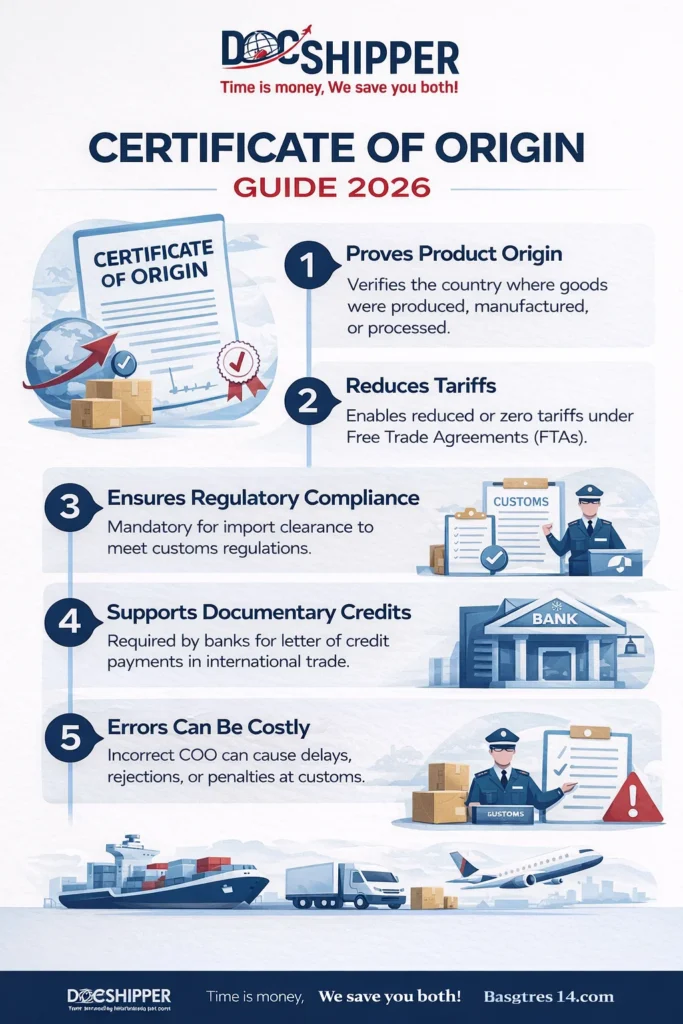
The Certificate of Origin (COO) is an official document certifying the country where goods were manufactured, produced, or processed. This document is essential for customs clearance, determining applicable tariffs, and verifying compliance with international trade agreements and preferential trade regimes.
Introduction
Many importers underestimate the Certificate of Origin until customs authorities reject their shipment or apply unexpected tariffs. This single document can determine whether you pay 0% or 15% duty on the same product.
In international logistics, the COO serves three critical functions: proving product origin, enabling preferential tariff treatment under trade agreements, and satisfying regulatory requirements in destination countries. Without proper certification, goods may face delays, penalties, or outright rejection at borders.
- Customs compliance: Required by authorities in most countries for import clearance
- Tariff determination: Enables reduced or zero-duty rates under Free Trade Agreements (FTAs)
- Trade policy enforcement: Verifies compliance with sanctions, embargoes, or preferential programs
- Quality assurance: Certain markets demand origin proof for health, safety, or consumer protection
- Documentary credit: Banks often require COOs for letter of credit transactions
Types of COO & Legal Framework
Understanding the distinction between non-preferential and preferential Certificates of Origin is fundamental. Non-preferential COOs simply declare where goods originate, while preferential COOs unlock reduced tariffs under specific trade agreements like USMCA, EU-UK TCA, or RCEP.
The origin criteria vary by agreement but typically require substantial transformation in the exporting country. For example, under EU rules, a product must undergo sufficient processing that results in a change of tariff classification or adds a minimum percentage of local value. Simply repackaging imported components does not qualify.
Issuing authorities differ by country. In the United States, Chambers of Commerce issue non-preferential COOs, while exporters self-certify under USMCA. The European Union relies on REX (Registered Exporter System) for preferential origins. According to EU Customs, registered exporters must maintain detailed records proving origin compliance for at least three years.
Form A represents a special category—the Generalized System of Preferences (GSP) certificate issued by developing countries to access reduced duties in developed markets. This preferential treatment aims to support economic development but requires strict adherence to rules of origin.
The legal implications of false origin declarations are severe. Customs authorities can impose penalties ranging from duty reassessments to criminal prosecution. The U.S. Customs and Border Protection regularly audits origin claims, and discrepancies can trigger company-wide investigations affecting future shipments.
At DocShipper, we systematically verify origin documentation before shipment departure, cross-referencing HS codes with applicable trade agreements to ensure your goods qualify for optimal duty treatment and avoid costly customs disputes.
Practical Examples & Data
Consider a textile manufacturer in Vietnam exporting garments to the European Union. Without a preferential COO under the EU-Vietnam FTA, standard duties of 12% apply. With proper EUR.1 certification proving Vietnamese origin, the duty drops to 0%, saving €12,000 on a €100,000 shipment.
| Scenario | Certificate Type | Duty Rate | Cost on $50,000 |
|---|---|---|---|
| Electronics (China to USA) | Non-preferential COO | 7.5% | $3,750 |
| Auto parts (Mexico to USA) | USMCA Certificate | 0% | $0 |
| Coffee (Ethiopia to EU) | Form A (GSP) | 0% | $0 |
| Machinery (Germany to UK) | TCA Statement on Origin | 0% | $0 |
A common error involves assembly operations. A company importing Chinese components to Malaysia, assembling them with minimal local content, then exporting to the EU cannot claim Malaysian origin. Customs authorities examine value-added percentages and manufacturing processes, not just final assembly location.
Digital transformation is reshaping COO processes. Singapore’s TradeTrust blockchain platform enables digital, tamper-proof origin certificates. The World Customs Organization reports that electronic COOs reduce processing time by 65% and cut administrative costs by 40% compared to paper documents.
Key data points for origin qualification:
- Value threshold: Most FTAs require 40-60% local content by value
- Tariff shift: Product must change HS classification at 4 or 6-digit level
- Specific processes: Certain sectors (textiles, agriculture) have unique rules
- Cumulation: Some agreements allow materials from partner countries to count as originating
- De minimis: Small percentages of non-originating materials (typically 10%) may be ignored
For complex supply chains spanning multiple countries, origin determination becomes intricate. DocShipper’s customs specialists conduct origin assessments, calculating regional value content and advising on optimal sourcing strategies to maximize preferential treatment under applicable trade agreements.
Conclusion
The Certificate of Origin directly impacts your import costs, customs clearance speed, and trade compliance. Understanding which type applies to your shipment and ensuring accurate documentation prevents expensive delays and penalties.
Need expert guidance on origin certification for your international shipments? Contact DocShipper for comprehensive customs and logistics support.
📚 Quiz
Test Your Knowledge: Certificate of Origin (COO)
Q1 — What is the primary purpose of a Certificate of Origin (COO) in international trade?
Q2 — A company imports Chinese components into Malaysia, assembles them with minimal local content, and exports the finished product to the EU. Can they claim Malaysian origin on their COO?
Q3 — A Vietnamese textile manufacturer wants to export garments to the EU at 0% duty instead of the standard 12% rate. Which document should they obtain?
🎯 Your Result
📞 Free Quote in 24hFAQ | Certificate of Origin (COO): Definition, Types & Practical Examples
Non-preferential COOs simply state where goods originate for general customs purposes. Preferential COOs prove eligibility for reduced tariffs under specific trade agreements like USMCA or EU FTAs, potentially saving significant duty costs.
Issuing authorities vary by country and certificate type. Chambers of Commerce typically issue non-preferential COOs, while preferential certificates may be issued by customs authorities, chambers, or through exporter self-certification systems depending on the trade agreement.
No. Each shipment requires its own Certificate of Origin with specific details matching the commercial invoice, including product descriptions, quantities, values, and consignee information. Blanket certificates are not accepted by customs authorities.
Processing time ranges from same-day to five business days depending on the issuing authority and certificate type. Electronic systems like Singapore's TradeTrust can generate COOs instantly, while traditional paper processes may require several days.
Errors can result in customs delays, duty reassessments, or shipment rejection. Minor discrepancies may be correctable through amendments, but significant errors require new certificates. Customs authorities may impose penalties for fraudulent or negligent misstatements of origin.
Not always. Requirements depend on destination country regulations, product type, and shipment value. Many countries mandate COOs for commercial shipments above certain thresholds, while others require them only for specific products or to claim preferential tariffs.
Check the specific rules of origin in the relevant trade agreement. Generally, products must undergo substantial transformation in the exporting country, meet minimum local content thresholds (typically 40-60%), or satisfy specific manufacturing processes defined in the agreement.
Form A is the certificate used under the Generalized System of Preferences (GSP), allowing developing countries to export certain products to developed markets at reduced or zero tariffs. It must be issued by authorized government agencies in the beneficiary country.
Increasingly, yes. Many countries now accept electronic COOs through platforms like ICC's Digital Standards Initiative or national systems. However, acceptance varies by destination country, so verify requirements before shipping. Digital COOs offer faster processing and enhanced security.
Supporting documents include bills of materials, production records, supplier declarations, purchase invoices for raw materials, and manufacturing process documentation. Authorities may audit these records, so maintain detailed files for at least three to five years.
Origin for customs purposes follows strict legal criteria defined in trade agreements, focusing on substantial transformation and value-added. "Made in" labeling for consumer products may have different, often less stringent requirements set by consumer protection agencies rather than customs authorities.
Penalties range from duty reassessments with interest to civil fines reaching hundreds of thousands of dollars. Willful misrepresentation can result in criminal prosecution, imprisonment, and permanent loss of trade privileges. Companies may face enhanced scrutiny on all future imports.
Need Help with
Logistics or Sourcing ?
First, we secure the right products from the right suppliers at the right price by managing the sourcing process from start to finish. Then, we simplify your shipping experience - from pickup to final delivery - ensuring any product, anywhere, is delivered at highly competitive prices.


Fill the Form
Prefer email? Send us your inquiry, and we’ll get back to you as soon as possible.
Contact us




