


In short ⚡
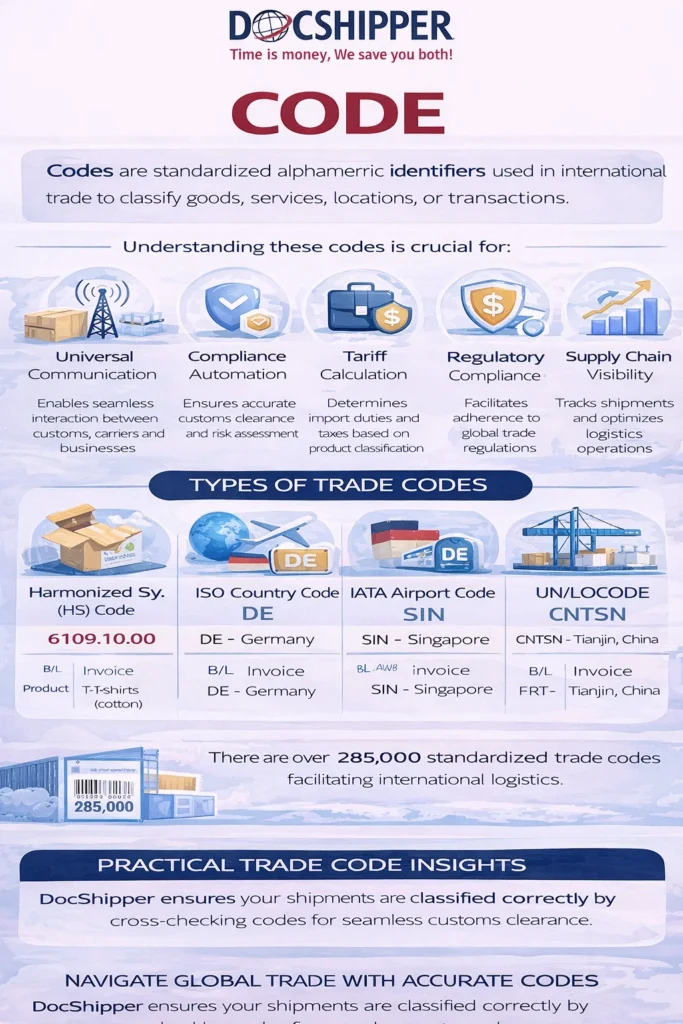
Code in logistics refers to standardized alphanumeric identifiers used to classify goods, services, locations, or transactions in international trade. These systems—such as HS codes, ISO country codes, or IATA airport codes—ensure universal communication between customs authorities, carriers, and businesses worldwide, facilitating accurate documentation, tariff calculation, and regulatory compliance.
Introduction
Ever wondered why a single digit error in your shipping documents can trigger customs delays or unexpected duties? That’s the power—and risk—of codes in international logistics.
Codes form the backbone of global trade communication. They eliminate ambiguity across languages, legal systems, and operational procedures. Whether you’re declaring goods at customs, booking air cargo, or calculating landed costs, standardized codes ensure every stakeholder interprets information identically.
- Universal language: Codes transcend linguistic barriers in cross-border transactions
- Tariff determination: HS codes directly dictate import duties and taxes
- Compliance automation: Enables electronic customs clearance and risk assessment
- Supply chain visibility: Tracking systems rely on location and shipment codes
- Statistical accuracy: Governments use trade codes for economic analysis and policy
Classification Systems & Regulatory Framework
The Harmonized System (HS) dominates product classification globally. Maintained by the World Customs Organization, this six-digit nomenclature covers over 5,000 commodity groups. Countries extend it to 8-10 digits for national tariff schedules.
Beyond product codes, logistics relies on multiple standardization frameworks. ISO 3166 defines two-letter country codes (e.g., US, FR, CN), while UN/LOCODE identifies 103,034 transport locations worldwide. Air cargo uses IATA codes for airports, and maritime shipping references port codes for terminal operations.
The TARIC system (EU) adds layers to HS codes, incorporating trade measures like anti-dumping duties or import restrictions. A complete TARIC code can reach 10 digits, encoding product origin, end-use, and applicable regulations.
Legal implications are significant. Misclassification—intentional or accidental—can result in penalties ranging from duty adjustments to criminal prosecution. The WCO provides binding rulings to resolve classification disputes, though interpretations vary between jurisdictions.
Electronic data interchange (EDI) standards like UN/EDIFACT mandate specific code formats for automated processing. Customs systems reject submissions with invalid or outdated codes, causing shipment holds.
At DocShipper, we systematically verify all classification codes before customs submission, cross-referencing against current tariff databases to prevent clearance issues and optimize duty payments.
Practical Applications & Case Studies
Understanding codes in action clarifies their operational impact. Consider a French importer receiving smartphones from China.
Use Case: Electronics Import
Product: Smartphone with 5G capability
HS Code: 8517.13.00 (Smartphones)
Origin: CN (China)
Destination: FR (France)
Port of Entry: FRLEH (Le Havre)
EU Duty Rate: 0% (under trade agreements)
VAT: 20% (standard French rate)
The six-digit HS code determines duty-free status, while the country code triggers origin verification requirements. The port code routes the shipment to the correct terminal, and VAT calculation depends on the combined commodity/country classification.
| Code Type | Example | Primary Use | Digits |
|---|---|---|---|
| HS Code | 6109.10 | Product classification | 6-10 |
| ISO Country | DE | Origin/destination | 2 |
| IATA Airport | JFK | Air cargo routing | 3 |
| UN/LOCODE | USNYC | Port/terminal ID | 5 |
| Currency | EUR | Financial transactions | 3 |
Data-Driven Insight: A 2023 WCO study found that 12% of global shipments contain HS code errors, with misclassification costing businesses an estimated $40 billion annually in overpaid duties and compliance penalties.
Key Operational Points:
- HS codes update every five years; the latest revision (HS 2022) introduced 351 amendments
- Incorrect country codes can invalidate preferential trade agreements
- Airport code confusion (e.g., SFO vs. SJC) causes cargo misrouting in 3% of air shipments
- Customs systems auto-reject codes not matching official databases
- Multi-country shipments require separate classification for each jurisdiction
Conclusion
Codes are the silent infrastructure of international trade—invisible when correct, catastrophic when wrong. Mastering their application ensures compliance, cost optimization, and operational efficiency across your supply chain.
Need expert guidance on classification or customs coding? Contact DocShipper for tailored support on your international shipments.
📚 Quizz
Test Your Knowledge: Codes in International Trade
Q1 — What is the primary purpose of standardized codes in international logistics?
Q2 — A common misconception is that the six-digit HS code is sufficient for all countries. What is the correct interpretation?
Q3 — A French importer receives smartphones from China and uses the wrong HS code on the customs declaration. Which outcome is most likely?
🎯 Your Result
📞 Free Quote in 24hFAQ | Code: Definition, Types & Practical Examples in International Trade
The Harmonized System code is a six-digit international product identifier that determines customs duties, import restrictions, and statistical tracking for traded goods worldwide.
The World Customs Organization updates HS codes every five years. The current version (HS 2022) took effect in January 2022, with the next revision scheduled for 2027.
Yes. The base six-digit code is universal, but countries add digits for national tariffs. A product may have different 8-10 digit codes depending on destination, composition, or intended use.
Importers and exporters are legally responsible for classification. Customs authorities may challenge classifications, and professional brokers often provide classification services to ensure accuracy.
Consequences range from duty adjustments and fines to shipment seizure. Repeated errors may trigger audits. Intentional misclassification constitutes customs fraud with criminal penalties.
ISO 3166 two-letter codes (US, GB, JP) are standard for most trade documentation. However, some legacy systems use three-letter codes or numeric identifiers—always verify format requirements.
Use official customs databases (e.g., EU TARIC, US HTS), consult the WCO nomenclature, or seek binding rulings from customs authorities. Professional classification services reduce error risk.
No. The HS system classifies tangible goods only. Services use different frameworks like the UN Central Product Classification (CPC) or WTO Services Sectoral Classification List.
HS codes (six digits) are international. HTS (Harmonized Tariff Schedule) codes extend to 8-10 digits for national tariff systems. For example, US HTS codes have 10 digits.
Emerging AI systems assist classification but aren't yet fully reliable. Legal responsibility remains with the declarant, so human verification is essential for compliance.
FTAs grant preferential duties for qualifying goods. Proper HS classification is mandatory to claim benefits, along with origin certificates referencing the exact tariff code.
Check the WCO official database, your destination country's customs website, or use commercial trade compliance platforms that update codes in real-time with regulatory changes.
Need Help with
Logistics or Sourcing ?
First, we secure the right products from the right suppliers at the right price by managing the sourcing process from start to finish. Then, we simplify your shipping experience - from pickup to final delivery - ensuring any product, anywhere, is delivered at highly competitive prices.


Fill the Form
Prefer email? Send us your inquiry, and we’ll get back to you as soon as possible.
Contact us




