


In short ⚡
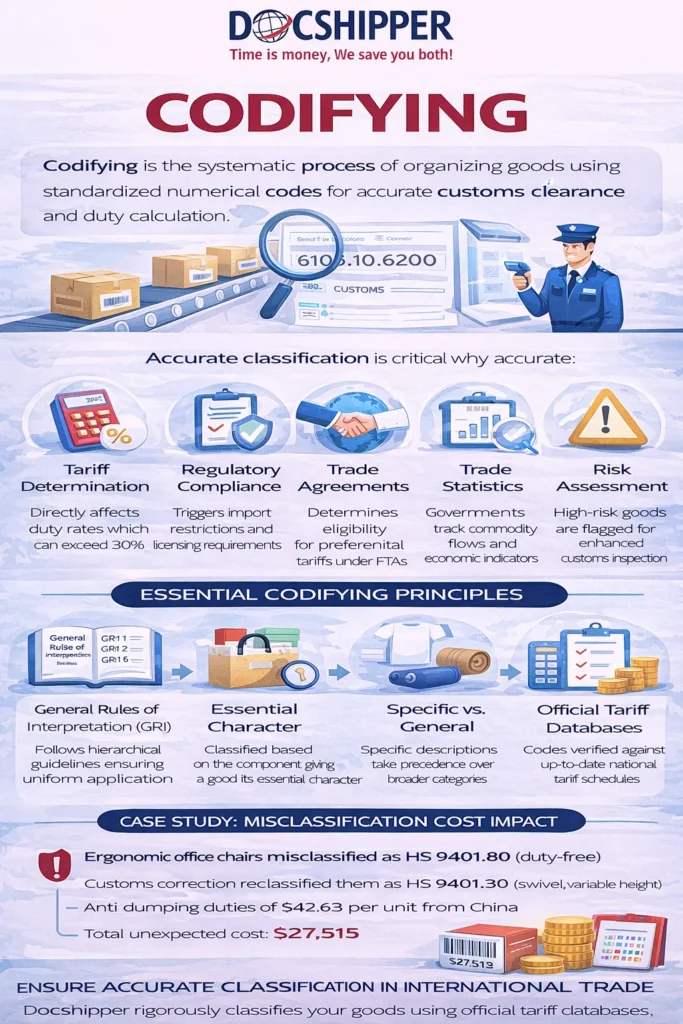
Codifying is the systematic process of organizing and classifying goods using standardized numerical codes (HS, HTS, CN) for customs clearance, tariff determination, and regulatory compliance. This international classification system ensures consistent product identification across borders, enabling accurate duty calculation and trade statistics collection worldwide.
Introduction
One of the most common mistakes importers make is underestimating the complexity of product classification. A single digit error in a customs code can trigger incorrect duty rates, regulatory violations, or shipment delays.
Codifying serves as the universal language of international trade. Every product crossing borders must be assigned a specific code that determines its tariff treatment, import restrictions, and statistical tracking.
The significance of accurate codifying in logistics includes:
- Tariff determination: Codes directly dictate duty rates, ranging from 0% to over 30% depending on product category
- Regulatory compliance: Certain codes trigger licenses, certifications, or import prohibitions
- Trade statistics: Governments use codes to monitor trade flows and economic indicators
- Origin verification: Codes determine eligibility for preferential trade agreements (FTAs)
- Risk assessment: Customs authorities flag high-risk codes for enhanced inspection
Understanding Codifying Mechanisms & Regulatory Framework
The foundation of codifying rests on the Harmonized System (HS), maintained by the World Customs Organization (WCO). This six-digit base code is adopted by over 200 countries and covers approximately 5,000 commodity groups.
Countries extend the HS with additional digits to create national tariff schedules. The United States uses the Harmonized Tariff Schedule (HTS) with 10 digits, while the European Union employs the Combined Nomenclature (CN) with 8 digits. These extensions allow for more granular product differentiation and specific duty rates.
The classification process follows the General Rules of Interpretation (GRI), a hierarchical framework that determines code assignment when products have multiple potential classifications. GRI 1 states that classification is determined by headings and section notes first, followed by subsequent rules only when necessary.
Legal implications are substantial. According to WCO regulations, importers bear legal responsibility for accurate classification. Misclassification—even unintentional—can result in penalties ranging from duty adjustments to criminal prosecution in cases of deliberate fraud.
The binding tariff information (BTI) system allows importers to obtain official rulings from customs authorities before shipment. Valid for three years in the EU and similar periods in other jurisdictions, BTIs provide legal certainty and protection against reclassification disputes.
At DocShipper, we systematically verify product codes against official tariff databases and maintain BTI applications for clients with complex or ambiguous products, ensuring compliance before goods leave origin.
Practical Examples & Classification Data
Understanding codifying through concrete scenarios demonstrates its real-world impact on import costs and procedures.
Comparative Classification Scenario
| Product | HS Code | US Duty Rate | EU Duty Rate | Special Requirements |
|---|---|---|---|---|
| Cotton T-shirt | 6109.10 | 16.5% | 12% | Textile quota monitoring |
| Polyester T-shirt | 6109.90 | 32% | 12% | Fiber content declaration |
| Smartphone | 8517.13 | 0% | 0% | FCC certification, CE marking |
| Lithium battery (separate) | 8506.50 | 3.4% | 4.7% | UN 3480 dangerous goods compliance |
| Coffee (roasted) | 0901.21 | 0% | 7.5% | FDA prior notice, phytosanitary certificate |
Use Case: Misclassification Cost Impact
A US importer classified ergonomic office chairs under HS 9401.80 (other seats) at 0% duty. Customs reclassified them as 9401.30 (swivel seats with variable height adjustment) at 0% duty but triggered anti-dumping duties of $42.63 per unit from China.
Financial impact on 500-unit shipment:
- Original classification: $0 anti-dumping duty
- Corrected classification: $21,315 anti-dumping duty
- Penalty for negligent misclassification: $5,000
- Storage fees during clearance delay: $1,200
- Total unexpected cost: $27,515
Key Classification Principles
- Essential character: When products combine multiple materials, classification follows the component giving essential character (GRI 3b)
- Specific vs. general: More specific descriptions take precedence over general categories (GRI 3a)
- Incomplete/unfinished goods: Products with essential character of complete items are classified as complete (GRI 2a)
- Sets and kits: Retail sets are classified by the component giving essential character, not individual parts
- Parts and accessories: Generic parts follow their own classification unless specifically designed for particular machinery
Conclusion
Accurate codifying is not merely an administrative formality—it directly impacts landed costs, regulatory compliance, and supply chain efficiency. The difference between correct and incorrect classification can mean thousands in unexpected duties or shipment rejections.
Need assistance with product classification or customs compliance? Contact DocShipper for expert guidance on codifying your imports.
📚 Quiz
Test Your Knowledge: Codifying
1. What is the primary purpose of codifying in international trade?
2. Who bears the legal responsibility for accurate product classification under customs law?
3. A US importer ships 500 ergonomic office chairs classified under the wrong HS code, missing applicable anti-dumping duties of $42.63 per unit. What is the most accurate description of this situation?
🎯 Your Result
📞 Free Quote in 24hFAQ | Codifying: Definition, Process & Practical Examples in International Trade
The HS code is the 6-digit international standard maintained by WCO. The HTS code extends this to 10 digits for US-specific tariff classification, adding granular product distinctions and duty rates.
The importer of record bears legal responsibility for accurate codifying. Customs brokers assist but ultimate liability rests with the importing entity, making verification essential.
The WCO updates the Harmonized System every five years. The most recent update occurred in 2022, with the next scheduled for 2027. National schedules may update annually.
No. Each product has one correct classification based on GRI rules. However, similar products with slight variations may have different codes based on material composition, function, or specifications.
A BTI is an official classification decision from customs authorities, valid for 3+ years. It provides legal certainty, protects against reclassification, and can be used for planning duty costs accurately.
Start with official tariff databases, review section notes, apply GRI rules sequentially, and consider requesting a binding ruling for complex products. Professional classification services ensure accuracy.
Penalties range from duty adjustments with interest for negligence, to fines up to domestic value for gross negligence, to criminal prosecution for fraudulent misclassification. Severity depends on intent.
The first 6 digits are internationally standardized. Countries add digits for national specificity—US uses 10, EU uses 8, Canada uses 10. Base classification remains consistent globally.
FTA preferential rates apply to specific HS codes. Incorrect classification can disqualify shipments from duty reductions, even when origin requirements are met. Code accuracy is essential for FTA utilization.
Yes. Customs can audit and reclassify entries within statute of limitations (typically 5 years in US). Retroactive duty assessments, penalties, and interest may apply to all affected shipments.
Commercial invoice descriptions must be specific enough for customs to verify classification. Generic terms like "parts" or "accessories" trigger delays. Include material, function, and technical specifications.
Apply GRI 3 rules: classify by essential character if determinable, otherwise by the component listed last in the tariff. Retail sets follow the component providing essential character to the set.
Need Help with
Logistics or Sourcing ?
First, we secure the right products from the right suppliers at the right price by managing the sourcing process from start to finish. Then, we simplify your shipping experience - from pickup to final delivery - ensuring any product, anywhere, is delivered at highly competitive prices.


Fill the Form
Prefer email? Send us your inquiry, and we’ll get back to you as soon as possible.
Contact us




