


In short ⚡
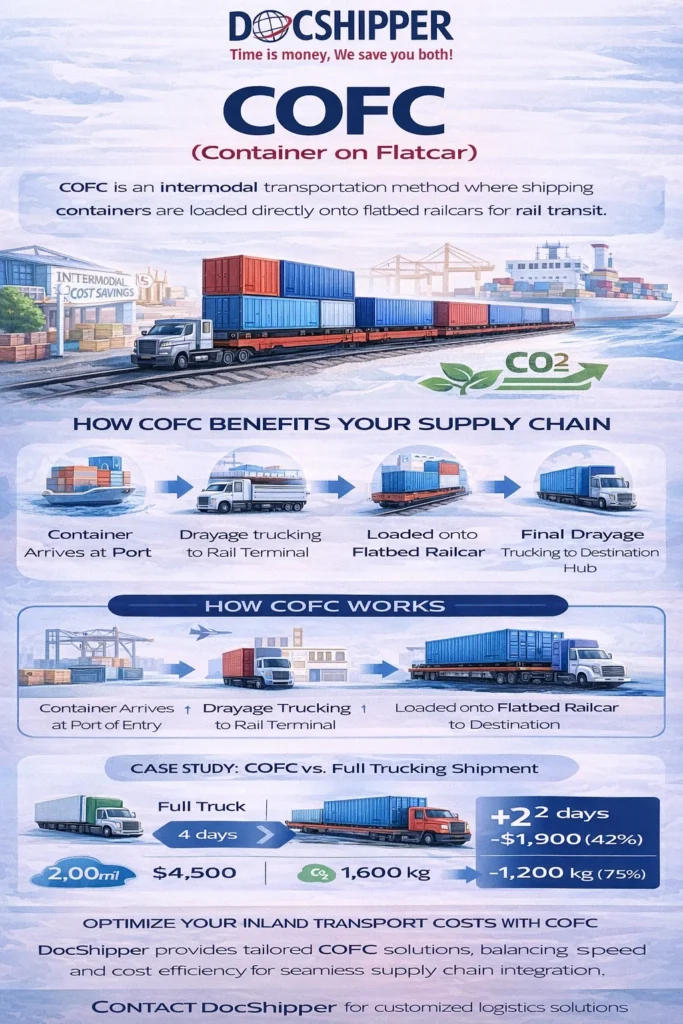
COFC (Container on Flatcar) is an intermodal transportation method where shipping containers are loaded directly onto specialized flatbed railcars for rail transit. This cost-effective rail solution enables seamless movement of containerized cargo across long distances, reducing trucking costs while maintaining container integrity throughout the journey.Introduction
Many importers struggle to optimize inland transportation costs after containers arrive at seaports. The choice between full trucking and intermodal rail solutions directly impacts profit margins on international shipments. COFC represents a strategic alternative that balances speed, cost, and environmental considerations.
In modern supply chains, COFC serves as a critical link between ocean terminals and inland distribution centers. This method has gained prominence as fuel costs rise and sustainability becomes a procurement priority.
- Cost reduction: Rail transport costs 30-50% less than trucking for distances over 500 miles
- Container compatibility: Accommodates standard 20ft, 40ft, and 45ft ISO containers
- Environmental advantage: Reduces carbon emissions by up to 75% compared to truck-only transport
- Network flexibility: Connects major ports to inland rail hubs across North America and Europe
- Reduced road congestion: One train removes 280+ trucks from highways
Technical Framework & Operational Expertise
COFC operations require specialized well-type flatcars designed with lowered center sections to accommodate container height while maintaining railway clearance standards. Unlike TOFC (Trailer on Flatcar), COFC eliminates chassis and road gear, maximizing payload efficiency.
The loading process involves intermodal cranes equipped with spreader bars that lift containers by corner castings. Containers are secured using twist locks that engage the ISO corner fittings, preventing movement during transit. This standardized system enables rapid transfer operations at intermodal terminals.
Double-stack configuration represents an advanced COFC variant where containers are stacked two-high on specialized railcars. This configuration doubles capacity per train, significantly reducing per-container transportation costs. However, tunnel and bridge clearances limit double-stacking to specific rail corridors.
Regulatory compliance involves adherence to AAR (Association of American Railroads) standards for weight distribution and securement. The Federal Railroad Administration mandates specific inspection protocols before departure. European operations follow ERA (European Union Agency for Railways) technical specifications for intermodal units.
Transit time calculation depends on distance, rail network congestion, and terminal dwell time. Typical cross-country COFC shipments (coast-to-coast USA) require 5-7 days compared to 3-4 days for dedicated trucking. At DocShipper, we analyze transit requirements against cost savings to recommend optimal modal combinations for each shipment.
The drayage component remains essential—trucks transport containers between customer facilities and rail terminals. Effective COFC implementation requires coordinating three parties: origin drayage carrier, rail operator, and destination drayage carrier. DocShipper manages this coordination to eliminate delays and miscommunication.
Practical Examples & Cost Analysis
Consider a manufacturer importing machinery from Shanghai to Chicago. The container arrives at Los Angeles port. Two transportation options exist:
| Transport Mode | Distance | Transit Time | Cost (40ft container) | CO2 Emissions |
|---|---|---|---|---|
| Full Truck | 2,015 miles | 3-4 days | $4,200 | 1,850 kg |
| COFC Rail | 2,015 miles | 6-7 days | $2,400 | 465 kg |
| Savings/Difference | — | +3 days | -$1,800 (43%) | -75% |
This comparison demonstrates COFC’s economic advantage for non-urgent shipments. The importer saves $1,800 per container—significant when moving 50+ containers monthly. The environmental benefit supports corporate sustainability reporting requirements.
Use Case: Automotive Parts Distribution
A tier-1 automotive supplier ships components from Detroit to Texas assembly plants. Using COFC via Kansas City Southern Railway, they achieve:
- Volume efficiency: 120 containers monthly at $1,650 per container (vs. $2,800 trucking)
- Annual savings: $138,000 in transportation costs
- Reliability: 96% on-time performance with predictable scheduling
- Inventory optimization: Adjusted safety stock levels to accommodate 2-day transit difference
- Regulatory compliance: Reduced Scope 3 emissions by 68% for ESG reporting
The break-even distance for COFC typically occurs around 500-750 miles. Below this threshold, direct trucking proves more economical due to terminal handling costs and drayage fees. DocShipper conducts lane-specific analysis to identify optimal modal selection for each route.
Double-stack advantage: West Coast to Midwest corridors utilizing double-stack COFC reduce per-container costs by an additional 20-30% compared to single-stack configurations. This infrastructure exists on major routes like Los Angeles-Chicago and Seattle-Memphis.
Conclusion
COFC represents a proven cost-reduction strategy for importers managing inland container movements beyond 500 miles. The modal shift requires planning around extended transit times but delivers substantial financial and environmental benefits.
Need assistance optimizing your intermodal transportation strategy? Contact DocShipper for customized logistics solutions that balance cost, speed, and reliability.
📚 Quiz
Test Your Knowledge: COFC (Container on Flatcar)
1. What is the correct definition of COFC (Container on Flatcar)?
2. A logistics manager argues that COFC is always the best option regardless of distance. Is this correct?
3. An importer needs to move 50 containers per month from Los Angeles port to Chicago (2,015 miles). Their cargo is non-urgent and they have sustainability targets to meet. Which option best fits their needs?
🎯 Your Result
📞 Free Quote in 24hFAQ | COFC (Container on Flatcar): Definition, Calculation & Practical Examples
COFC places containers directly on flatcars, while TOFC loads entire truck trailers (with wheels and chassis) onto railcars. COFC offers better weight efficiency and lower costs since it eliminates redundant road gear.
Yes, reefer containers operate on COFC with generator sets (gensets) providing power during rail transit. Railroads offer plug-in facilities at major terminals for extended stops. Fuel monitoring ensures temperature integrity throughout the journey.
Containers lock to flatcars using twist locks that engage ISO corner castings. These mechanical locks prevent vertical and horizontal movement. Additional chains or straps may secure containers in double-stack configurations per AAR standards.
Standard 20ft, 40ft, 40ft High Cube, and 45ft containers all accommodate COFC transport. Specialized equipment handles 53ft domestic containers on specific rail corridors. Weight limits vary by railcar type, typically 60,000-67,200 lbs gross.
COFC operates extensively in North America and Europe. Asian markets utilize similar intermodal rail systems with regional variations. Cross-border COFC services exist between USA-Canada and within EU member states under unified railway standards.
Rail carriers provide container tracking via railcar number and container ID. Real-time GPS tracking availability varies by carrier. Most Class I railroads offer online portals showing current location, estimated arrival, and delay notifications.
Common delay factors include rail network congestion, weather events, track maintenance, customs inspections (for cross-border moves), and terminal equipment availability. Buffer time of 1-2 days accounts for these variables in planning.
Yes, total gross weight (container + cargo) cannot exceed railcar capacity, typically 286,000 lbs per four-axle car. Individual container weight limits depend on ISO rating and railcar configuration. Overweight containers require special handling and permits.
Hazardous materials move via COFC under strict DOT and railroad regulations. Placarding, documentation, and segregation requirements apply. Certain hazmat classes face restrictions or prohibitions. Specialized intermodal carriers handle dangerous goods compliance.
Rail carriers provide limited liability coverage (typically $100,000 per container). Shippers should secure cargo insurance for full replacement value. Marine cargo policies extend coverage to include inland rail transit segments under all-risk terms.
Standard COFC service requires 3-5 business days advance booking for equipment positioning and scheduling. Peak seasons (harvest, retail holidays) may extend lead times to 7-10 days. Dedicated unit train services offer priority scheduling with contracted capacity.
Intermodal terminals operated by Class I railroads (BNSF, Union Pacific, CSX, Norfolk Southern) and regional carriers handle COFC. Major facilities exist near ports and inland hubs. Terminal capabilities vary—some offer on-site customs clearance, transloading, and warehousing services.
Need Help with
Logistics or Sourcing ?
First, we secure the right products from the right suppliers at the right price by managing the sourcing process from start to finish. Then, we simplify your shipping experience - from pickup to final delivery - ensuring any product, anywhere, is delivered at highly competitive prices.


Fill the Form
Prefer email? Send us your inquiry, and we’ll get back to you as soon as possible.
Contact us




