


In short ⚡
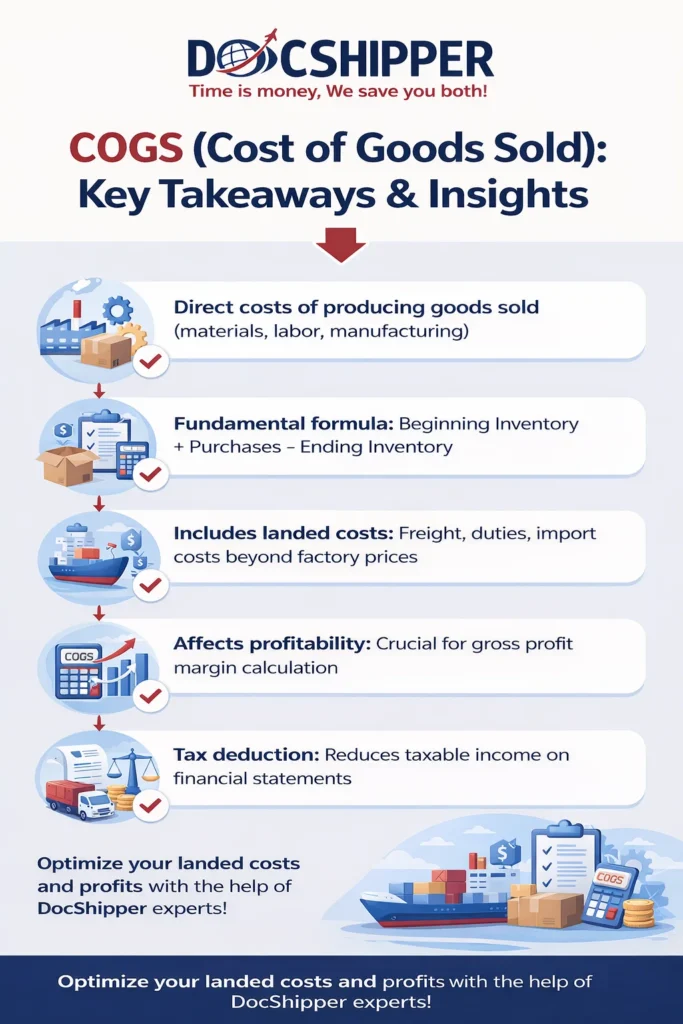
COGS (Cost of Goods Sold) represents the direct costs attributable to producing goods sold by a company during a specific period. It includes raw materials, labor directly involved in production, and manufacturing overhead, excluding indirect expenses like marketing or distribution.Introduction
Many importers struggle to accurately determine their true product costs, leading to pricing errors and margin miscalculations. Understanding COGS is essential for international trade profitability, tax compliance, and strategic decision-making.
In the import-export supply chain, COGS directly impacts customs valuations, duty calculations, and overall business viability. Misunderstanding this metric can result in compliance issues or financial losses.
- Direct cost measurement: Only production-related expenses are included
- Inventory valuation: Links beginning inventory, purchases, and ending inventory
- Tax deductibility: COGS reduces taxable income on financial statements
- Profitability indicator: Essential for calculating gross profit margins
- Supply chain impact: Includes freight, duties, and handling costs for imported goods
In-Depth Understanding & Expertise
The fundamental COGS formula is: Beginning Inventory + Purchases – Ending Inventory = COGS. This calculation reflects the actual cost of inventory sold during an accounting period, not simply what was purchased.
For importers, COGS extends beyond factory prices. It encompasses landed costs—the total price of getting products to your warehouse. This includes international freight, customs duties, port fees, insurance, and inspection costs. At DocShipper, we systematically track these components to provide clients with accurate COGS calculations for financial planning.
Inventory valuation methods significantly affect COGS reporting. FIFO (First-In, First-Out) assumes oldest inventory sells first, while LIFO (Last-In, First-Out) assumes newest inventory sells first. The weighted average method calculates a mean cost across all units. Each approach yields different COGS figures and tax implications.
Tax authorities scrutinize COGS closely. According to IRS guidelines, only direct production costs qualify. Selling expenses, administrative overhead, and storage costs after production are excluded. Proper documentation—invoices, bills of lading, customs declarations—is mandatory for audit compliance.
For manufacturers, absorption costing includes both variable and fixed manufacturing overhead in COGS. Importers using contract manufacturers must verify whether quoted prices include all production costs or just materials and direct labor. Misclassifying indirect costs inflates COGS artificially, distorting profitability metrics.
Concrete Examples & Data
Consider an electronics importer with the following quarterly data:
| Component | Amount (USD) |
|---|---|
| Beginning Inventory | $45,000 |
| Purchases (FOB factory) | $120,000 |
| International Freight | $8,500 |
| Customs Duties (8%) | $9,600 |
| Port Handling & Clearance | $2,900 |
| Ending Inventory | $38,000 |
| Total COGS | $148,000 |
Calculation: $45,000 + ($120,000 + $8,500 + $9,600 + $2,900) – $38,000 = $148,000
This example demonstrates how landed costs increase COGS by 17.5% beyond factory prices. Ignoring these expenses would understate true product costs and overstate profit margins.
Industry benchmarks show typical COGS percentages vary significantly:
- Electronics importers: 60-75% of revenue
- Fashion/apparel: 40-55% of revenue
- Food products: 65-80% of revenue
- Furniture: 50-65% of revenue
- Automotive parts: 70-85% of revenue
A furniture importer selling $500,000 worth of goods with COGS of $325,000 achieves a gross profit margin of 35% ($175,000 / $500,000). If COGS rises to $350,000 due to increased freight rates, the margin drops to 30%—a significant impact on profitability.
At DocShipper, we help clients optimize COGS through consolidated shipping, duty drawback programs, and strategic sourcing. Small reductions in landed costs translate to substantial margin improvements over annual volumes.
Conclusion
Mastering COGS calculation is non-negotiable for import-export success. Accurate tracking ensures compliant financial reporting, realistic pricing strategies, and sustainable profit margins in competitive global markets.
Need expert guidance on optimizing your landed costs and COGS structure? Contact DocShipper for tailored logistics solutions.
📚 Quiz
Test Your Knowledge: COGS (Cost of Goods Sold)
Q1. Which of the following best defines COGS (Cost of Goods Sold)?
Q2. An importer ships goods from a factory overseas to their warehouse. Which of the following costs should be included in COGS?
Q3. A furniture importer has a beginning inventory of $50,000, purchases $200,000 worth of goods (including all landed costs), and ends the period with $60,000 in inventory. What is their COGS?
🎯 Your Result
📞 Free Quote in 24hFAQ | COGS (Cost of Goods Sold): Definition, Calculation & Concrete Examples
COGS includes only direct production costs, while operating expenses cover indirect costs like marketing, rent, and administrative salaries not tied to manufacturing.
No. Outbound freight to customers is a selling expense. Only inbound freight bringing goods to your facility qualifies as COGS.
Import duties paid to clear goods through customs are direct costs added to COGS, increasing the landed cost basis for inventory valuation.
Switching between FIFO, LIFO, or weighted average requires IRS approval and must be consistently applied once adopted to maintain comparability.
Commercial invoices, bills of lading, customs entry forms, warehouse receipts, and production records substantiate COGS claims during tax examinations.
Gross profit margin equals (Revenue - COGS) / Revenue. Lower COGS relative to sales increases margins, while rising costs compress profitability.
Storage costs incurred before goods are ready for sale may qualify, but warehousing finished inventory after production typically counts as operating expenses.
Service companies use "Cost of Services" instead, including direct labor and materials consumed in delivering services, following similar accounting principles.
Customer returns reduce COGS when inventory is restocked at original cost. Damaged returns written off remain in COGS as a loss.
For importers, exchange rate changes between purchase and payment dates alter actual COGS in home currency, affecting margins unpredictably.
Yes. Inventory shrinkage, spoilage, or obsolescence is added to COGS when written off, reducing taxable income in the period recognized.
COGS should be calculated at least quarterly for financial reporting, though monthly tracking provides better visibility into cost trends and margin performance.
Need Help with
Logistics or Sourcing ?
First, we secure the right products from the right suppliers at the right price by managing the sourcing process from start to finish. Then, we simplify your shipping experience - from pickup to final delivery - ensuring any product, anywhere, is delivered at highly competitive prices.


Fill the Form
Prefer email? Send us your inquiry, and we’ll get back to you as soon as possible.
Contact us




