


In short ⚡
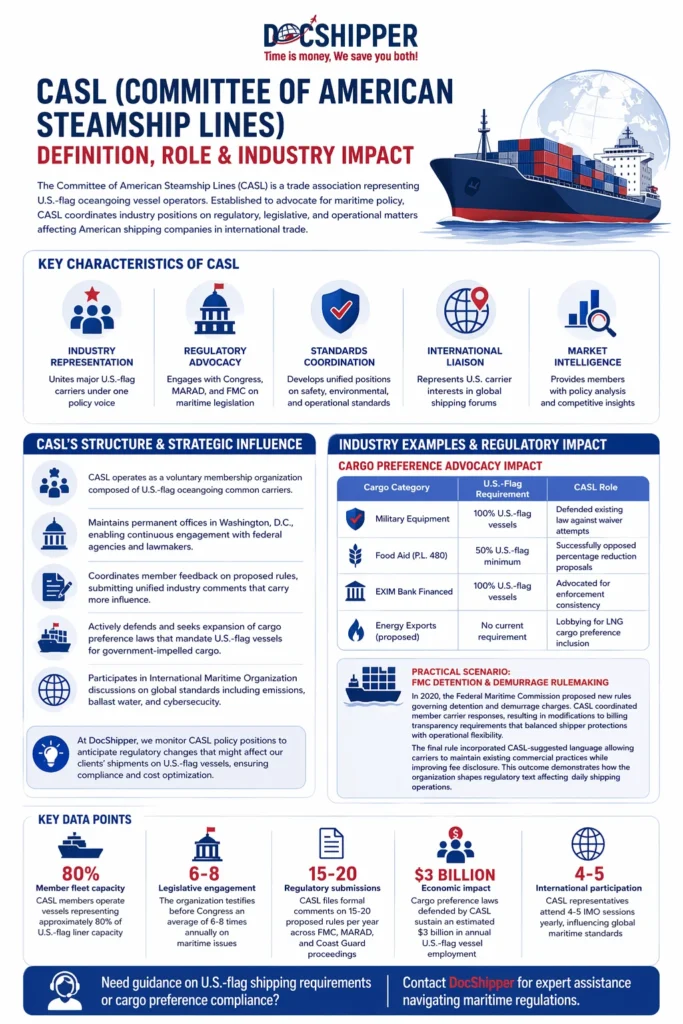
The Committee of American Steamship Lines (CASL) is a trade association representing U.S.-flag oceangoing vessel operators. Established to advocate for maritime policy, CASL coordinates industry positions on regulatory, legislative, and operational matters affecting American shipping companies in international trade.
Introduction
In the complex world of maritime logistics, many importers and exporters overlook the powerful industry bodies shaping the rules they operate under. The Committee of American Steamship Lines plays a critical behind-the-scenes role in U.S. maritime policy.
Understanding CASL matters because its advocacy directly influences freight rates, vessel routing regulations, and compliance requirements for cargo moving on American-flagged vessels. For companies engaged in U.S. import/export, CASL’s positions can affect shipping costs and service availability.
Key characteristics of CASL include:
- Industry representation: Unites major U.S.-flag carriers under one policy voice
- Regulatory advocacy: Engages with Congress, MARAD, and FMC on maritime legislation
- Standards coordination: Develops unified positions on safety, environmental, and operational standards
- International liaison: Represents U.S. carrier interests in global shipping forums
- Market intelligence: Provides members with policy analysis and competitive insights
CASL’s Structure & Strategic Influence
CASL operates as a voluntary membership organization composed of U.S.-flag oceangoing common carriers. Unlike broader maritime associations, CASL focuses specifically on liner shipping operations and policy issues affecting scheduled cargo services.
The organization’s governance structure includes executive leadership drawn from member companies, ensuring decisions reflect operational realities. CASL maintains permanent offices in Washington, D.C., enabling continuous engagement with federal agencies and lawmakers.
A core function involves regulatory coordination. When the Federal Maritime Commission proposes new rules affecting carrier operations, CASL consolidates member feedback into unified industry comments. This collective approach amplifies influence compared to individual company submissions.
CASL’s legislative advocacy extends to cargo preference laws, which mandate that certain government-impelled cargoes travel on U.S.-flag vessels. The organization actively defends these provisions while seeking their expansion to new cargo categories. According to the U.S. Maritime Administration, cargo preference sustains significant portions of the U.S.-flag fleet.
The association also addresses international maritime policy. CASL participates in discussions at the International Maritime Organization, ensuring U.S. carrier perspectives inform global shipping standards. This includes positions on emission regulations, ballast water management, and cybersecurity protocols.
At DocShipper, we monitor CASL policy positions to anticipate regulatory changes that might affect our clients’ shipments on U.S.-flag vessels, ensuring compliance and cost optimization.
Industry Examples & Regulatory Impact
CASL’s influence becomes tangible through specific policy outcomes and industry scenarios. Understanding these examples clarifies how the organization shapes practical shipping operations.
Cargo Preference Advocacy Impact
| Cargo Category | U.S.-Flag Requirement | CASL Role |
|---|---|---|
| Military Equipment | 100% U.S.-flag vessels | Defended existing law against waiver attempts |
| Food Aid (P.L. 480) | 50% U.S.-flag minimum | Successfully opposed percentage reduction proposals |
| EXIM Bank Financed | 100% U.S.-flag vessels | Advocated for enforcement consistency |
| Energy Exports (proposed) | No current requirement | Lobbying for LNG cargo preference inclusion |
Practical Scenario: FMC Detention & Demurrage Rulemaking
In 2020, the Federal Maritime Commission proposed new rules governing detention and demurrage charges. CASL coordinated member carrier responses, resulting in modifications to billing transparency requirements that balanced shipper protections with operational flexibility.
The final rule incorporated CASL-suggested language allowing carriers to maintain existing commercial practices while improving fee disclosure. This outcome demonstrates how the organization shapes regulatory text affecting daily shipping operations.
Key Data Points
- Member fleet capacity: CASL members operate vessels representing approximately 80% of U.S.-flag liner capacity
- Legislative engagement: The organization testifies before Congress an average of 6-8 times annually on maritime issues
- Regulatory submissions: CASL files formal comments on 15-20 proposed rules per year across FMC, MARAD, and Coast Guard proceedings
- Economic impact: Cargo preference laws defended by CASL sustain an estimated $3 billion in annual U.S.-flag vessel employment
- International participation: CASL representatives attend 4-5 IMO sessions yearly, influencing global maritime standards
Conclusion
The Committee of American Steamship Lines serves as the primary policy voice for U.S.-flag oceangoing carriers, directly shaping the regulatory environment for international maritime commerce. Its advocacy influences cargo routing requirements, operational costs, and compliance obligations for importers and exporters utilizing American vessels.
Need guidance on U.S.-flag shipping requirements or cargo preference compliance? Contact DocShipper for expert assistance navigating maritime regulations.
📚 Quiz
Test Your Knowledge: CASL (Committee of American Steamship Lines)
Q1 — What is the primary purpose of the Committee of American Steamship Lines (CASL)?
Q2 — A foreign-flag carrier with a U.S. corporate parent company wants to join CASL to benefit from its policy advocacy. Is this possible?
Q3 — A shipper needs to transport U.S. government food aid (P.L. 480 cargo) internationally. How does CASL's advocacy directly affect this shipment?
🎯 Your Result
📞 Free Quote in 24hFAQ | CASL (Committee of American Steamship Lines): Definition, Role & Industry Impact
Membership is limited to U.S.-flag oceangoing common carriers operating scheduled liner services. Companies must maintain vessels documented under U.S. registry and engage in international cargo transportation to qualify for membership.
Unlike broader groups like the American Maritime Partnership, CASL focuses exclusively on liner shipping policy rather than the entire maritime sector. It represents oceangoing carriers specifically, not domestic vessel operators or shipbuilders.
No. CASL does not engage in rate-setting activities, which would violate antitrust laws. The organization focuses solely on policy advocacy, regulatory coordination, and industry representation on non-commercial matters.
CASL positions on cargo preference laws can expand or maintain requirements for U.S.-flag vessel usage, potentially affecting routing options and freight costs for certain government-impelled or financed cargoes.
CASL generally supports environmental standards that apply uniformly across international shipping while advocating for implementation timelines that allow fleet modernization. The organization engages on IMO emission reduction strategies and fuel transition policies.
No. Membership is restricted to carriers operating U.S.-flag vessels. Foreign-flag operators, even those with U.S. corporate parents, do not qualify for CASL membership due to the organization's focus on American maritime interests.
CASL regularly submits comments on proposed FMC regulations, participates in commission hearings, and provides industry perspective on enforcement actions. The organization serves as a liaison between carriers and the regulatory agency.
While CASL focuses on international oceangoing trade, it supports Jones Act cabotage protections as part of broader U.S. maritime policy. The organization coordinates with domestic shipping advocates on legislative defense efforts.
CASL primarily produces policy analysis for members and government stakeholders rather than public market reports. Some testimony and regulatory filings become publicly available through government archives.
The organization operates through member dues assessed based on fleet size and operational scale. CASL does not receive government funding, maintaining independence in its advocacy positions.
CASL advocates for federal investment in port modernization and channel deepening projects that enhance U.S.-flag carrier competitiveness. The organization supports Harbor Maintenance Trust Fund appropriations and infrastructure legislation benefiting maritime commerce.
No. CASL is a trade association, not a shipping service provider. Shippers seeking U.S.-flag carrier services should contact member companies directly or work with freight forwarders specializing in American vessel routing.
Need Help with
Logistics or Sourcing ?
First, we secure the right products from the right suppliers at the right price by managing the sourcing process from start to finish. Then, we simplify your shipping experience - from pickup to final delivery - ensuring any product, anywhere, is delivered at highly competitive prices.


Fill the Form
Prefer email? Send us your inquiry, and we’ll get back to you as soon as possible.
Contact us




