


In short ⚡
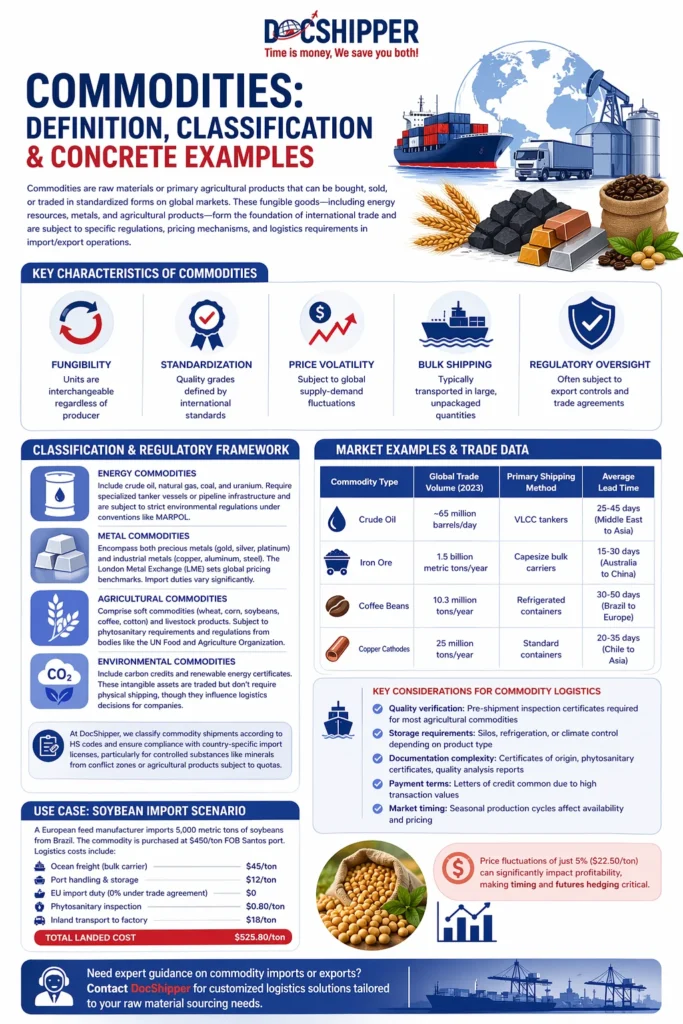
Commodities are raw materials or primary agricultural products that can be bought, sold, or traded in standardized forms on global markets. These fungible goods—including energy resources, metals, and agricultural products—form the foundation of international trade and are subject to specific regulations, pricing mechanisms, and logistics requirements in import/export operations.
Introduction
Many businesses struggle to understand how commodities differ from manufactured goods when planning international shipments. This distinction directly impacts customs classification, pricing volatility, and logistics strategies.
In global supply chains, commodities represent the upstream materials that feed manufacturing processes worldwide. Their standardized nature allows for futures trading, but also creates unique challenges for freight forwarding and compliance.
Key characteristics of commodities in international trade:
- Fungibility: Units are interchangeable regardless of producer
- Standardization: Quality grades defined by international standards
- Price volatility: Subject to global supply-demand fluctuations
- Bulk shipping: Typically transported in large, unpackaged quantities
- Regulatory oversight: Often subject to export controls and trade agreements
Classification & Regulatory Framework
Commodities are categorized into four primary groups that determine their handling requirements and regulatory treatment in international logistics.
Energy commodities include crude oil, natural gas, coal, and uranium. These products require specialized tanker vessels or pipeline infrastructure and are subject to strict environmental regulations under conventions like MARPOL.
Metal commodities encompass both precious metals (gold, silver, platinum) and industrial metals (copper, aluminum, steel). The London Metal Exchange (LME) sets global pricing benchmarks. Import duties vary significantly—the EU applies zero tariffs on many raw metals but higher rates on processed forms.
Agricultural commodities comprise soft commodities (wheat, corn, soybeans, coffee, cotton) and livestock products. These face phytosanitary requirements and must comply with regulations from bodies like the UN Food and Agriculture Organization. Perishability adds time-sensitive logistics constraints.
Environmental commodities represent a newer category including carbon credits and renewable energy certificates. These intangible assets are traded but don’t require physical shipping, though they influence logistics decisions for companies managing carbon footprints.
At DocShipper, we classify commodity shipments according to HS codes and ensure compliance with country-specific import licenses, particularly for controlled substances like minerals from conflict zones or agricultural products subject to quotas.
Market Examples & Trade Data
Understanding commodity trade flows requires examining real-world scenarios and market dynamics that impact shipping decisions.
| Commodity Type | Global Trade Volume (2023) | Primary Shipping Method | Average Lead Time |
|---|---|---|---|
| Crude Oil | ~65 million barrels/day | VLCC tankers | 25-45 days (Middle East to Asia) |
| Iron Ore | 1.5 billion metric tons/year | Capesize bulk carriers | 15-30 days (Australia to China) |
| Coffee Beans | 10.3 million tons/year | Refrigerated containers | 30-50 days (Brazil to Europe) |
| Copper Cathodes | 25 million tons/year | Standard containers | 20-35 days (Chile to Asia) |
Use Case: Soybean Import Scenario
A European feed manufacturer imports 5,000 metric tons of soybeans from Brazil. The commodity is purchased at $450/ton FOB Santos port. Logistics costs include:
- Ocean freight (bulk carrier): $45/ton
- Port handling & storage: $12/ton
- EU import duty (0% under trade agreement): $0
- Phytosanitary inspection: $0.80/ton
- Inland transport to factory: $18/ton
Total landed cost: $525.80/ton. Price fluctuations of just 5% ($22.50/ton) can significantly impact profitability, making timing and futures hedging critical.
Key considerations for commodity logistics:
- Quality verification: Pre-shipment inspection certificates required for most agricultural commodities
- Storage requirements: Silos, refrigeration, or climate control depending on product type
- Documentation complexity: Certificates of origin, phytosanitary certificates, quality analysis reports
- Payment terms: Letters of credit common due to high transaction values
- Market timing: Seasonal production cycles affect availability and pricing
Conclusion
Commodities form the essential building blocks of global trade, requiring specialized logistics knowledge to navigate their unique regulatory, pricing, and handling requirements. Understanding classification systems and market dynamics enables businesses to optimize supply chains and manage risk effectively.
Need expert guidance on commodity imports or exports? Contact DocShipper for customized logistics solutions tailored to your raw material sourcing needs.
📚 Quiz
Test Your Knowledge: Commodities
Q1 — Which of the following best defines a commodity in international trade?
Q2 — A buyer claims that all commodities must be traded on an official exchange (like the LME or CME). Is this correct?
Q3 — A European manufacturer imports 5,000 metric tons of soybeans from Brazil. Which document is specifically required to verify the product's quality at the point of origin and prevent disputes?
🎯 Your Result
📞 Free Quote in 24hFAQ | Commodities: Definition, Classification & Concrete Examples
Commodities are classified as raw or minimally processed materials with standardized grades, while regular products undergo manufacturing transformation. This affects HS code assignment, duty rates, and documentation requirements at customs.
No. While major commodities like oil, gold, and wheat are exchange-traded, many regional or specialty commodities are sold through direct contracts between producers and buyers without exchange involvement.
Price volatility influences inventory strategies and shipping timing. When prices are high, buyers may expedite shipments; when low, they might opt for slower, cheaper transport or delay purchases entirely.
Commodity cargo insurance must cover price fluctuations, contamination risks, weight loss during transit, and specific perils like spontaneous combustion for certain agricultural products. Marine cargo policies typically use Institute Cargo Clauses.
Most hard commodities ship in bulk without individual packaging. Soft commodities may require bags, while liquids use tankers. Packaging requirements depend on the commodity type and destination country regulations.
Pre-shipment inspection certificates from independent surveyors establish quality at origin. Disputes are typically resolved through arbitration clauses in contracts, often referencing standards from organizations like GAFTA for grains or FOSFA for oils.
Spot trading involves immediate delivery and payment, while futures contracts lock in prices for delivery at a specified future date. Futures allow hedging against price volatility but don't always result in physical delivery.
Yes. Many countries restrict exports of strategic commodities like rare earth minerals, certain agricultural products during shortages, or materials that could be used for weapons production. Export licenses are often required.
Origin determines applicable tariff rates under free trade agreements or preferential schemes. Certificates of origin must prove the commodity was produced in the claimed country to benefit from reduced duties.
Brokers connect buyers and sellers, negotiate contracts, and sometimes arrange logistics. They don't typically handle physical goods but facilitate transactions and may coordinate with freight forwarders for shipment execution.
While uncommon due to cost, high-value commodities like precious metals, gemstones, or urgent pharmaceutical raw materials may ship by air. Most bulk commodities use ocean or rail transport for economic reasons.
Regulations like the EU's Carbon Border Adjustment Mechanism impose costs on carbon-intensive commodity imports. Sustainability certifications (like Rainforest Alliance for coffee) increasingly influence buyer decisions and market access.
Need Help with
Logistics or Sourcing ?
First, we secure the right products from the right suppliers at the right price by managing the sourcing process from start to finish. Then, we simplify your shipping experience - from pickup to final delivery - ensuring any product, anywhere, is delivered at highly competitive prices.


Fill the Form
Prefer email? Send us your inquiry, and we’ll get back to you as soon as possible.
Contact us




