


In short ⚡
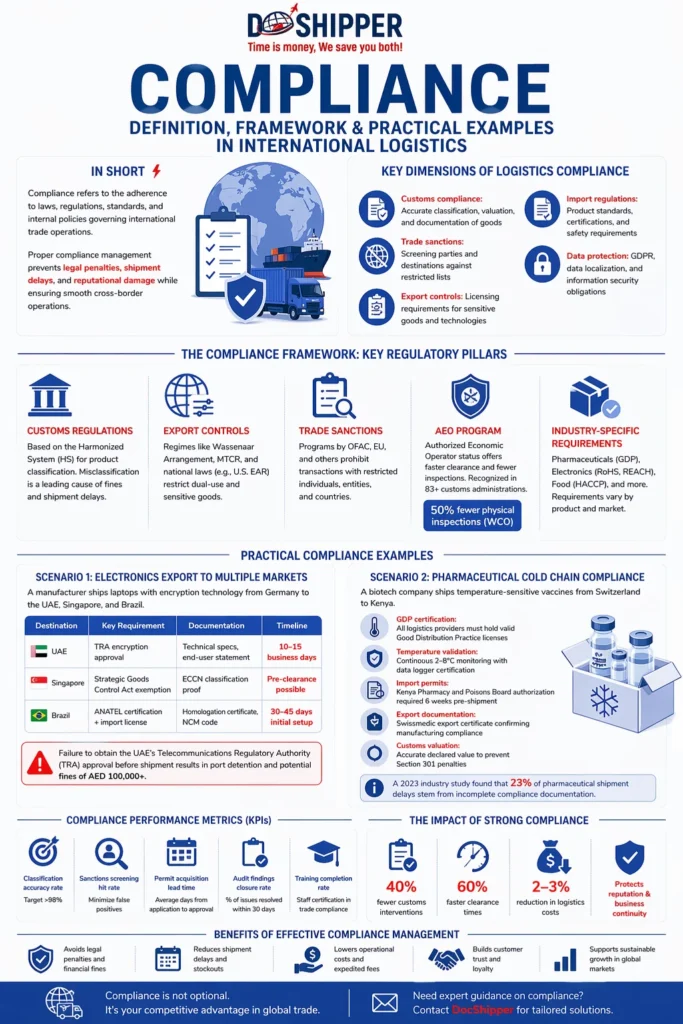
Compliance refers to the adherence to laws, regulations, standards, and internal policies governing international trade operations. In logistics, it encompasses customs regulations, export controls, sanctions screening, data protection laws, and industry-specific requirements. Proper compliance management prevents legal penalties, shipment delays, and reputational damage while ensuring smooth cross-border operations.
Introduction
Every year, companies face millions in fines due to compliance failures in international shipping. A single overlooked regulation can trigger customs seizures, financial penalties, or even criminal prosecution. In an era of tightening global trade controls, understanding compliance is no longer optional—it’s fundamental to operational continuity.
Compliance in logistics extends far beyond filling out paperwork correctly. It represents a comprehensive approach to managing legal, ethical, and operational risks across the entire supply chain. From export licensing to data privacy, from sanctions screening to product safety standards, compliance touches every aspect of international trade.
Key dimensions of logistics compliance include:
- Customs compliance: Accurate classification, valuation, and documentation of goods
- Trade sanctions: Screening parties and destinations against restricted lists
- Export controls: Licensing requirements for sensitive goods and technologies
- Import regulations: Product standards, certifications, and safety requirements
- Data protection: GDPR, data localization, and information security obligations
Compliance Framework & Regulatory Architecture
International trade compliance operates within a multi-layered regulatory ecosystem. Organizations must navigate overlapping jurisdictions, each with distinct enforcement mechanisms and penalty structures.
The World Customs Organization (WCO) provides the foundational framework through the Harmonized System (HS) for product classification. This six-digit code system, extended to 8-10 digits by individual countries, determines applicable duties, permits, and restrictions. Misclassification remains one of the most common compliance violations, often resulting from inadequate technical knowledge or deliberate manipulation.
Export control regimes restrict the transfer of dual-use goods, military items, and sensitive technologies. The Wassenaar Arrangement, the Missile Technology Control Regime (MTCR), and national frameworks like the U.S. Export Administration Regulations (EAR) create licensing requirements. At DocShipper, we systematically verify export control classifications before shipment to prevent regulatory violations.
Sanctions programs administered by bodies like the U.S. Office of Foreign Assets Control (OFAC) and the EU prohibit transactions with designated individuals, entities, and countries. Real-time screening against consolidated lists is mandatory. Violations carry severe penalties—OFAC fines can reach millions per transaction.
The Authorized Economic Operator (AEO) program, recognized across 83 customs administrations through mutual recognition agreements, offers expedited clearance for compliant traders. Certification requires demonstrating robust internal controls, financial solvency, and a clean compliance history. According to the World Customs Organization, AEO-certified companies experience 50% fewer physical inspections.
Product-specific regulations vary dramatically by sector. Pharmaceuticals face Good Distribution Practice (GDP) requirements. Electronics must meet RoHS and REACH standards. Food products require HACCP certification and phytosanitary documentation. Each regulatory layer adds complexity to the compliance matrix.
Practical Implementation & Risk Scenarios
Effective compliance transforms abstract regulations into operational procedures. The following scenarios illustrate common challenges and their solutions.
Scenario 1: Electronics Export to Multiple Markets
A manufacturer ships laptops containing encryption technology from Germany to customers in the UAE, Singapore, and Brazil. Each destination presents distinct compliance requirements:
| Destination | Key Requirement | Documentation | Timeline |
|---|---|---|---|
| UAE | TRA encryption approval | Technical specs, end-user statement | 10-15 business days |
| Singapore | Strategic Goods Control Act exemption | ECCN classification proof | Pre-clearance possible |
| Brazil | ANATEL certification + import license | Homologation certificate, NCM code | 30-45 days initial setup |
Failure to obtain the UAE’s Telecommunications Regulatory Authority (TRA) approval before shipment results in port detention and potential fines of AED 100,000+. DocShipper’s compliance team verifies all encryption-related permits before booking shipments to regulated markets.
Scenario 2: Pharmaceutical Cold Chain Compliance
A biotech company ships temperature-sensitive vaccines from Switzerland to Kenya. Compliance requirements span multiple domains:
- GDP certification: All logistics providers must hold valid Good Distribution Practice licenses
- Temperature validation: Continuous 2-8°C monitoring with data logger certification Import permits: Kenya Pharmacy and Poisons Board authorization required 6 weeks pre-shipment
- Export documentation: Swissmedic export certificate confirming manufacturing compliance
- Customs valuation: Accurate declared value to prevent Section 301 penalties
A 2023 industry study found that 23% of pharmaceutical shipment delays stem from incomplete compliance documentation, not logistics failures. Proactive permit acquisition and validated cold chain partners reduce this risk dramatically.
Data-Driven Compliance Metrics
Leading organizations track compliance performance through quantifiable KPIs:
- Classification accuracy rate: Target >98% to minimize post-clearance audits
- Sanctions screening hit rate: Measure false positives vs. true matches
- Permit acquisition lead time: Average days from application to approval
- Audit findings closure rate: Percentage of issues resolved within 30 days
- Training completion rate: Staff certification in trade compliance fundamentals
Companies with mature compliance programs report 40% fewer customs interventions and 60% faster clearance times compared to reactive approaches.
Conclusion
Compliance in international logistics represents the intersection of legal obligation, operational efficiency, and strategic risk management. Organizations that embed compliance into their supply chain DNA gain competitive advantages through faster clearances, reduced costs, and enhanced reputation.
Need expert guidance on navigating complex compliance requirements? Contact DocShipper for tailored solutions that protect your operations while accelerating your global trade.
📚 Quiz
Test Your Knowledge: Compliance in International Logistics
Q1 — What does "compliance" refer to in the context of international logistics?
Q2 — A company believes that "trade compliance" and "customs compliance" are the same thing. Is this correct?
Q3 — A biotech company ships vaccines from Switzerland to Kenya without first obtaining the Kenya Pharmacy and Poisons Board authorization. What is the most likely outcome?
🎯 Your Result
📞 Free Quote in 24hFAQ | Compliance: Definition, Framework & Practical Examples in International Logistics
Customs compliance focuses on accurate documentation, classification, and valuation for border clearance. Trade compliance encompasses broader regulations including export controls, sanctions, product standards, and licensing requirements across the entire supply chain.
Screening lists should be updated in real-time or at minimum daily. Sanctions lists change frequently—OFAC updates its Specially Designated Nationals list multiple times weekly. Automated screening systems with continuous updates are essential for compliance.
Penalties vary by jurisdiction and violation severity. U.S. customs violations can result in fines up to the domestic value of goods plus penalties. OFAC sanctions violations carry fines up to $20 million or twice the transaction value. Criminal prosecution is possible for willful violations.
AEO certification benefits depend on shipping volume and destination markets. Companies with regular shipments to multiple countries gain significant advantages through reduced inspections and faster clearance. The initial audit preparation requires 6-12 months and dedicated resources.
Check your product's Export Control Classification Number (ECCN) against your destination country. Items on the Commerce Control List may require Bureau of Industry and Security (BIS) licenses. Dual-use goods, military items, and certain technologies face additional restrictions.
FDA-regulated imports require Prior Notice submission, accurate product codes, manufacturer registration, and specific certifications depending on product category. Food products need FSVP compliance, medical devices require establishment registration, and drugs need NDC numbers.
Compliance software automates screening, classification suggestions, and documentation workflows but cannot replace human judgment. Complex scenarios, regulatory interpretation, and strategic decision-making require experienced trade compliance professionals supported by technology tools.
Post-Brexit trade requires customs declarations, Rules of Origin documentation, and separate regulatory compliance for both markets. UK businesses need EORI numbers for both territories. Mutual recognition of standards ended, requiring separate conformity assessments for many products.
Compliance audits review trade documentation, internal controls, and adherence to regulations. Preparation involves organizing import/export records, classification rationales, licensing documentation, and screening logs. Conduct internal pre-audits to identify gaps before official reviews.
FTAs reduce or eliminate duties but add origin certification requirements. Exporters must prove products meet Rules of Origin through detailed documentation like certificates of origin, supplier declarations, and manufacturing records. Non-compliance results in duty recovery.
Effective programs include written policies, classification and valuation procedures, screening protocols, recordkeeping systems, regular training, internal audits, and corrective action processes. Senior management commitment and adequate resourcing are critical success factors.
Retention requirements vary by jurisdiction. U.S. Customs requires five years from entry date. Export control records must be kept five years from transaction date. Some countries require longer periods—check specific regulations for each market you operate in.
Need Help with
Logistics or Sourcing ?
First, we secure the right products from the right suppliers at the right price by managing the sourcing process from start to finish. Then, we simplify your shipping experience - from pickup to final delivery - ensuring any product, anywhere, is delivered at highly competitive prices.


Fill the Form
Prefer email? Send us your inquiry, and we’ll get back to you as soon as possible.
Contact us




