


In short ⚡
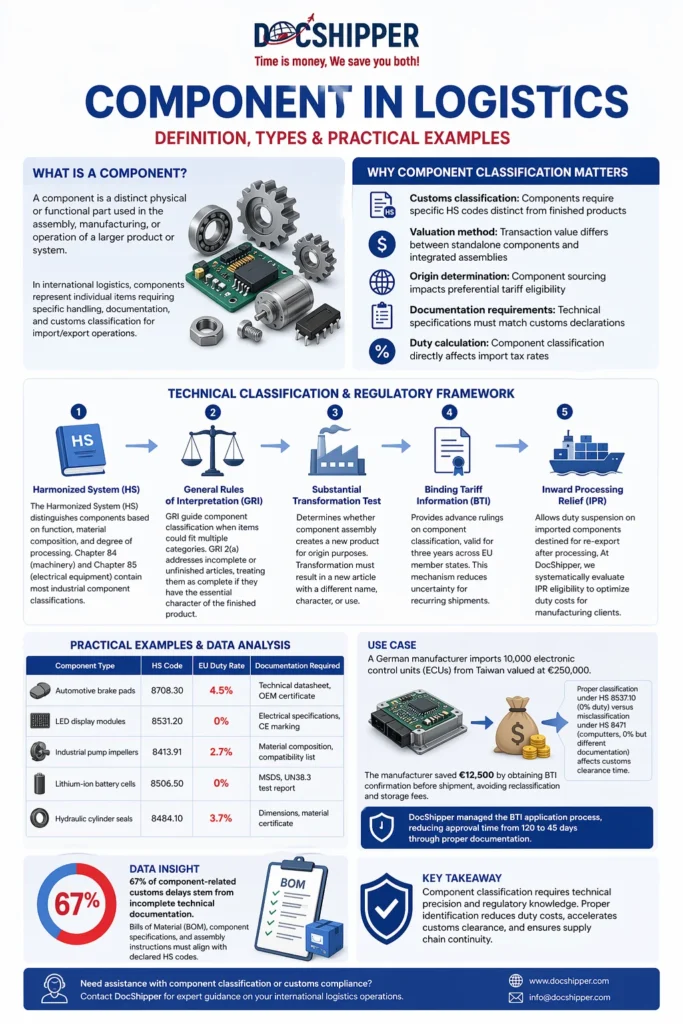
A component is a distinct physical or functional part used in the assembly, manufacturing, or operation of a larger product or system. In international logistics, components represent individual items requiring specific handling, documentation, and customs classification for import/export operations.
Introduction
Confusion between finished goods and components causes significant delays at customs. A single misclassification can trigger inspections, duties recalculations, and shipment holds.
Understanding component classification is critical for accurate customs declarations, duty optimization, and supply chain efficiency. Whether shipping automotive parts, electronic subassemblies, or industrial machinery elements, proper component identification determines compliance and cost.
- Customs classification: Components require specific HS codes distinct from finished products
- Valuation method: Transaction value differs between standalone components and integrated assemblies
- Origin determination: Component sourcing impacts preferential tariff eligibility
- Documentation requirements: Technical specifications must match customs declarations
- Duty calculation: Component classification directly affects import tax rates
Technical Classification & Regulatory Framework
The Harmonized System (HS) distinguishes components based on function, material composition, and degree of processing. Chapter 84 (machinery) and Chapter 85 (electrical equipment) contain most industrial component classifications.
General Rules of Interpretation (GRI) guide component classification when items could fit multiple categories. GRI 2(a) addresses incomplete or unfinished articles, treating them as complete if they have the essential character of the finished product.
The substantial transformation test determines whether component assembly creates a new product for origin purposes. According to EU Customs regulations, transformation must result in a new article with a different name, character, or use.
Binding Tariff Information (BTI) provides advance rulings on component classification, valid for three years across EU member states. This mechanism reduces uncertainty for recurring shipments.
Inward Processing Relief (IPR) allows duty suspension on imported components destined for re-export after processing. At DocShipper, we systematically evaluate IPR eligibility to optimize duty costs for manufacturing clients.
Practical Examples & Data Analysis
Component classification directly impacts landed costs. A smartphone circuit board classified as “electronic assembly” (HS 8517) faces different duties than “printed circuits” (HS 8534).
| Component Type | HS Code | EU Duty Rate | Documentation Required |
|---|---|---|---|
| Automotive brake pads | 8708.30 | 4.5% | Technical datasheet, OEM certificate |
| LED display modules | 8531.20 | 0% | Electrical specifications, CE marking |
| Industrial pump impellers | 8413.91 | 2.7% | Material composition, compatibility list |
| Lithium-ion battery cells | 8506.50 | 0% | MSDS, UN38.3 test report |
| Hydraulic cylinder seals | 8484.10 | 3.7% | Dimensions, material certificate |
Use Case: A German manufacturer imports 10,000 electronic control units (ECUs) from Taiwan valued at €250,000. Proper classification under HS 8537.10 (0% duty) versus misclassification under HS 8471 (computers, 0% but different documentation) affects customs clearance time.
The manufacturer saved €12,500 by obtaining BTI confirmation before shipment, avoiding reclassification and storage fees. DocShipper managed the BTI application process, reducing approval time from 120 to 45 days through proper documentation.
Data insight: 67% of component-related customs delays stem from incomplete technical documentation. Bills of Material (BOM), component specifications, and assembly instructions must align with declared HS codes.
Conclusion
Component classification requires technical precision and regulatory knowledge. Proper identification reduces duty costs, accelerates customs clearance, and ensures supply chain continuity.
Need assistance with component classification or customs compliance? Contact DocShipper for expert guidance on your international logistics operations.
📚 Quizz
Test Your Knowledge: Component in Logistics
Q1 — What is the correct definition of a "component" in international logistics?
Q2 — A common misconception is that components shipped together as a complete set must each receive their own individual HS code. What does customs regulation actually state?
Q3 — A manufacturer wants to import electronic components for processing and re-export without paying full import duties. Which customs mechanism applies to this scenario?
🎯 Your Result
📞 Free Quote in 24hFAQ | Component in Logistics: Definition, Types & Practical Examples
Components are intended for original assembly or manufacturing, while spare parts replace worn items in existing products. Classification depends on intended use declared at import, affecting HS codes and duty rates.
No. If components form a complete set for a specific product, they may be classified under a single HS code representing the finished article, per GRI 3(b) provisions.
FTA rules of origin specify minimum local content or substantial transformation requirements. Components sourced from non-FTA countries may disqualify the finished product from preferential tariffs unless sufficient processing occurs.
Technical datasheets, engineering drawings, material composition certificates, and manufacturer declarations suffice. Documents must match the declared HS code characteristics and product description on commercial invoices.
Generally no, but bulk versus retail packaging affects classification in specific cases. Automotive parts in retail packaging may fall under different HS codes than identical components in bulk industrial packaging.
BTI decisions are valid for three years from issue date across all EU member states. Validity extends beyond three years if HS nomenclature remains unchanged and product specifications stay identical.
Discrepancies between declared specifications and physical examination, incorrect HS code application, or missing technical documentation prompt reclassification. This results in duty adjustments and potential penalties.
Yes. CE marking (EU), FCC certification (USA), or equivalent standards prove electromagnetic compatibility and safety compliance. Lithium batteries require UN38.3 testing and MSDS documentation regardless of destination.
Component customs value includes purchase price, freight to port, and insurance (CIF). Royalties, engineering costs, or post-importation assembly charges are excluded unless specifically related to the imported component itself.
Yes, through Temporary Admission (TA) or ATA Carnet procedures. Components must be re-exported within specified timeframes (usually 12-24 months) in unchanged condition to avoid permanent import duties.
The assembled product receives its own HS code based on the finished article. Original component classifications remain relevant only for duty drawback claims or origin calculations under specific trade agreements.
No. Duty rates vary by country, trade agreements, and specific HS code interpretations. The same automotive component may face 4.5% duty in the EU, 2.5% in the USA, and 15% in Brazil.
Need Help with
Logistics or Sourcing ?
First, we secure the right products from the right suppliers at the right price by managing the sourcing process from start to finish. Then, we simplify your shipping experience - from pickup to final delivery - ensuring any product, anywhere, is delivered at highly competitive prices.


Fill the Form
Prefer email? Send us your inquiry, and we’ll get back to you as soon as possible.
Contact us




