


In short ⚡
Consumer behavior refers to the study of how individuals, groups, and organizations select, purchase, use, and dispose of goods, services, ideas, or experiences to satisfy their needs and desires. In international logistics and trade, understanding consumer behavior patterns drives supply chain decisions, inventory management, and market entry strategies across borders.Introduction
Why do European consumers prefer eco-certified products while Asian markets prioritize price competitiveness? This fundamental question illustrates why consumer behavior analysis has become critical for international trade success.
In global logistics, misunderstanding consumer preferences leads to overstocked warehouses, costly returns, and failed market penetration. Companies shipping goods across borders must decode cultural nuances, purchasing triggers, and post-purchase satisfaction patterns.
- Cultural factors shape product perception and acceptance rates differently across regions
- Psychological triggers influence timing, quantity, and channel preferences for purchases
- Social influences determine brand loyalty and word-of-mouth impact in target markets
- Economic conditions affect price sensitivity and willingness to pay for imported goods
- Digital transformation has created new behavioral patterns in cross-border e-commerce
At DocShipper, we integrate consumer behavior insights into our logistics planning to optimize delivery timing, packaging choices, and inventory positioning for our clients’ international shipments.
Deep Dive & Expertise
Consumer behavior analysis in international trade operates through five interconnected dimensions that logistics professionals must master.
Cultural adaptation requirements vary dramatically across markets. High-context cultures (Japan, China) emphasize relationship-building and brand heritage, requiring longer market entry timelines. Low-context cultures (Germany, USA) respond to direct value propositions and functional benefits. This affects everything from product labeling to delivery communication protocols.
Decision-making processes differ structurally between markets. European consumers typically conduct extensive pre-purchase research (average 11 touchpoints before buying). Middle Eastern markets show higher impulse purchase rates but demand immediate availability. These patterns directly impact warehouse location strategies and stock rotation policies.
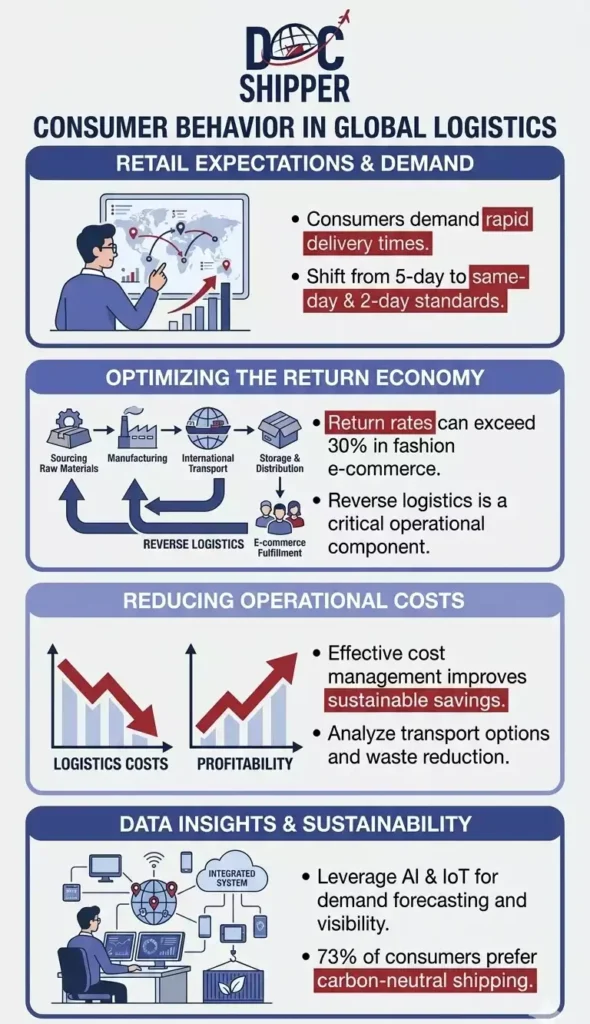
Post-purchase behavior creates significant logistical implications. Markets with high return rates (up to 30% in fashion e-commerce) require reverse logistics infrastructure. Customer service expectations vary: Nordic countries expect 24-hour response times, while Latin American markets tolerate 72-hour windows. According to Eurostat data, cross-border return costs average 15-20% of product value.
Payment preferences shape cash flow and risk management. Cash-on-delivery remains dominant in Southeast Asia (65% of transactions), requiring different carrier partnerships than credit-card markets. Digital wallet adoption in China (90% penetration) versus Europe (35%) affects transaction speed and customs documentation.
Sustainability consciousness now influences 73% of European purchasing decisions, according to EU consumer surveys. This drives demand for carbon-neutral shipping options, recyclable packaging, and supply chain transparency. DocShipper systematically incorporates eco-certification requirements into customs documentation to meet these evolving consumer expectations.
Concrete Examples & Data
Real-world consumer behavior patterns translate into measurable logistics adjustments across international markets.
Comparative Market Analysis
| Market | Purchase Trigger | Avg. Decision Time | Return Rate | Logistics Impact |
|---|---|---|---|---|
| Germany | Product specifications | 7-14 days | 18% | Detailed labeling required |
| UAE | Brand prestige | 2-3 days | 12% | Premium packaging essential |
| USA | Price comparison | 3-5 days | 25% | Fast shipping mandatory |
| Japan | Quality certification | 10-21 days | 8% | Flawless condition critical |
| Brazil | Social proof | 5-7 days | 22% | Influencer partnerships valued |
Use Case: Electronics Importer Adaptation
A European electronics distributor analyzed consumer behavior data before entering Asian markets:
- South Korea: Consumers expect same-day delivery in Seoul metro area (population 25M). Solution: Established 3 micro-fulfillment centers instead of 1 central warehouse. Cost increased 12% but sales velocity rose 340%.
- Indonesia: 78% prefer cash-on-delivery despite credit card ownership. Implementation: Partnered with local courier networks offering payment collection. Reduced cart abandonment from 65% to 23%.
- Singapore: Sustainability-conscious buyers (82% check carbon footprint). Action: Switched to sea freight with carbon offset certificates. Premium pricing accepted, margins improved 8%.
- India: Festival season drives 60% of annual sales (Diwali period). Strategy: Pre-positioned inventory 45 days early in bonded warehouses. Avoided stockouts that competitors faced.
- Thailand: Social commerce dominates (71% discover products via LINE/Facebook). Adjustment: Integrated inventory systems with social platforms for real-time availability updates.
These behavioral insights transformed logistics from cost center to competitive advantage. Understanding that Japanese consumers inspect packaging for damage before accepting delivery led to triple-layer protective wrapping—reducing claims by 89%.
Conclusion
Consumer behavior analysis transforms international logistics from reactive shipping to strategic market positioning. Companies that decode cultural preferences, purchasing patterns, and post-sale expectations gain measurable advantages in delivery performance, inventory efficiency, and customer retention across borders.
Need expert guidance on adapting your logistics strategy to consumer behavior insights? Contact DocShipper for tailored international trade solutions.
📚 Quiz
Test Your Knowledge: Consumer Behavior
1. What does "consumer behavior" refer to in the context of international trade?
2. A logistics manager assumes that a single warehouse strategy will work equally well in all Asian markets. Based on consumer behavior insights, is this assumption correct?
3. An importer is entering the Indonesian market and notices a 65% cart abandonment rate. According to consumer behavior data, what is the most likely cause and solution?
🎯 Your Result
📞 Free Quote in 24hFAQ | Consumer Behavior: Definition, Analysis & Concrete Examples in International Trade
Purchase urgency levels determine whether to use express customs brokerage (higher cost, 24-48h clearance) or standard processing (3-5 days). Markets expecting fast delivery justify premium clearance services to meet consumer expectations.
Packaging influences purchase decisions by 60-70% in visual-oriented cultures (Japan, France). Minimalist designs succeed in Scandinavia, while elaborate packaging drives sales in Middle Eastern luxury markets. Logistics must accommodate varying protection and presentation requirements.
High-return markets (fashion, electronics) require in-country return processing facilities to meet consumer expectations for quick refunds. Centralized European return hubs work for low-return categories but frustrate consumers in high-return segments.
Cultural norms around immediacy differ. Amazon Prime conditioned US consumers to expect 2-day delivery. Chinese consumers accustomed to same-day service reject 5-day timelines. Infrastructure maturity and competitive benchmarks set local expectations that logistics must meet.
Price-conscious markets (Southeast Asia, Eastern Europe) accept longer sea freight delivery times for lower product costs. Premium markets (Switzerland, UAE) demand air freight speed despite 300-500% higher logistics costs, which consumers absorb through pricing.
Purchase frequency, basket size, seasonal concentration, and replenishment patterns drive stock levels. Subscription-based purchasing (common in Nordics) enables lean inventory. Sporadic bulk buying (typical in Latin America) requires safety stock buffers.
Cash-on-delivery markets tie up capital until delivery completion (7-21 days). Credit card markets release funds within 2-3 days. This 18-day difference affects working capital requirements and carrier selection—COD carriers charge 3-8% collection fees.
Social media sharing culture in markets like South Korea and UAE makes unboxing a marketing channel. Premium packaging generates user-generated content worth 5-10x the packaging investment. Logistics must preserve presentation quality through transit.
Low-trust markets require local presence signals—domestic phone numbers, in-country return addresses, local payment processors. High-trust markets (Germany, Netherlands) accept international sellers with proper certification. This determines warehouse and registration requirements.
Mobile-first markets (China 85%, India 78%) expect mobile-optimized tracking, delivery rescheduling, and communication. Desktop-oriented markets tolerate email updates. This affects technology investment in customer-facing logistics platforms.
Eco-conscious consumers in Northern Europe, Canada, and Australia increasingly select carbon-neutral shipping options despite 8-15% cost premiums. Markets with lower environmental awareness prioritize speed and cost over sustainability credentials.
Direct communication cultures (USA, Australia) expect immediate phone support. Indirect cultures (Japan, Thailand) prefer written communication with formal apologies. Logistics providers must staff support channels matching cultural communication preferences to maintain satisfaction scores.
Need Help with
Logistics or Sourcing ?
First, we secure the right products from the right suppliers at the right price by managing the sourcing process from start to finish. Then, we simplify your shipping experience - from pickup to final delivery - ensuring any product, anywhere, is delivered at highly competitive prices.


Fill the Form
Prefer email? Send us your inquiry, and we’ll get back to you as soon as possible.
Contact us




