


In short ⚡
Customs clearance is the mandatory administrative procedure allowing goods to cross international borders legally. It involves submitting documentation, paying duties and taxes, and obtaining authorization from customs authorities before merchandise can enter or exit a country's territory.
Introduction
Many importers underestimate customs clearance complexity until their shipment sits blocked at the port for weeks. This critical step determines whether your goods arrive on time or face costly delays and penalties.
In international logistics, customs clearance represents the gateway between countries. Every cross-border shipment must pass through this regulatory checkpoint, making it fundamental to global trade operations.
- Regulatory compliance: Ensures adherence to import/export laws and trade agreements
- Revenue collection: Governments collect duties, taxes, and fees on imported goods
- Security screening: Prevents prohibited items, counterfeits, and dangerous materials from entering
- Trade statistics: Provides data for economic analysis and policy development
- Product standards: Verifies goods meet safety, health, and quality requirements
Understanding Customs Clearance Mechanisms
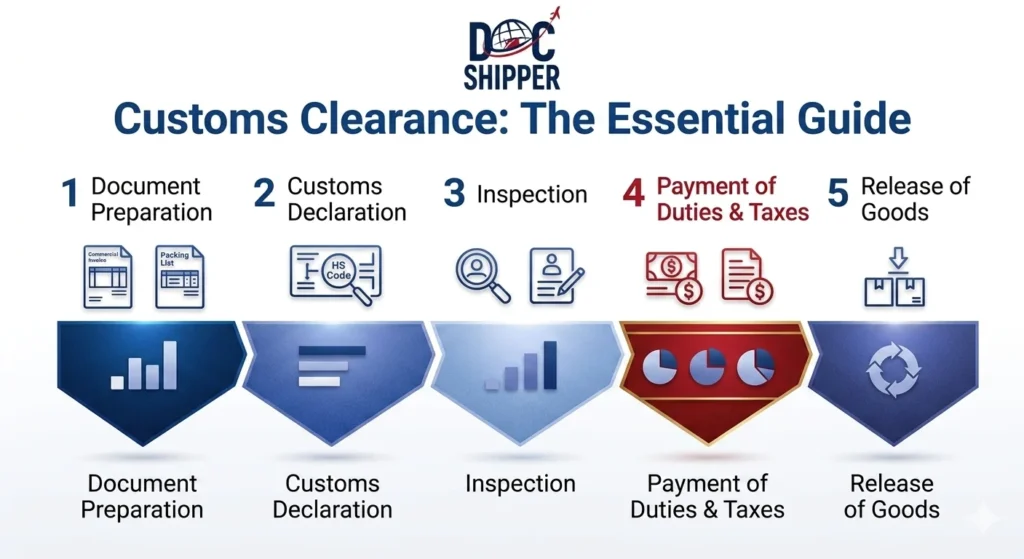
The customs clearance process begins when goods arrive at the border. The importer or their customs broker must submit a customs declaration containing detailed information about the shipment’s contents, value, origin, and classification.
HS Code classification forms the foundation of customs processing. This internationally standardized system assigns a 6-to-10-digit code to every product, determining applicable duty rates and regulatory requirements. Misclassification represents one of the most common causes of clearance delays.
Authorities calculate duties using three primary methods: ad valorem (percentage of value), specific (fixed amount per unit), or compound (combination of both). The customs value typically follows the transaction value method defined by the WTO Valuation Agreement, as detailed by the World Trade Organization.
Risk assessment systems determine inspection intensity. Modern customs administrations use automated selectivity algorithms that flag high-risk shipments for physical examination while allowing low-risk cargo to clear rapidly through green channels.
At DocShipper, we handle customs declarations in over 50 countries, ensuring accurate classification and documentation to minimize examination rates and accelerate clearance times for our clients.
The final step involves release authorization. Once customs verifies documentation, collects payments, and completes any required inspections, they issue a release notice allowing the cargo to proceed to its destination or enter the country’s commerce stream.
Practical Examples & Data
Understanding customs clearance becomes clearer through real-world scenarios. Consider a European electronics importer receiving smartphones from China valued at €100,000.
| Cost Component | Calculation | Amount (€) |
|---|---|---|
| CIF Value | Goods + Insurance + Freight | 100,000 |
| Customs Duty | 2.5% of CIF (HS 8517.12) | 2,500 |
| VAT Base | CIF + Duty | 102,500 |
| VAT | 20% of VAT Base | 20,500 |
| Total Import Cost | — | 123,000 |
This example demonstrates how landed cost exceeds the purchase price by 23%. Importers must budget for these additional expenses to maintain profitability.
Clearance timeframes vary significantly by country and product category. According to World Bank data, average customs clearance times range from 12 hours in Singapore to over 10 days in some developing nations. DocShipper’s experience shows that proper documentation preparation reduces clearance time by 40-60% compared to unprepared shipments.
A pharmaceutical company importing medical devices faces additional complexity. Beyond standard customs procedures, they must obtain pre-market approval from health authorities, submit certificates of conformity, and demonstrate compliance with medical device regulations—adding 2-4 weeks to the process.
Common clearance scenarios include:
- Standard declaration: 85% of shipments, processed within 24-48 hours with complete documentation
- Physical inspection: 5-15% of shipments, adding 2-7 days depending on cargo volume
- Document verification: 20-30% of shipments, requiring additional proof of origin or value
- Specialized clearance: Controlled goods requiring permits (weapons, chemicals, food) taking 1-6 weeks
- Temporary admission: Exhibition goods or samples under ATA Carnet, cleared same-day with proper documentation
Conclusion
Customs clearance remains the critical control point in international trade, directly impacting delivery schedules, costs, and compliance. Mastering its requirements transforms potential obstacles into competitive advantages.
Need expert assistance navigating customs procedures? Contact DocShipper for comprehensive customs brokerage services across global markets.
📚 Quiz
Test Your Knowledge: Customs Clearance
Q1 — What is the primary purpose of customs clearance in international trade?
Q2 — A shipment is flagged for physical inspection by customs. What is the most likely cause of this?
Q3 — A European importer purchases smartphones from China at a CIF value of €100,000. The applicable customs duty rate is 2.5% and VAT is 20%. What is the correct total landed cost?
🎯 Your Result
📞 Free Quote in 24hFAQ | Customs Clearance: Definition, Process & Practical Examples
Essential documents include commercial invoice, packing list, bill of lading or airway bill, certificate of origin, and import license if applicable. Specific products may require additional certificates like phytosanitary or health certificates.
Standard clearance ranges from 1-5 business days with complete documentation. Physical inspections add 2-7 days, while specialized goods requiring permits may take several weeks depending on regulatory requirements.
Yes, importers can self-clear shipments, but brokers provide expertise in classification, valuation, and regulatory compliance. Most businesses use brokers to minimize errors and accelerate processing, especially for complex or high-value shipments.
Customs issues a detention notice explaining the reason—typically documentation issues, valuation disputes, or suspected violations. You must respond within the specified timeframe, providing requested information or corrections to secure release.
Duties are based on the HS code classification, customs value (usually CIF price), and applicable tariff rate. Rates vary by product category, country of origin, and applicable trade agreements like free trade zones.
Customs clearance is the administrative process itself, while customs brokerage is the professional service of managing that process on behalf of importers or exporters, handling documentation, payments, and regulatory compliance.
Commercial samples of negligible value may enter duty-free, but this depends on quantity, value, and country regulations. Most countries require proper declaration even for samples, and some charge reduced duty rates rather than full exemption.
A customs bond is a financial guarantee ensuring payment of duties and compliance with regulations. Required for commercial imports in many countries, it protects customs authorities against non-payment or violations by the importer.
Yes, many countries allow pre-arrival clearance where documentation is submitted before physical arrival. This accelerates release upon landing, particularly beneficial for time-sensitive cargo like perishables or just-in-time manufacturing components.
Penalties range from duty adjustments and fines (typically 10-40% of duties owed) to cargo seizure for serious violations. Repeated errors may result in increased inspection rates, while fraudulent declarations can lead to criminal prosecution.
Air freight clearance is generally faster (1-2 days) due to smaller volumes and expedited processing. Sea freight involves larger shipments with more complex documentation and longer processing times (2-5 days), but lower per-unit costs.
Authorized Economic Operator (AEO) status recognizes trusted traders with strong compliance records. Benefits include reduced inspections, priority processing, simplified procedures, and mutual recognition agreements with partner countries, significantly accelerating clearance.
Need Help with
Logistics or Sourcing ?
First, we secure the right products from the right suppliers at the right price by managing the sourcing process from start to finish. Then, we simplify your shipping experience - from pickup to final delivery - ensuring any product, anywhere, is delivered at highly competitive prices.


Fill the Form
Prefer email? Send us your inquiry, and we’ll get back to you as soon as possible.
Contact us




