


In short ⚡
Customs duty is a tax imposed by governments on goods imported or exported across international borders. It serves to generate revenue, protect domestic industries, and regulate trade flows. Rates vary based on product classification, origin country, and applicable trade agreements.
Introduction
Many importers underestimate the complexity of customs duty calculations, leading to unexpected costs and shipment delays. Understanding how these tariffs work is essential for accurate budgeting and compliance in international trade.
Customs duties represent a critical component of landed costs. They directly impact pricing strategies, profit margins, and competitive positioning in global markets.
- Revenue generation: Governments collect billions annually through customs duties
- Trade protection: Higher tariffs shield domestic producers from foreign competition
- Product classification: HS codes determine applicable duty rates
- Preferential agreements: FTAs and trade pacts can reduce or eliminate duties
- Valuation methods: Duty calculation bases on transaction value, CIF, or other criteria
In-Depth Analysis & Expertise
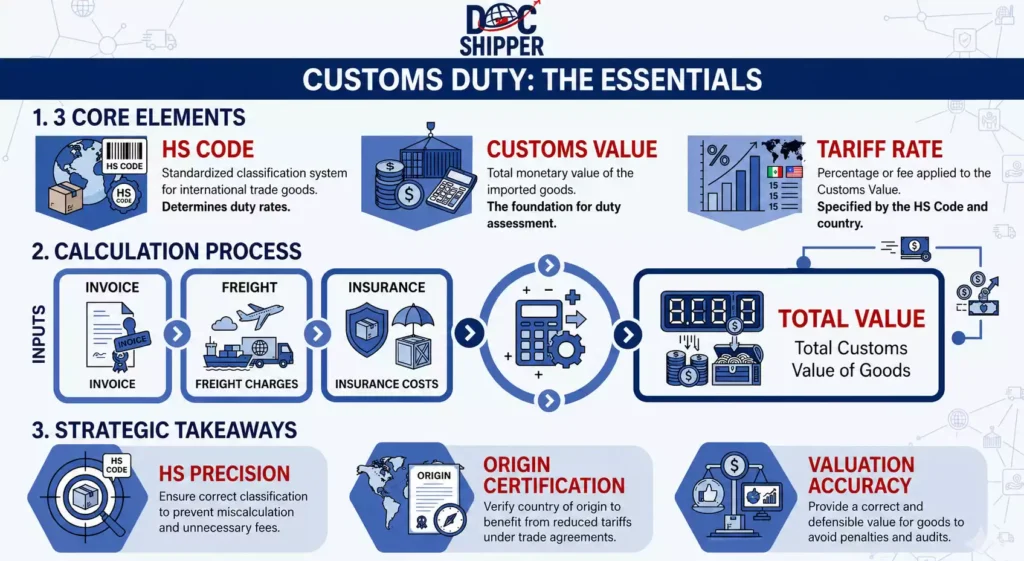
Customs duty calculation hinges on three fundamental elements: the Harmonized System (HS) code, the customs value, and the applicable tariff rate. Misclassification of goods represents the most common compliance error in international shipping.
The customs value typically follows the transaction value method defined by the WTO Valuation Agreement. This includes the invoice price plus international freight, insurance, and certain additional costs. Some countries apply CIF (Cost, Insurance, Freight) valuation, while others use FOB (Free On Board) methods.
Preferential trade agreements fundamentally alter duty obligations. The EU-Japan EPA, USMCA, or RCEP can reduce rates to zero for qualifying goods. However, obtaining preferential treatment requires proper documentation, including certificates of origin and proof of substantial transformation.
According to the World Trade Organization, customs valuation must be transparent, uniform, and neutral. Importers bear responsibility for accurate declarations, with penalties for undervaluation ranging from financial fines to criminal prosecution.
Anti-dumping duties and countervailing duties add complexity beyond standard tariffs. These protective measures target unfairly traded goods, sometimes exceeding 100% of product value. At DocShipper, we systematically verify applicable duties during quotation to prevent costly surprises at customs clearance.
Practical Examples & Data
Understanding customs duty through concrete scenarios clarifies how theoretical frameworks apply to real transactions. The following examples demonstrate calculation methods across different product categories and trade contexts.
Comparative Duty Rates by Product Category (2024)
| Product Category | HS Code Range | EU Standard Rate | US Standard Rate | China Standard Rate |
|---|---|---|---|---|
| Textiles (Cotton) | 5208-5212 | 8-12% | 7.5-16.5% | 8-10% |
| Electronics (Smartphones) | 8517.12 | 0% | 0% | 0% |
| Automotive Parts | 8708 | 3-4.5% | 2.5-25% | 6-10% |
| Wine & Spirits | 2204-2208 | 0-32 EUR/hl | $1.27-$13.50/liter | 10-65% |
| Furniture (Wood) | 9403 | 0-2.7% | 0-4.4% | 0-8% |
Use Case: Importing Electronics from China to France
Scenario: A French retailer imports 500 laptop computers from Shenzhen.
- Invoice value: €150,000 (€300 per unit)
- Freight cost: €3,500
- Insurance: €750
- HS Code: 8471.30 (Portable automatic data processing machines)
- EU duty rate: 0% (ITA agreement)
- VAT rate: 20%
Calculation:
Customs value = €150,000 + €3,500 + €750 = €154,250
Customs duty = €154,250 × 0% = €0
VAT base = €154,250 + €0 = €154,250
VAT = €154,250 × 20% = €30,850
Total taxes due = €30,850
Key Takeaways for Duty Optimization
- HS code precision: A single digit change can alter duty rates by 10-20%
- Origin certification: EUR.1 or REX registration unlocks preferential rates
- Valuation accuracy: Undervaluation risks penalties exceeding duty savings
- Bonded warehousing: Defers duty payment until goods enter domestic market
- Duty drawback programs: Recovers duties on re-exported or processed goods
Conclusion
Mastering customs duty mechanics transforms it from a cost burden into a strategic advantage. Accurate classification, proper valuation, and leveraging trade agreements directly enhance competitiveness in international markets.
Need expert guidance on customs duty optimization for your shipments? Contact DocShipper for personalized support across all aspects of international logistics.
📚 Quiz
Test Your Knowledge: Customs Duty
1. What is the primary basis used to calculate customs duty on imported goods?
2. A common misconception is that customs duty and VAT are the same tax. Which statement correctly distinguishes them?
3. A French retailer imports 500 laptops from China. The invoice value is €150,000, freight is €3,500, and insurance is €750. The applicable EU duty rate is 0% (ITA agreement). What is the correct customs value and total customs duty owed?
🎯 Your Result
📞 Free Quote in 24hFAQ | Customs Duty: Definition, Calculation & Practical Examples
Customs duty is a tariff on imported goods based on product classification and origin. VAT/sales tax applies to the total landed cost (including duty) and is a consumption tax. Both are collected at customs but serve different purposes.
The importer of record bears legal responsibility for customs duty payment. In DDP (Delivered Duty Paid) shipments, the seller covers these costs. Under DDU or DAP terms, the buyer pays all import duties and taxes.
Duty rates applicable at the time of customs declaration govern the transaction, not the shipping date. Trade policy changes, anti-dumping investigations, or tariff escalations can alter rates between shipment and arrival.
Undervaluation triggers penalties ranging from duty adjustments to criminal charges. Overvaluation wastes money on excess duties. Customs authorities use databases and risk profiling to identify discrepancies, with audits extending back several years.
Yes. Personal effects, humanitarian aid, diplomatic shipments, and goods under de minimis thresholds (€150 in EU, $800 in US) may be duty-free. Specific product categories under trade agreements also qualify for zero-duty treatment.
FTAs reduce or eliminate duties for qualifying goods originating in member countries. Compliance requires proper documentation (certificates of origin) and meeting rules of origin criteria, such as minimum local content thresholds or substantial transformation.
Ad valorem duty calculates as a percentage of customs value (e.g., 5% of €10,000 = €500). Specific duty applies a fixed amount per unit (e.g., €2 per kilogram). Some products face compound duties combining both methods.
Yes, through duty drawback programs when goods are re-exported, destroyed under customs supervision, or used in manufacturing for export. Claims require detailed documentation and typically must be filed within 3 years of duty payment.
Standard clearance takes 1-3 business days. Complex classifications, valuation disputes, or random inspections extend this to 5-10 days. Express clearance programs for trusted traders can reduce processing to hours.
The Harmonized System code is a 6-10 digit classification identifying products for customs purposes. It determines applicable duty rates, import restrictions, and statistical tracking. Misclassification is the leading cause of customs compliance violations.
Commercial samples of negligible value may enter duty-free if properly marked and declared. Prototypes and samples for testing typically face standard duties unless covered by temporary importation procedures (ATA Carnet) with re-export guarantees.
Anti-dumping duties counteract products sold below fair market value. Rates are product and country-specific, sometimes exceeding 100%. They apply in addition to standard customs duty and remain in effect for 5 years unless extended after review.
Need Help with
Logistics or Sourcing ?
First, we secure the right products from the right suppliers at the right price by managing the sourcing process from start to finish. Then, we simplify your shipping experience - from pickup to final delivery - ensuring any product, anywhere, is delivered at highly competitive prices.


Fill the Form
Prefer email? Send us your inquiry, and we’ll get back to you as soon as possible.
Contact us




