


In short ⚡
Charter Party is a legal contract between a shipowner and a charterer for the hire of a vessel or cargo space. It defines terms including freight rates, laytime, demurrage, and liability, serving as the foundation for maritime transport agreements in international trade.Introduction
Many importers and exporters face confusion when chartering vessels: What exactly am I signing? What are my obligations? A misunderstood Charter Party can lead to costly disputes, demurrage charges, and shipment delays.
In international logistics, the Charter Party governs the relationship between cargo owners and vessel operators. Whether shipping bulk commodities, project cargo, or containerized goods, this contract determines costs, responsibilities, and risk allocation throughout the voyage.
Key characteristics of Charter Parties include:
- Contractual flexibility: Terms negotiated based on cargo type, route, and market conditions
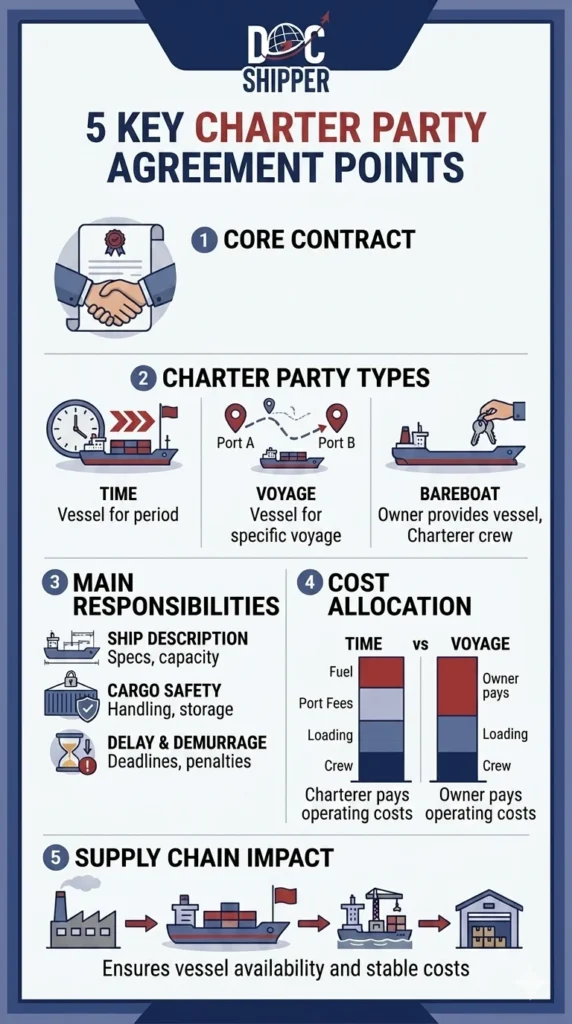
- Three main types: Voyage Charter, Time Charter, and Bareboat Charter
- Standardized forms: GENCON, NYPE, BALTIME used as templates with rider clauses
- Legal enforceability: Governed by maritime law and international conventions
- Financial implications: Includes freight, laytime, demurrage, and despatch calculations
Charter Party Mechanics & Legal Framework
The Charter Party functions as the constitutional document of maritime transport. Unlike a Bill of Lading, which serves as a receipt and title document, the Charter Party establishes the foundational agreement between parties.
Voyage Charter contracts hire a vessel for a specific journey between named ports. The shipowner retains operational control while the charterer pays freight based on cargo quantity. This arrangement suits one-time shipments or spot market transactions.
Time Charter agreements lease the vessel for a specified period. The charterer gains commercial control, directing the vessel’s employment while the owner maintains crewing and technical management. Payment occurs as daily hire regardless of cargo operations.
Bareboat Charter (or demise charter) transfers complete possession to the charterer, who assumes all operational responsibilities including crew, maintenance, and insurance. This resembles a long-term lease arrangement common in fleet expansion strategies.
The contract incorporates critical clauses addressing laytime (allowed loading/discharge time), demurrage (penalties for delays), and despatch (bonuses for early completion). These provisions directly impact the total transport cost and require precise calculation.
According to the International Maritime Organization, Charter Parties must comply with international conventions including SOLAS, MARPOL, and applicable trade sanctions. At DocShipper, we systematically review Charter Party terms to ensure compliance with both maritime regulations and our clients’ commercial objectives, preventing contractual disputes before vessels depart.
Practical Examples & Industry Data
Understanding Charter Party applications through real scenarios clarifies their practical implications in international trade operations.
Comparative Analysis: Charter Types
| Charter Type | Duration | Control | Best For | Typical Cost Structure |
|---|---|---|---|---|
| Voyage Charter | Single voyage | Owner retains | Bulk commodities, spot market | $25-45/ton freight |
| Time Charter | Months to years | Charterer directs | Regular trade routes | $15,000-30,000/day |
| Bareboat Charter | Long-term (5+ years) | Full charterer control | Fleet expansion, specialized operations | $8,000-20,000/day |
Use Case: Grain Shipment Charter Calculation
Scenario: A grain exporter charters a Handymax vessel (52,000 DWT) for shipment from US Gulf to Rotterdam.
- Cargo quantity: 50,000 metric tons of wheat
- Freight rate: $32 per metric ton
- Laytime allowed: 5 days loading + 4 days discharge
- Demurrage rate: $18,000 per day
- Actual time used: 11 days total (2 days over laytime)
Cost breakdown:
- Base freight: 50,000 tons × $32 = $1,600,000
- Demurrage: 2 days × $18,000 = $36,000
- Total transport cost: $1,636,000
- Effective rate per ton: $32.72 (2.25% increase due to delays)
Industry Insights
According to Baltic Exchange data, time charter rates for Panamax vessels fluctuated between $11,000 and $28,000 daily in 2023, reflecting volatile market conditions. Charter Party negotiations increasingly incorporate fuel adjustment clauses due to IMO 2020 sulfur regulations, adding 8-15% to base rates.
The containerized cargo sector shows 68% of global trade moves under liner service contracts rather than traditional Charter Parties, while bulk commodities (grains, coal, iron ore) remain predominantly chartered. Project cargo and oversized shipments typically require specialized voyage charters with custom loading provisions.
Conclusion
The Charter Party remains the cornerstone of maritime transport agreements, defining obligations, costs, and risks for both shipowners and cargo interests. Understanding its mechanics prevents disputes and optimizes logistics expenditure.
Need expert guidance on Charter Party negotiations or maritime transport solutions? Contact DocShipper for comprehensive support across your international shipping operations.
📚 Quiz
Test Your Knowledge: Charter Party
Q1 — What is a Charter Party in maritime transport?
Q2 — Under a Bareboat Charter, who is responsible for crewing, maintenance, and insurance of the vessel?
Q3 — A grain exporter charters a vessel for a single shipment from the US Gulf to Rotterdam. The vessel takes 2 extra days beyond the agreed laytime. What is the financial consequence?
🎯 Your Result
📞 Free Quote in 24hFAQ | Charter Party: Definition, Types & Practical Examples
A Charter Party is the contract between shipowner and charterer governing vessel hire terms. A Bill of Lading is a cargo receipt and title document issued to the shipper, often incorporating Charter Party terms by reference.
Typically, the shipowner pays port charges at loading ports, while the charterer covers discharge port expenses. However, Charter Party terms may allocate costs differently, making contract review essential.
Laytime begins when the vessel tenders Notice of Readiness (NOR) and ends when cargo operations complete. Calculations exclude Sundays, holidays, and weather delays unless the contract specifies "reversible" or "SHINC" terms.
Yes, through mutual agreement documented in written addendums. Common amendments address route changes, additional cargo, or revised laytime provisions. Both parties must consent to modifications.
In Time Charters, hire continues regardless of delays. In Voyage Charters, delays outside laytime trigger demurrage charges payable to the shipowner, calculated at agreed daily rates specified in the contract.
Standard forms like GENCON or NYPE provide templates, but specific terms in rider clauses and addendums take precedence. Legal enforceability depends on proper execution and compliance with applicable maritime law.
A cesser clause terminates the charterer's liability once cargo is loaded and freight prepaid. The shipowner then relies on a lien over the cargo for any outstanding charges like demurrage.
Time Charters typically include bunker adjustment clauses linking hire rates to fuel price indices. Voyage Charters may incorporate fuel surcharges or specify fuel quality requirements affecting overall costs.
In Time Charters, subletting (sub-chartering) is usually permitted unless explicitly prohibited. Bareboat Charters generally allow subletting with owner consent. Voyage Charters rarely involve subletting due to their single-trip nature.
Shipowners maintain hull and machinery insurance. Time charterers typically arrange cargo insurance and cover operational risks. Bareboat charterers assume all insurance obligations including hull, P&I, and cargo coverage.
Most Charter Parties include arbitration clauses specifying London, New York, or other maritime arbitration venues. Disputes commonly involve laytime calculations, cargo damage claims, or deviation allegations.
Charterers warrant that nominated ports are safe for the vessel to enter, remain, and depart without risk. Breach of this warranty makes charterers liable for vessel damage or delays caused by unsafe port conditions.
Need Help with
Logistics or Sourcing ?
First, we secure the right products from the right suppliers at the right price by managing the sourcing process from start to finish. Then, we simplify your shipping experience - from pickup to final delivery - ensuring any product, anywhere, is delivered at highly competitive prices.


Fill the Form
Prefer email? Send us your inquiry, and we’ll get back to you as soon as possible.
Contact us




