


In short ⚡
The CE Mark is a mandatory European conformity marking indicating that a product complies with EU health, safety, and environmental protection standards. This certification enables free movement of goods within the European Economic Area and demonstrates manufacturer responsibility for regulatory compliance.
Introduction
Many importers mistakenly believe the CE Mark is a quality seal or optional certification. In reality, it’s a legal requirement for most manufactured goods entering the European Union.
Without proper CE marking, products face customs detention, market withdrawal, and potential legal penalties. Understanding this conformity assessment system is essential for any business exporting to Europe.
- Legal obligation: Required before placing products on EU market
- Manufacturer’s declaration: Self-certification of compliance with applicable directives
- Market access: Enables free circulation across 30+ European countries
- Product categories: Applies to electronics, machinery, toys, medical devices, and more
- Enforcement mechanism: Market surveillance authorities verify compliance post-import
Regulatory Framework & Compliance Requirements
The CE Mark operates under the New Legislative Framework, which harmonizes conformity assessment procedures across EU member states. Over 20 product directives specify technical requirements manufacturers must meet.
Key regulatory directives include the Low Voltage Directive (LVD), Electromagnetic Compatibility (EMC) Directive, Machinery Directive, and Radio Equipment Directive (RED). Each directive defines essential safety requirements and conformity assessment routes.
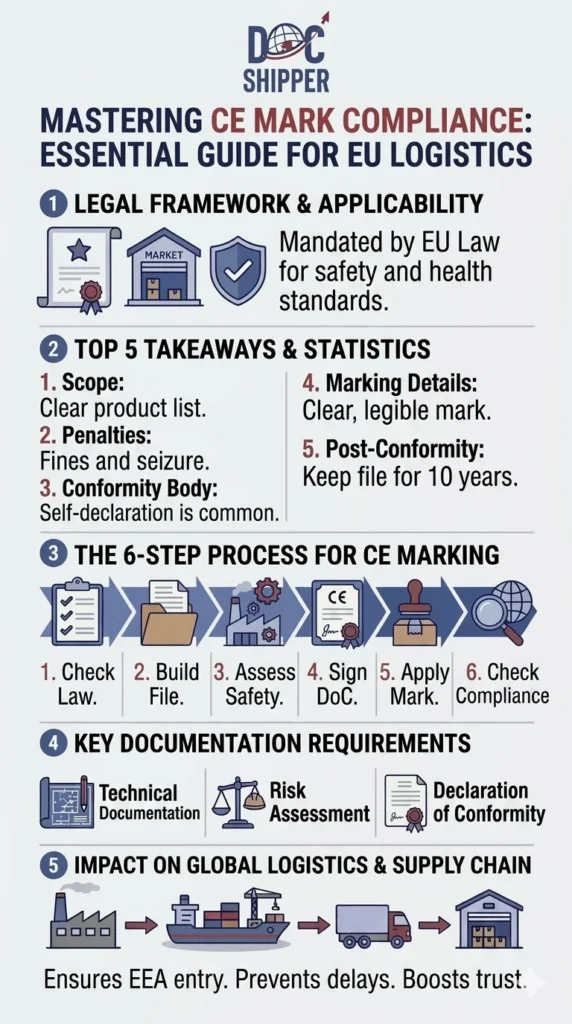
The conformity assessment process varies by product risk level. Low-risk products allow self-certification, while high-risk items require third-party testing by Notified Bodies. Manufacturers must compile a Technical File documenting design specifications, risk assessments, and test reports.
A Declaration of Conformity must accompany CE-marked products, stating which directives apply and identifying the responsible manufacturer. This legally binding document becomes crucial during customs inspections or market surveillance checks.
According to European Commission guidelines, the CE Mark must be visible, legible, and indelible. Minimum height requirements (5mm) ensure clear identification during border controls.
At DocShipper, we systematically verify CE documentation during pre-shipment inspections to prevent costly customs delays and ensure your products meet all applicable EU directives before departure.
Practical Implementation & Certification Process
The certification timeline and costs vary significantly based on product complexity and testing requirements. Understanding these practical aspects helps importers plan budgets and delivery schedules accurately.
| Product Category | Typical Timeline | Estimated Cost Range | Notified Body Required |
|---|---|---|---|
| Consumer Electronics | 6-12 weeks | €2,000-€8,000 | Usually No |
| Industrial Machinery | 3-6 months | €5,000-€25,000 | Often Yes |
| Medical Devices (Class I) | 2-4 months | €3,000-€15,000 | Depends on Sterility |
| Personal Protective Equipment | 8-16 weeks | €4,000-€12,000 | Yes (Category III) |
Real-world scenario: A Chinese manufacturer exporting LED lighting fixtures to Germany must comply with LVD, EMC, and RoHS directives. Testing involves electromagnetic interference measurements, electrical safety checks, and hazardous substance analysis. Total compliance cost: approximately €5,500. Timeline: 10 weeks from sample submission to final certification.
Common compliance mistakes include affixing CE marks before completing conformity assessments, omitting required documentation, or using non-accredited test laboratories. These errors trigger customs holds and potential product recalls.
Post-market obligations require manufacturers to maintain Technical Files for 10 years and implement corrective actions if safety issues emerge. Market surveillance authorities conduct random inspections and can demand documentation at any time.
Third-country importers without EU presence must designate an Authorized Representative to handle regulatory correspondence and maintain compliance documentation within the European Economic Area.
Conclusion
The CE Mark represents far more than a simple logo—it’s the gateway to Europe’s single market and a manufacturer’s legal commitment to product safety. Proper compliance protects your business from regulatory penalties while ensuring smooth customs clearance.
Need expert guidance on CE marking requirements for your products? Contact DocShipper for comprehensive compliance support and documentation verification.
📚 Quiz
Test Your Knowledge: CE Mark
Q1. What does the CE Mark fundamentally represent?
Q2. A manufacturer affixes the CE Mark to their product immediately after completing the design phase, before running any conformity assessments or tests. Is this correct practice?
Q3. A Chinese manufacturer exports LED lighting fixtures to Germany. Which directives must their product comply with to obtain CE marking?
🎯 Your Result
📞 Free Quote in 24hFAQ | CE Mark: Definition, Requirements & Practical Examples
No. The CE Mark is a declaration by the manufacturer, not a third-party certification. It indicates self-assessed compliance with EU directives, though some products require Notified Body involvement.
Only if your product falls outside regulated categories. Most manufactured goods—electronics, machinery, toys, medical devices—require CE marking before market placement. Violations result in customs seizure and penalties.
Timelines range from 6 weeks for simple electronics to 6+ months for complex machinery requiring Notified Body assessment. Product testing, documentation preparation, and directive applicability determine duration.
The official CE Mark uses specific proportions and spacing defined by EU regulation. The "China Export" mark (often identical-looking) has no legal standing in Europe and constitutes trademark infringement.
Yes, if changes affect compliance with applicable directives. Minor aesthetic updates may not require re-assessment, but functional modifications, new components, or design alterations typically necessitate updated conformity evaluation.
Only the manufacturer or their authorized EU representative. Importers, distributors, and retailers cannot apply CE marking unless they modify products in ways that affect conformity, thereby assuming manufacturer responsibilities.
The Declaration of Conformity, user instructions in the destination country's language, and Technical File (maintained by manufacturer). Customs may request these documents during import clearance procedures.
Yes. EU directives apply uniformly across member states, ensuring harmonized requirements. However, market surveillance enforcement intensity and national language requirements for documentation may vary by country.
Test reports must come from laboratories competent in relevant standards, but EU accreditation isn't always mandatory for self-certification. High-risk products requiring Notified Body involvement need EU-recognized testing facilities.
Shipments face immediate detention. Authorities may demand corrective documentation, impose fines, or refuse market entry. Repeated violations can result in import bans and legal proceedings against responsible parties.
The UK introduced the UKCA mark for Great Britain (England, Wales, Scotland). CE marking remains accepted until specific transition deadlines. Northern Ireland continues following EU rules under the Protocol.
Fees vary by product complexity and testing scope, typically ranging from €3,000 to €30,000+. Medical devices, pressure equipment, and lifts generally incur higher costs due to extensive assessment requirements and ongoing surveillance.
Need Help with
Logistics or Sourcing ?
First, we secure the right products from the right suppliers at the right price by managing the sourcing process from start to finish. Then, we simplify your shipping experience - from pickup to final delivery - ensuring any product, anywhere, is delivered at highly competitive prices.


Fill the Form
Prefer email? Send us your inquiry, and we’ll get back to you as soon as possible.
Contact us




