


In short ⚡
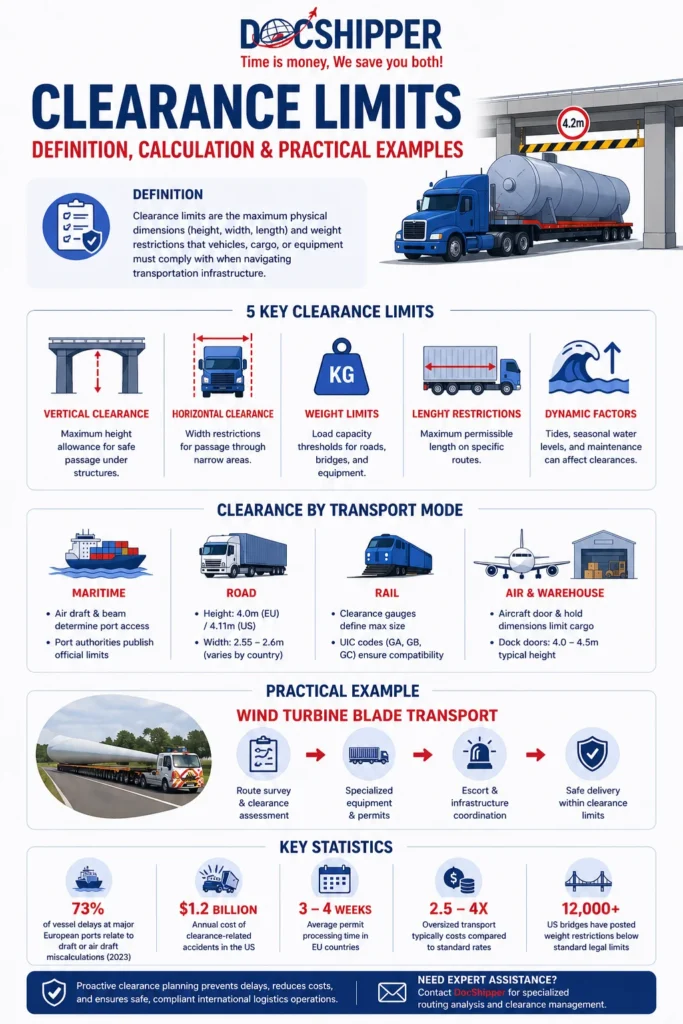
Clearance limits are the maximum physical dimensions (height, width, length) and weight restrictions that vehicles, cargo, or equipment must comply with when navigating transportation infrastructure such as bridges, tunnels, ports, and warehouses. These specifications ensure safe passage and prevent structural damage or operational disruptions in the logistics chain.
Introduction
Shipping oversized cargo without verifying clearance limits is one of the most common—and costly—mistakes in international logistics. A container that exceeds bridge height restrictions or a vessel too large for port infrastructure can trigger delays, rerouting expenses, or even legal penalties.
In global supply chains, clearance limits act as invisible gatekeepers. They dictate which routes are viable, which transport modes are feasible, and how cargo must be prepared. Understanding these constraints is essential for freight forwarders, carriers, and importers alike.
Key characteristics of clearance limits include:
- Vertical clearance: Maximum height allowance for overpasses, bridges, and tunnel passages
- Horizontal clearance: Width restrictions for narrow passages, port channels, and warehouse doors
- Weight limits: Load capacity thresholds for roads, bridges, and handling equipment
- Length restrictions: Maximum permissible vehicle or cargo length on specific routes
- Dynamic factors: Tidal variations, seasonal water levels, and infrastructure maintenance schedules
Technical Framework & Regulatory Standards
Clearance limits are governed by a complex network of national regulations, international conventions, and infrastructure-specific guidelines. Each transport mode operates under distinct parameters that logistics professionals must navigate.
Maritime clearance limits are primarily determined by port infrastructure and navigational channels. The concept of “air draft” (vertical distance from waterline to highest point) and “beam” (vessel width) dictates which ports a ship can access. Major shipping routes publish official clearance specifications through port authorities.
Road transport clearance varies significantly by jurisdiction. In the European Union, the standard maximum height is 4.0 meters, while the United States typically allows 4.11 meters (13.5 feet) on interstate highways. Width limits generally range from 2.55 to 2.6 meters internationally, though special permits can authorize exceptions.
Rail clearance profiles follow standardized gauges but vary in loading gauge (the maximum height and width). The International Union of Railways (UIC) defines specific clearance codes (GA, GB, GC) that determine compatible rolling stock and cargo dimensions across European networks. Reference: International Union of Railways.
Air cargo clearance is constrained by aircraft door dimensions and internal hold configurations. Wide-body freighters like the Boeing 747-8F offer main deck door clearances of approximately 3.40m x 2.59m, while narrowbody aircraft impose significantly tighter restrictions.
Warehouse and terminal clearance includes dock door heights (typically 4.0-4.5m), crane reach limitations, and floor load capacities. These operational constraints often receive less attention but can create critical bottlenecks in multimodal transport chains.
At DocShipper, we systematically verify clearance limits across the entire transport route before finalizing shipping plans, preventing costly surprises and ensuring seamless cargo flow from origin to destination.
Practical Applications & Real-World Data
Understanding theoretical clearance limits is insufficient without practical application. Real-world logistics requires precise calculations, contingency planning, and awareness of common scenarios where clearance becomes the determining factor.
Comparative Analysis: Standard vs. Oversized Cargo
| Parameter | Standard Container (40′ HC) | Oversized Equipment | Critical Considerations |
|---|---|---|---|
| Height | 2.89m (9.5 ft) | 3.5m+ (machinery, wind turbines) | Bridge clearances, power lines |
| Width | 2.44m (8 ft) | 3.0m+ (industrial modules) | Tunnel passages, narrow roads |
| Length | 12.19m (40 ft) | 15m+ (structural beams) | Turning radius, maneuverability |
| Weight | 30,480 kg max gross | 50,000 kg+ (heavy machinery) | Axle load limits, bridge capacity |
| Permit Requirements | None (standard routing) | Special permits, escort vehicles | Lead time: 2-6 weeks |
Use Case: Wind Turbine Blade Transport
Scenario: A manufacturer in Denmark needs to transport wind turbine blades (length: 75 meters, width: 4.5 meters) to a wind farm in northern Germany.
Clearance challenges identified:
- Multiple bridge crossings with 4.2m height restrictions requiring specialized low-bed trailers
- Urban route segments with 3.0m width limitations necessitating nighttime transport windows
- Roundabout navigation requiring custom pivot trailers with hydraulic steering
- Coordination with local authorities for temporary traffic signal removal
- Total transport time extended from 8 hours (standard) to 22 hours (with clearance accommodations)
Solution implemented: Multi-axle modular trailers with adjustable height, police escort, route survey with 3D clearance modeling, and pre-arranged temporary infrastructure modifications. Total additional cost: €15,000 compared to standard transport.
Critical Data Points for Logistics Planning
- Port clearance verification: 73% of vessel delays at major European ports relate to draft or air draft miscalculations (Port of Rotterdam Authority, 2023)
- Road transport incidents: Clearance-related accidents cost the logistics industry approximately $1.2 billion annually in the US alone
- Permit processing times: Average 3-4 weeks for oversized load permits in EU countries, 2-8 weeks in North America depending on jurisdiction
- Cost multipliers: Oversized cargo transport typically costs 2.5-4x standard rates due to clearance accommodations and specialized equipment
- Infrastructure variability: Over 12,000 bridges in the US have posted weight restrictions below standard legal limits
Conclusion
Clearance limits represent non-negotiable physical constraints that directly impact routing decisions, transport costs, and delivery timelines. Proactive verification and expert planning transform potential obstacles into manageable logistics parameters.
Need assistance navigating complex clearance requirements for your shipments? Contact DocShipper for specialized routing analysis and end-to-end clearance management.
📚 Quiz
Clearance Limits
Q1 — What do clearance limits define in a logistics context?
Q2 — A logistics manager assumes that clearance limits only apply to oversized cargo and that standard 40' High Cube containers can be routed freely without any clearance checks. Is this correct?
Q3 — A freight forwarder is planning a multimodal shipment for industrial modules (width: 3.2m, weight: 55,000 kg) from a European port to an inland factory. Which approach correctly applies clearance limit management?
🎯 Your Result
📞 Free Quote in 24hFAQ | Clearance Limits: Definition, Calculation & Practical Examples
Exceeding clearance limits can result in cargo damage, infrastructure damage, legal penalties, shipment delays, and additional rerouting costs. In severe cases, authorities may impound the vehicle and cargo until proper permits are obtained.
Consult national transportation authority databases, contact local road/port authorities, use specialized routing software with clearance databases, or engage a freight forwarder with route survey capabilities to verify all critical clearance points.
No. Clearance limits vary significantly by country, region, and infrastructure type. European standards differ from North American regulations, and developing markets often have more restrictive or poorly documented clearance specifications.
Static clearance refers to fixed infrastructure dimensions (bridge height, tunnel width). Dynamic clearance accounts for variable factors like tidal changes affecting vessel air draft, seasonal water levels, or temporary construction restrictions.
Yes, through special transport permits. Authorities may authorize temporary modifications such as traffic signal removal, lane closures, or escort requirements. This requires advance application, route surveys, and typically incurs additional fees.
Permit processing typically requires 2-6 weeks depending on jurisdiction and cargo dimensions. Complex routes crossing multiple jurisdictions may require 8-12 weeks. Emergency expedited permits exist but carry premium fees.
The most frequent violations involve height restrictions (bridge strikes), weight limits (bridge damage), and width constraints (tunnel collisions). Many occur due to inadequate route planning or failure to account for cargo securing equipment adding height.
Yes. Even empty containers and chassis must comply with clearance limits. The combined height of truck, chassis, and empty container can still exceed bridge clearances, particularly with high-cube containers on standard chassis.
Water levels fluctuate with seasons, affecting vessel draft and bridge clearances over waterways. Winter conditions may restrict certain routes. Agricultural harvest seasons can temporarily reduce available road clearances due to equipment movement.
GPS-based routing software with integrated clearance databases, 3D route modeling tools, load dimension sensors, and automated permit management systems help logistics providers maintain compliance and optimize routing for dimensional cargo.
Partial standardization exists through organizations like ISO for container dimensions and IMO for maritime specifications. However, infrastructure clearances remain largely governed by national and local regulations with significant variation.
Each transport mode transition point must be verified for clearance compatibility. Cargo acceptable for ocean transport may exceed road clearances at destination. This requires careful modal selection and sometimes cargo disassembly/reassembly between transport phases.
Need Help with
Logistics or Sourcing ?
First, we secure the right products from the right suppliers at the right price by managing the sourcing process from start to finish. Then, we simplify your shipping experience - from pickup to final delivery - ensuring any product, anywhere, is delivered at highly competitive prices.


Fill the Form
Prefer email? Send us your inquiry, and we’ll get back to you as soon as possible.
Contact us




