


In short ⚡
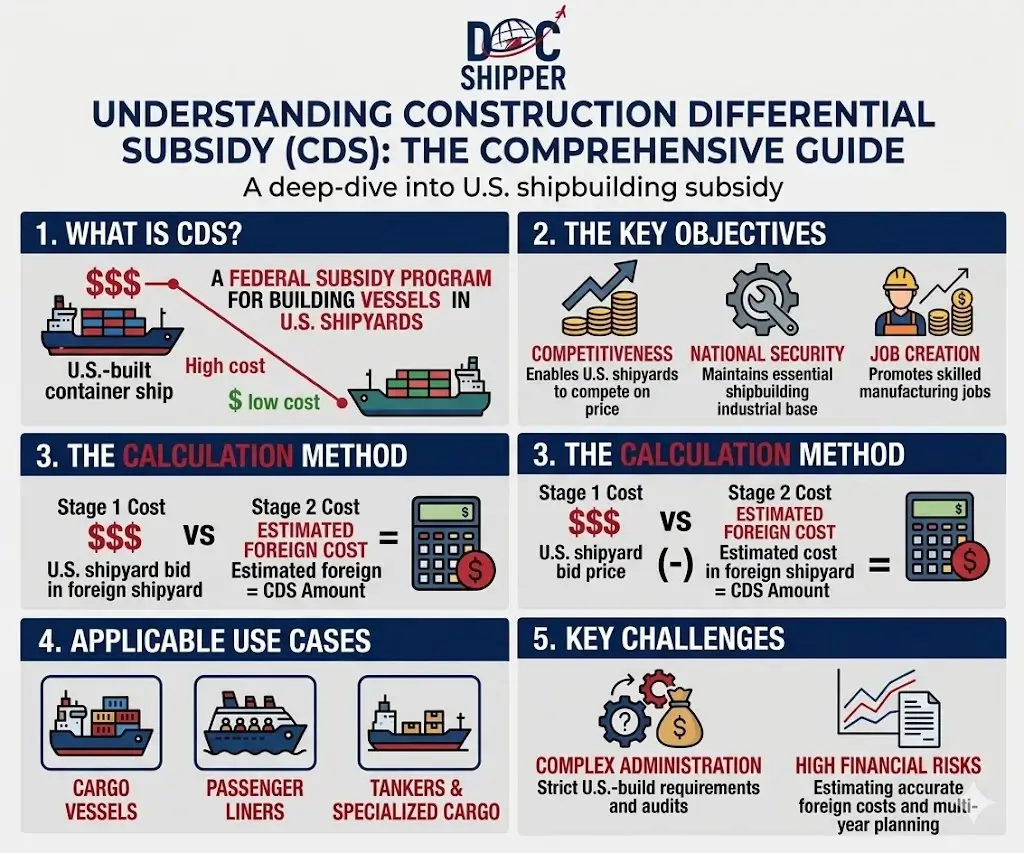
Construction Differential Subsidy (CDS) is a maritime financial mechanism that compensates shipowners for the cost difference between building vessels domestically versus internationally. This subsidy ensures national shipbuilding competitiveness while maintaining strategic maritime capabilities and protecting domestic maritime industries from foreign competition.
Introduction
Shipowners face a critical dilemma: domestic shipyards often charge 20-40% more than Asian competitors. Without financial support, national maritime industries collapse, creating strategic vulnerabilities.
The Construction Differential Subsidy addresses this imbalance by bridging the cost gap. It maintains domestic shipbuilding expertise while ensuring merchant fleets remain economically viable.
Key characteristics include:
- Government-funded compensation for higher domestic construction costs
- Strategic maritime security preservation through domestic capacity
- Competitive parity with international shipbuilding markets
- Long-term subsidy agreements tied to vessel operational requirements
- Regulatory compliance obligations for recipient shipowners
Regulatory Framework & Financial Mechanisms
The CDS operates within complex international maritime law frameworks. The Merchant Marine Act of 1936 (United States) established the foundational model, creating precedent for similar programs globally.
Eligibility criteria typically require vessels to be U.S.-flagged (or equivalent national registry), constructed domestically, and operated in specific trade routes. Shipowners must demonstrate financial viability and commit to long-term operational agreements.
The subsidy calculation methodology compares certified domestic construction bids against international market equivalents. Independent auditors verify cost differentials, ensuring transparency. Payments are typically disbursed over 20-25 years as operational subsidies.
World Trade Organization (WTO) regulations scrutinize CDS programs as potential trade distortions. Compliant programs must demonstrate strategic defense justifications rather than pure commercial advantages. The WTO Agreement on Subsidies and Countervailing Measures provides governing principles.
Recapture provisions protect government investments. If vessels are sold internationally or reflagged prematurely, shipowners must repay proportional subsidy amounts. At DocShipper, we guide clients through these complex recapture scenarios during vessel acquisition planning.
Calculation Methods & Real-World Applications
Understanding CDS calculation requires examining real cost differentials. A container vessel comparison illustrates the mechanism:
| Construction Location | Vessel Cost | Subsidy Amount | Net Owner Cost |
|---|---|---|---|
| South Korean Shipyard | $85 million | $0 | $85 million |
| U.S. Domestic Shipyard | $125 million | $40 million (CDS) | $85 million |
| European Shipyard | $105 million | $20 million (EU equivalent) | $85 million |
The subsidy percentage formula typically follows:
CDS Amount = (Domestic Cost – Foreign Equivalent Cost) × Approval Rate
Case Study: Matson Navigation Company utilized CDS for two Aloha-class containerships in 2018. Domestic construction cost $418 million versus estimated $290 million internationally. The $128 million differential qualified for partial CDS coverage, enabling economically viable U.S.-flag operations in Hawaii trade.
Key operational requirements include:
- Minimum service duration: 20-year operational commitment
- Trade route restrictions: Primarily domestic or strategic international routes
- Crewing mandates: National crew requirements (e.g., Jones Act compliance)
- Maintenance standards: Vessels must meet classification society requirements
- Government mobilization rights: Military sealift availability during emergencies
DocShipper assists maritime operators in navigating CDS applications, ensuring compliance documentation and optimizing subsidy qualification strategies throughout vessel procurement cycles.
Conclusion
The Construction Differential Subsidy remains essential for maintaining domestic shipbuilding capabilities while ensuring maritime operators remain competitive. Understanding calculation methodologies and compliance requirements is critical for strategic fleet planning.
Need expert guidance on maritime subsidy programs or vessel acquisition strategies? Contact DocShipper for specialized consultation on international shipping solutions.
📚 Quizz
Test Your Knowledge: Construction Differential Subsidy
Q1 — What is the primary purpose of the Construction Differential Subsidy (CDS)?
Q2 — A shipowner receives a CDS and sells the vessel 10 years into a 20-year commitment agreement. What happens?
Q3 — A U.S. shipping company wants to build a containership. The domestic shipyard quotes $125 million; a South Korean shipyard quotes $85 million. The CDS approval rate is 100% of the differential. What is the CDS amount and the net owner cost?
🎯 Your Result
📞 Free Quote in 24hFAQ | Construction Differential Subsidy: Definition, Calculation & Concrete Examples
The United States maintains the most established CDS program through the Maritime Administration. Japan, South Korea, and several European nations offer equivalent shipbuilding support mechanisms under different regulatory frameworks, though structures vary significantly by jurisdiction.
Application processing ranges from 12-24 months depending on vessel complexity and regulatory review cycles. Shipowners must submit detailed cost comparisons, operational plans, and financial viability documentation. Early engagement with maritime authorities accelerates approval timelines.
No. CDS programs require national flag registry and domestic ownership structures. Vessels must be built in qualifying domestic shipyards and operated under national maritime laws. Foreign entities may establish domestic subsidiaries, but ownership transfer restrictions apply.
Recapture provisions require proportional subsidy repayment based on remaining commitment years. If a vessel with 10 years remaining on a 20-year agreement is sold, approximately 50% of received subsidies must be returned to the government.
Tax treatment varies by jurisdiction. In the U.S., CDS payments are generally not taxable income but reduce the vessel's depreciable basis. Shipowners should consult maritime tax specialists to understand specific implications for their operational structure.
CDS covers construction cost differentials, while ODS compensates for higher operational expenses (crew wages, maintenance). CDS is a one-time capital subsidy; ODS provides ongoing operational support. Many programs historically offered both, though ODS programs have largely been phased out.
Major conversions may qualify for partial CDS if they substantially increase vessel value and domestic shipyard work exceeds minimum thresholds. Minor retrofits typically do not qualify. Eligibility depends on conversion scope and strategic maritime value assessments.
Applications require certified domestic construction bids, comparable international quotations, detailed vessel specifications, operational business plans, financial statements, ownership documentation, and commitment letters for operational requirements. Independent cost verification audits are mandatory.
Most programs prioritize commercial cargo vessels (containerships, tankers, bulk carriers). Passenger vessels, specialized offshore units, and military vessels may qualify under specific programs. Fishing vessels and recreational craft typically do not qualify for CDS support.
WTO subsidy agreements permit CDS when justified by national security or strategic maritime interests. Programs must avoid purely commercial competitive advantages. Transparent cost verification and non-discriminatory application processes help ensure WTO compliance.
Yes. CDS often combines with Title XI loan guarantees, capital construction funds, and accelerated depreciation programs. Cumulative benefits cannot exceed total construction costs. Coordination with maritime finance specialists ensures optimal subsidy stacking strategies.
DocShipper provides comprehensive consultation on CDS eligibility assessment, documentation preparation, cost verification coordination, and compliance management throughout vessel construction and operational commitment periods. Our maritime logistics expertise streamlines complex subsidy application workflows.
Need Help with
Logistics or Sourcing ?
First, we secure the right products from the right suppliers at the right price by managing the sourcing process from start to finish. Then, we simplify your shipping experience - from pickup to final delivery - ensuring any product, anywhere, is delivered at highly competitive prices.


Fill the Form
Prefer email? Send us your inquiry, and we’ll get back to you as soon as possible.
Contact us




