


In short ⚡
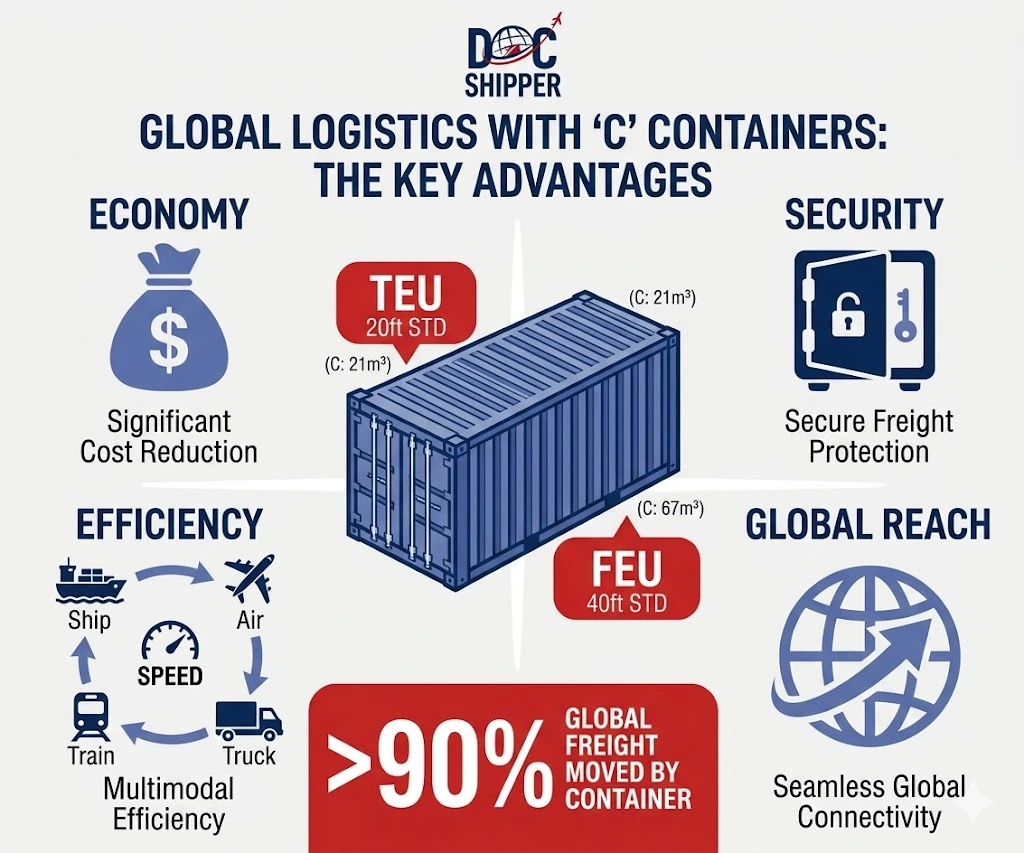
The C Container is a standardized intermodal shipping container measuring 20 feet in length, designed for multimodal transport of goods via sea, rail, and road. It serves as the fundamental unit in global logistics, offering approximately 33 cubic meters of cargo space with a maximum payload capacity of 28 tons, making it the most versatile container type in international trade.
Introduction
Many importers confuse container classifications, leading to costly booking errors and space inefficiencies. The C Container—commonly known as the 20-foot container—represents the backbone of containerized shipping, accounting for nearly 40% of global container movements.
Understanding this container type is crucial for optimizing shipping costs, calculating CBM requirements, and ensuring compliance with international transport regulations. Whether you’re shipping electronics from China or machinery to Europe, the C Container remains the most accessible entry point into international logistics.
Key characteristics include:
- Standardized dimensions: 20ft × 8ft × 8.6ft (L×W×H)
- Internal volume: approximately 33.2 cubic meters
- Maximum gross weight: 30,480 kg (including tare weight)
- Payload capacity: typically 28,000 kg depending on regulations
- TEU equivalent: 1 TEU (Twenty-foot Equivalent Unit)
Technical Specifications & Regulatory Framework
The C Container operates under strict ISO 668 standards, which define precise external and internal measurements. External dimensions measure 6.058m (length) × 2.438m (width) × 2.591m (height), while internal dimensions typically provide 5.898m × 2.352m × 2.385m of usable space.
The tare weight—the container’s empty weight—averages 2,300 kg for standard dry cargo units. This leaves approximately 28,180 kg for actual cargo, though road transport regulations in Europe often limit this further to comply with axle weight restrictions outlined in EU Directive 2015/719.
The door opening dimensions measure 2.340m (width) × 2.280m (height), a critical specification when loading palletized goods or oversized items. Standard EUR pallets (1200mm × 800mm) fit 11 units per container when properly stacked, while North American pallets (1219mm × 1016mm) accommodate only 9-10 units.
CSC plate certification remains mandatory for all containers in international transit. This safety approval plate verifies structural integrity and must be renewed every 30 months through authorized inspection bodies. At DocShipper, we systematically verify CSC compliance during container booking to prevent customs delays and ensure cargo safety throughout the supply chain.
The corner casting system enables secure stacking up to 9 containers high when fully loaded, and up to 12 when empty. These standardized corner fittings allow seamless transfer between ships, trains, and trucks without repacking—the fundamental principle that revolutionized global trade in the 1960s.
Practical Applications & Data Analysis
Understanding theoretical specifications becomes actionable when applied to real shipping scenarios. The C Container’s versatility makes it suitable for diverse cargo types, from consumer electronics to industrial components.
Comparative Cost Analysis
| Route | 20ft Container (C) | 40ft Container | Cost Efficiency |
|---|---|---|---|
| Shanghai → Rotterdam | $1,800 – $2,400 | $2,600 – $3,200 | 20ft = 31% cheaper per TEU |
| Shenzhen → Los Angeles | $2,100 – $2,800 | $3,200 – $4,000 | 20ft = 34% cheaper per TEU |
| Mumbai → Hamburg | $1,500 – $2,000 | $2,300 – $2,900 | 20ft = 35% cheaper per TEU |
Practical Loading Scenario
Case Study: Electronics shipment from Guangzhou to Paris
- Cargo: 800 cartons of consumer electronics (each 50cm × 40cm × 30cm)
- Total volume: 800 × 0.06 CBM = 48 CBM
- Container capacity: 33.2 CBM (C Container)
- Solution: Requires 2 × C Containers or 1 × 40ft container
- Cost comparison: 2×20ft = $4,800 vs 1×40ft = $3,200 → 40ft saves $1,600
However, when cargo volume reaches only 25-30 CBM, the C Container becomes more economical. Shipments under 28 CBM avoid paying for unused space, making the 20ft option 15-20% more cost-efficient for smaller consignments.
Weight Distribution Calculations
Proper weight distribution prevents structural damage and ensures compliance. The maximum floor load for a C Container averages 4.5 tons per linear meter. For heavy machinery:
- Total payload: 28,000 kg
- Container length: 5.898m
- Average distribution: 4,746 kg/m
- Concentrated loads require reinforcement or load-spreading platforms
At DocShipper, our logistics specialists calculate precise weight distribution for industrial shipments, preventing costly container rejections at loading terminals and ensuring safe transit across multiple transport modes.
Conclusion
The C Container remains the most flexible unit in international logistics, offering optimal cost-efficiency for small to medium shipments while maintaining full intermodal compatibility. Mastering its specifications, capacity calculations, and regulatory requirements enables importers to make informed decisions that directly impact bottom-line shipping costs.
Need expert guidance on container selection or end-to-end logistics management? Contact DocShipper for personalized support across your entire supply chain.
📚 Quiz
Test Your Knowledge: C Container
Q1 — What does a C Container (20ft) represent in international shipping capacity calculations?
Q2 — A shipper has 48 CBM of electronics to send from Guangzhou to Paris. Is a single C Container sufficient?
Q3 — A client needs to ship temperature-sensitive pharmaceuticals internationally. Can a standard C Container be used?
🎯 Your Result
📞 Free Quote in 24hFAQ | C Container: Definition, Calculation & Concrete Examples
The "C" designation refers to the container's classification in the ISO standard system, specifically denoting a 20-foot general-purpose dry cargo container. It represents one TEU (Twenty-foot Equivalent Unit) in capacity calculations.
A C Container accommodates 11 EUR pallets (1200×800mm) or 9-10 US pallets (1219×1016mm) when floor-loaded. Exact numbers depend on pallet stacking height and cargo stability requirements.
The internal volume measures approximately 33.2 cubic meters (1,172 cubic feet), though practical loading capacity often reduces to 30-31 CBM due to cargo shape irregularities and securing requirements.
Standard C Containers are not suitable for hazardous goods. You require specialized containers with IMO certification, proper placarding, and compliance with IMDG Code regulations for dangerous cargo transport.
A standard C Container stands 8.6ft tall (2.591m), while a 20ft high cube measures 9.6ft (2.896m), providing an additional 3.7 CBM of capacity—ideal for lightweight, voluminous cargo.
Multiply cargo dimensions (L×W×H in meters) to get CBM per unit, then multiply by quantity. If total ≤ 30 CBM and weight ≤ 28,000 kg, a C Container suffices. Always account for 10% space loss due to irregular shapes.
The maximum gross weight is 30,480 kg, including the container's tare weight (≈2,300 kg). Effective payload capacity reaches approximately 28,000 kg, though road transport regulations may impose lower limits.
Standard C Containers lack refrigeration units. For temperature-sensitive cargo, you need a 20ft reefer container with integrated cooling systems, which maintains temperatures from -30°C to +30°C.
Costs vary by route, season, and market conditions. Typical rates range from $1,500 (Asia-Middle East) to $3,000 (Asia-Europe) during normal periods, with potential spikes during peak seasons or supply chain disruptions.
Essential documents include the Bill of Lading, Commercial Invoice, Packing List, Certificate of Origin, and container-specific documents like the CSC safety approval plate and VGM (Verified Gross Mass) declaration.
Yes, C Containers are specifically designed for seamless intermodal transport across sea, rail, and road networks. Their standardized corner castings enable quick transfers between transport modes without cargo handling.
With proper maintenance, shipping containers remain operational for 15-20 years. After retirement from international shipping, many are repurposed for storage, construction, or conversion projects due to their structural durability.
Need Help with
Logistics or Sourcing ?
First, we secure the right products from the right suppliers at the right price by managing the sourcing process from start to finish. Then, we simplify your shipping experience - from pickup to final delivery - ensuring any product, anywhere, is delivered at highly competitive prices.


Fill the Form
Prefer email? Send us your inquiry, and we’ll get back to you as soon as possible.
Contact us




