


In short ⚡
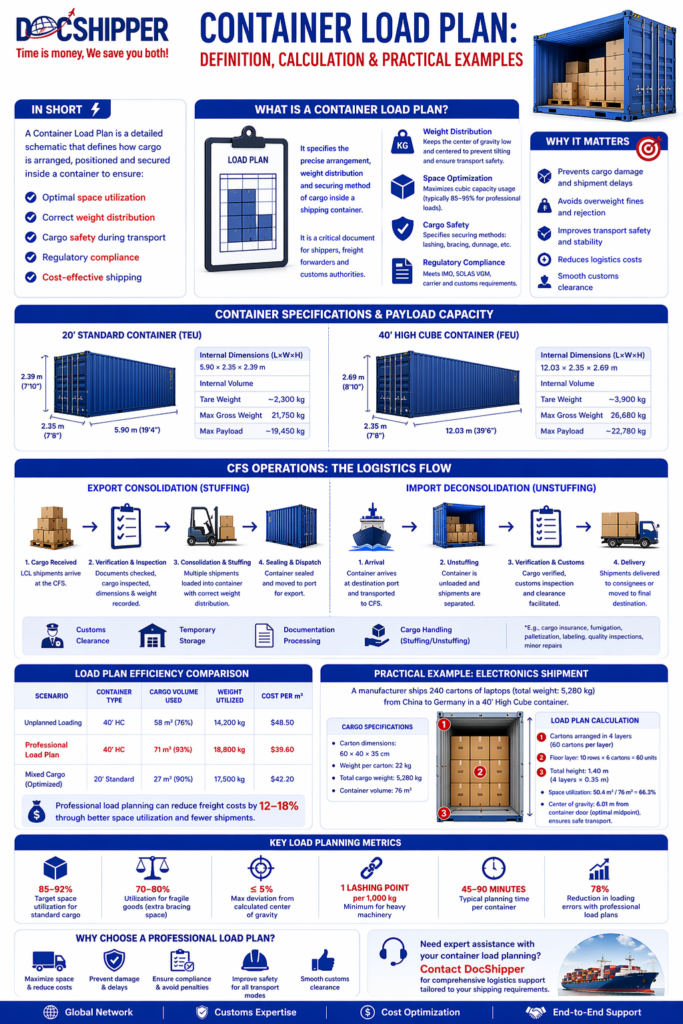
A Container Load Plan is a detailed schematic document that specifies the precise arrangement, positioning, and securing method of cargo inside a shipping container. It ensures optimal space utilization, weight distribution compliance, and cargo safety during international transport, while meeting customs and carrier requirements.
Introduction
Every year, thousands of shipments face delays, damages, or rejections due to improper container loading. A poorly executed load plan can result in cargo shifts during transit, exceeding axle weight limits, or customs inspection failures.
The Container Load Plan serves as the blueprint for safe, compliant, and cost-effective cargo stowage. It’s essential for freight forwarders, shippers, and logistics managers handling international trade.
Key characteristics of an effective Container Load Plan include:
- Weight distribution accuracy — prevents container tilting and ensures road transport compliance
- Dimensional optimization — maximizes cubic capacity utilization (typically 85-95% for professional loads)
- Cargo compatibility assessment — separates hazardous materials and fragile goods appropriately
- Securing method specification — details lashing, bracing, and dunnage requirements
- Regulatory compliance documentation — meets IMO, SOLAS VGM, and customs inspection standards
Technical Expertise & Load Planning Mechanisms
Creating a professional Container Load Plan requires understanding weight distribution physics. The center of gravity must remain low and centered to prevent dangerous tilting during lifting operations or sea transport.
The payload capacity varies by container type. A standard 20-foot container (TEU) typically supports 21,750 kg maximum gross weight, with a tare weight around 2,300 kg, leaving approximately 19,450 kg net payload. The 40-foot container (FEU) allows up to 26,680 kg gross weight.
Load planners must account for axle weight restrictions during inland transport. European regulations limit axle loads to 11.5 tons, requiring strategic placement of heavy items near container midpoints rather than ends.
The stowage factor calculation determines how efficiently cargo fills available space. It’s expressed as cubic meters per ton (m³/t). Dense cargo like machinery has low stowage factors (0.5-1.5 m³/t), while bulky items like furniture range from 3-6 m³/t.
Modern load planning incorporates 3D modeling software that simulates cargo arrangement before physical loading. These tools calculate center of gravity coordinates, identify void spaces, and generate visual loading instructions for warehouse teams.
According to the International Maritime Organization (IMO), proper load planning directly reduces container collapse incidents and improves vessel stability during rough seas.
At DocShipper, our logistics specialists systematically review container load plans before shipment departure, ensuring compliance with carrier specifications and destination country regulations to prevent costly delays.
Practical Examples & Calculation Data
Understanding theoretical principles becomes actionable through real-world scenarios. The following examples demonstrate how professional load planning impacts shipping efficiency and cost control.
Comparative Load Plan Efficiency
| Scenario | Container Type | Cargo Volume Used | Weight Utilized | Cost per m³ |
|---|---|---|---|---|
| Unplanned Loading | 40′ HC | 58 m³ (76%) | 14,200 kg | $48.50 |
| Professional Load Plan | 40′ HC | 71 m³ (93%) | 18,800 kg | $39.60 |
| Mixed Cargo (Optimized) | 20′ Standard | 27 m³ (90%) | 17,500 kg | $42.20 |
Use Case: Electronics Shipment from China to Germany
Scenario: A manufacturer needs to ship 240 cartons of consumer electronics (laptops) in a 40-foot High Cube container.
Cargo specifications:
- Carton dimensions: 60 cm × 40 cm × 35 cm
- Weight per carton: 22 kg
- Total cargo weight: 5,280 kg
- Container internal dimensions: 12.03 m × 2.35 m × 2.69 m (76 m³)
Load plan calculation:
- Cartons arranged in 4 layers (60 cartons per layer)
- Floor layer: 10 rows × 6 cartons = 60 units
- Total height: 1.40 m (4 layers × 0.35 m)
- Space utilization: 50.4 m³ / 76 m³ = 66.3%
- Remaining space allocated for protective dunnage and securing materials
Weight distribution verification: Center of gravity calculated at 6.01 m from container door (optimal midpoint positioning), preventing axle overload during European road transport.
Key Load Planning Metrics
- Target space utilization: 85-92% for standard cargo, 70-80% for fragile goods requiring extra bracing
- Weight distribution tolerance: Maximum 5% deviation from calculated center of gravity
- Securing point density: Minimum 1 lashing point per 1,000 kg for heavy machinery
- Planning time investment: Professional load plans typically require 45-90 minutes per container, reducing loading errors by 78%
- Cost impact: Optimized plans reduce freight costs by 12-18% through better space utilization and fewer shipments
Conclusion
A professional Container Load Plan transforms shipping from guesswork into precision logistics, directly impacting cost efficiency, cargo safety, and regulatory compliance. Investing time in proper load planning prevents expensive mistakes during international transport.
Need expert assistance with your container load planning? Contact DocShipper for comprehensive logistics support tailored to your shipping requirements.
📚 Quiz
Test Your Knowledge: Container Load Plan
1. What is the primary purpose of a Container Load Plan?
2. According to European road transport regulations, where should heavy items ideally be placed inside a container to comply with axle weight restrictions?
3. A shipper loads a 40' HC container without a load plan and achieves 76% space utilization. A freight forwarder then applies a professional Container Load Plan to the same container. What is the most likely outcome?
🎯 Your Result
📞 Free Quote in 24hFAQ | Container Load Plan: Definition, Calculation & Practical Examples
Professional logistics companies use specialized software like CargoWiz, EasyCargo, or QuickLoadPlan. These tools provide 3D visualization, weight distribution calculations, and automated optimization algorithms that manually planning cannot match efficiently.
A packing list itemizes cargo contents and quantities for customs purposes. A load plan specifies the physical arrangement, positioning coordinates, securing methods, and weight distribution inside the container—it's the operational blueprint for loading teams.
While not universally mandated, many carriers require load plans for heavy or specialized cargo. The SOLAS VGM regulation indirectly necessitates weight distribution documentation. Customs authorities may request load plans during inspections to verify declared goods.
Cargo shift can cause container damage, product breakage, vessel instability, or even container collapse. Shippers may face liability claims, insurance disputes, delivery delays, and additional costs for reloading or damaged goods replacement.
Yes, but compatibility must be assessed carefully. Separate hazardous materials from food products, protect fragile items from heavy machinery, and ensure proper segregation per IMDG Code regulations. Mixed cargo requires more complex load planning.
Multiply each cargo item's weight by its distance from a reference point (usually container door), sum these values, then divide by total cargo weight. Modern load planning software automates this calculation with 3D coordinate precision.
Freight forwarders typically charge $50-150 per container for professional load planning, depending on cargo complexity. This investment often saves 10-15% on freight costs through better space utilization, making it highly cost-effective.
Ideally 3-5 business days before scheduled loading. This allows time for warehouse coordination, securing material procurement, and carrier approval if required. Rush load plans increase error risk and may incur expedited service fees.
Top errors include ignoring axle weight limits, placing heavy items at container ends, inadequate securing for fragile goods, failing to account for door-opening access, and not leaving space for customs inspection access.
Yes. FCL (Full Container Load) plans optimize entire container space for one shipper. LCL (Less than Container Load) requires coordination with other shippers' cargo, following consolidation warehouse guidelines and often managed by freight forwarders.
Reefer containers require airflow consideration in load plans. Cargo must not block ventilation channels, and temperature-sensitive products need strategic positioning away from container walls where temperature fluctuations occur most.
While possible, mid-loading changes are costly and time-consuming. They require unloading completed sections, recalculating weight distribution, and extending warehouse labor hours. Always finalize load plans before physical loading begins.
Need Help with
Logistics or Sourcing ?
First, we secure the right products from the right suppliers at the right price by managing the sourcing process from start to finish. Then, we simplify your shipping experience - from pickup to final delivery - ensuring any product, anywhere, is delivered at highly competitive prices.


Fill the Form
Prefer email? Send us your inquiry, and we’ll get back to you as soon as possible.
Contact us




