


In short ⚡
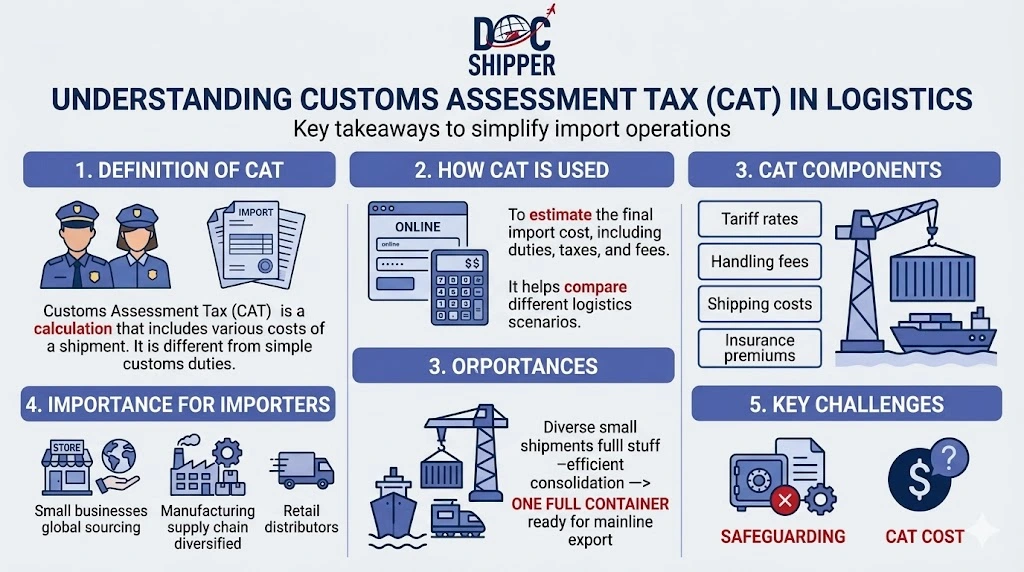
Customs Assessment Tax (CAT) is a levy imposed by customs authorities on imported goods based on their declared value, classification, and origin. This tax represents the total fiscal obligation calculated during customs clearance, including duties, VAT, and additional charges, ensuring compliance with national trade regulations.Introduction
Many importers face unexpected costs when their shipments arrive at customs. The confusion often stems from misunderstanding the Customs Assessment Tax, a comprehensive charge that goes beyond simple import duties. This tax directly impacts profit margins and supply chain planning for international trade operations.
In global logistics, CAT serves as the primary revenue mechanism for governments while regulating trade flows. It ensures that imported goods contribute fairly to national economies while maintaining competitive market conditions.
Key characteristics of Customs Assessment Tax include:
- Multi-component structure combining various fiscal elements
- Valuation-based calculation tied to declared customs value
- HS Code dependency determining applicable rates
- Origin-sensitive affected by trade agreements and preferential tariffs
- Mandatory compliance with penalties for misclassification or undervaluation
Understanding CAT: Components & Legal Framework
The Customs Assessment Tax comprises multiple fiscal elements that customs authorities calculate during clearance procedures. The primary components include customs duties (ad valorem or specific rates), Value Added Tax (applied on CIF value plus duties), excise taxes for specific product categories, and anti-dumping duties when applicable.
The customs valuation method follows the WTO Valuation Agreement, primarily using transaction value as the baseline. This includes the FOB price plus international freight, insurance, and other costs until the first port of entry. Authorities may adjust values if they suspect undervaluation or transfer pricing manipulation.
The Harmonized System (HS) classification determines the applicable duty rate for each product. A single digit error in the 6 to 10-digit HS code can result in significantly different tax obligations. Customs officers verify classifications against commercial invoices, technical specifications, and product samples.
Preferential trade agreements can substantially reduce CAT obligations. Free Trade Agreements (FTAs), Generalized System of Preferences (GSP), and Economic Partnership Agreements (EPAs) offer reduced or zero-duty rates when proper certificates of origin are provided. Documentation requirements vary by agreement and must be verified before shipment.
The legal framework governing CAT stems from national customs codes, international conventions (Kyoto Convention, WTO agreements), and bilateral trade treaties. The European Union applies the Union Customs Code (UCC), while the United States follows Title 19 of the Code of Federal Regulations. Non-compliance can trigger audits, penalties ranging from 10% to 40% of unpaid duties, and potential criminal prosecution for fraud. According to the World Customs Organization, harmonized procedures facilitate trade while ensuring revenue collection.
At DocShipper, we systematically verify CAT calculations before clearance to prevent costly delays and ensure accurate duty payments for our clients’ shipments.
Calculation Methods & Practical Examples
The standard CAT calculation formula follows this sequence: Customs Value (CIF) × Customs Duty Rate = Duty Amount, then (Customs Value + Duty Amount) × VAT Rate = VAT Amount. The total CAT equals the sum of all applicable charges.
Consider this practical scenario for electronics imports:
| Component | Amount (USD) | Calculation |
|---|---|---|
| FOB Value | $50,000 | Invoice price |
| Freight + Insurance | $3,500 | International transport costs |
CIF Value (Customs Value) | $53,500 | Basis for duty calculation |
| Customs Duty (3.5%) | $1,873 | $53,500 × 3.5% |
| Taxable Base for VAT | $55,373 | CIF + Duty |
| VAT (20%) | $11,075 | $55,373 × 20% |
| Total CAT | $12,948 | Duty + VAT |
Comparative scenario analysis reveals significant variations based on trade agreements:
- Standard MFN rate: Total CAT = $12,948 (24.2% of FOB value)
- With FTA preferential rate (0% duty): Total CAT = $10,700 (21.4% of FOB value) – saving $2,248
- GSP-eligible developing country: Potential 50% duty reduction = $11,824 total CAT
- Misclassification penalty scenario: If reclassified to 8.5% duty rate, total CAT jumps to $16,175 plus 15% penalty = $18,601
- Transfer pricing adjustment: If customs revalues at $60,000 CIF, total CAT increases to $14,520
The effective CAT rate (total tax as percentage of FOB value) varies dramatically by product category. Electronics typically face 20-25% effective rates, textiles 25-35%, automotive parts 15-20%, and agricultural products 10-40% depending on protection policies.
Timing considerations affect cash flow planning. CAT payment is required before cargo release, typically within 10-15 days of arrival. Deferred payment schemes exist in some jurisdictions, allowing authorized traders to pay monthly rather than per shipment, improving working capital management.
Conclusion
Customs Assessment Tax represents a complex but manageable cost element in international trade. Accurate calculation requires understanding valuation principles, classification systems, and applicable trade agreements. Strategic planning around CAT obligations directly impacts competitive positioning and profitability.
Need expert assistance navigating CAT calculations for your imports? Contact DocShipper for comprehensive customs clearance support tailored to your supply chain needs.
📚 Quiz
Test Your Knowledge: Customs Assessment Tax (CAT)
Q1 — What does the Customs Assessment Tax (CAT) represent in international trade?
Q2 — A common misconception about CAT is that Free Trade Agreements (FTAs) eliminate it entirely. What is the correct interpretation?
Q3 — An importer ships electronics with a CIF value of $53,500 and a 3.5% customs duty rate. VAT is 20%. What is the correct taxable base used to calculate VAT?
🎯 Your Result
📞 Free Quote in 24hFAQ | CAT (Customs Assessment Tax): Definition, Calculation & Practical Examples
Customs duty is one component of CAT. CAT includes customs duty plus VAT, excise taxes, and other charges assessed during clearance. It represents the total tax obligation, not just the import duty rate.
Customs value typically equals the CIF price (Cost, Insurance, Freight) to the port of entry. It includes the invoice price plus international transport and insurance costs, following WTO Valuation Agreement principles.
Yes, through preferential trade agreements, accurate HS classification, proper valuation documentation, and utilizing duty relief schemes like temporary admission or bonded warehouses where applicable.
Customs authorities conduct post-clearance audits. Undervaluation triggers penalties of 10-40% of unpaid duties, interest charges, potential criminal prosecution, and loss of trusted trader status affecting future clearances.
The importer of record bears legal responsibility for CAT payment. This may be the buyer, a customs broker acting on their behalf, or a freight forwarder with proper authorization and financial guarantees.
Each HS code corresponds to specific duty rates. A classification error can result in overpayment or underpayment, both problematic. Proper classification requires technical product knowledge and tariff schedule expertise.
Yes, exemptions exist for diplomatic goods, humanitarian aid, returned goods, samples of negligible value, and items under de minimis thresholds (typically $200-$800 depending on country).
CAT must be paid before cargo release from customs control. Payment timing varies by country but typically occurs within 10-15 days of arrival. Some jurisdictions offer deferred payment for authorized traders.
FTAs reduce or eliminate customs duties for qualifying goods with proper certificates of origin. VAT typically remains applicable. The reduction directly lowers total CAT but requires compliance with rules of origin.
Most jurisdictions offer duty drawback programs allowing refunds of duties paid on re-exported goods. VAT refunds follow different procedures. Strict documentation and time limits apply, typically 3-12 months.
Essential documents include commercial invoice, packing list, bill of lading/airway bill, certificate of origin (if claiming preferences), import license (for regulated goods), and technical specifications for classification purposes.
Verification methods include document review, database checks against comparable transactions, physical inspection, laboratory testing for composition analysis, and post-clearance audits of importer records covering 3-5 years of transactions.
Need Help with
Logistics or Sourcing ?
First, we secure the right products from the right suppliers at the right price by managing the sourcing process from start to finish. Then, we simplify your shipping experience - from pickup to final delivery - ensuring any product, anywhere, is delivered at highly competitive prices.


Fill the Form
Prefer email? Send us your inquiry, and we’ll get back to you as soon as possible.
Contact us




:%20Definition,%20Calculation%20&%20Practical%20Examples)