


In short ⚡
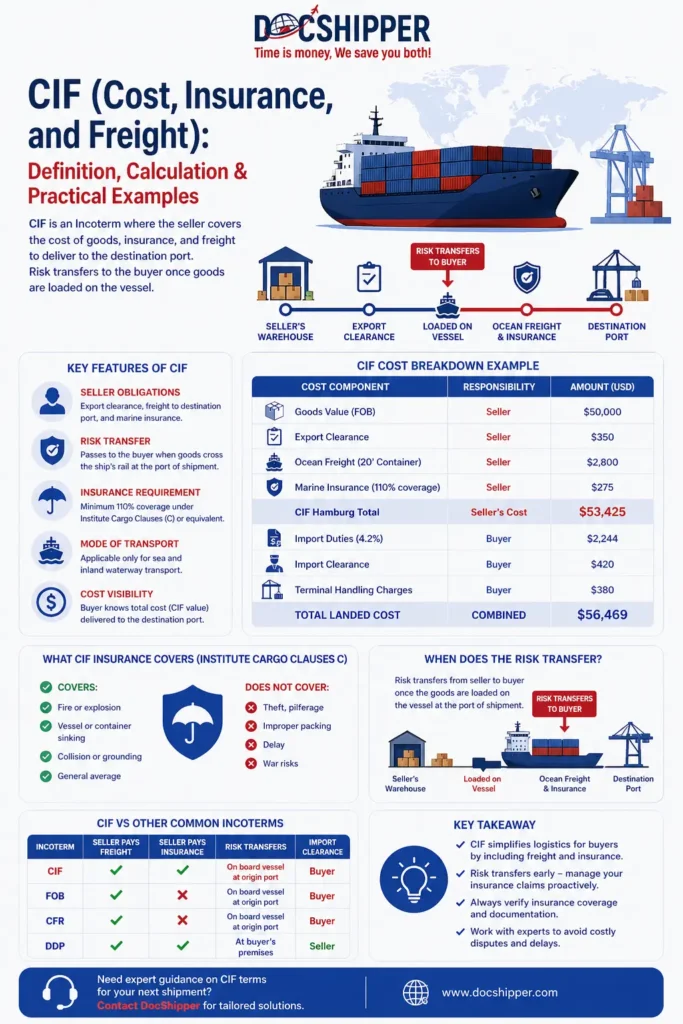
CIF (Cost, Insurance, and Freight) is an Incoterm where the seller covers all costs, insurance, and freight to deliver goods to the destination port. The buyer assumes risk once goods are loaded on the vessel, while the seller handles export clearance and marine insurance.Introduction
Many importers mistakenly believe CIF means the seller is responsible until goods arrive at their warehouse. This confusion leads to disputes over damaged cargo and insurance claims. Understanding CIF is essential because it defines precisely when risk transfers and who pays for what in international shipping.
In global trade, CIF remains one of the most commonly used terms for ocean freight. It provides a clear framework for cost allocation while protecting both parties through mandatory insurance coverage.
- Seller obligations: Export clearance, freight costs, and marine insurance to destination port
- Risk transfer: Passes to buyer when goods cross the ship’s rail at origin port
- Insurance requirement: Minimum coverage under Institute Cargo Clauses (C) or equivalent
- Mode of transport: Exclusively for sea and inland waterway transport
- Cost visibility: Buyer knows total landed cost at destination port upfront
CIF Mechanics and Responsibilities
Under CIF terms, the seller must contract and pay for carriage to the named destination port. However, risk diverges from cost—a critical distinction many overlook. The seller delivers when goods pass the ship’s rail at the port of shipment, not when they arrive at destination.
The insurance obligation is particularly important. The seller must procure cargo insurance covering 110% of the contract value, with minimum coverage equivalent to Institute Cargo Clauses (C). This protects against major casualties but excludes many specific risks. Buyers requiring comprehensive coverage should negotiate additional insurance or upgrade to Institute Cargo Clauses (A).
Export clearance falls entirely on the seller, including licenses, customs formalities, and security clearances. The buyer handles import clearance, duties, and taxes at destination. This division creates a clean separation of regulatory responsibilities across jurisdictions.
The documentation burden requires the seller to provide the commercial invoice, insurance policy, and transport document (bill of lading or sea waybill). These documents must enable the buyer to claim goods at destination and file insurance claims if necessary. According to ICC Incoterms® 2020, electronic equivalents are acceptable when agreed between parties.
Cost components the seller must cover include merchandise cost, export packing, loading charges at origin, freight to destination port, and marine insurance premium. The buyer pays for unloading at destination (unless included in freight), import duties, customs clearance, and inland transport from the port.
At DocShipper, we verify all CIF documentation before shipment to ensure insurance certificates meet minimum requirements and transport documents correctly reflect the agreed terms, preventing costly disputes at destination.
Practical Examples and Cost Breakdown
Understanding CIF pricing becomes clearer through concrete scenarios. Consider a shipment of electronics from Shenzhen to Hamburg valued at $50,000.
| Cost Component | Responsibility | Amount (USD) |
|---|---|---|
| Goods Value (FOB) | Seller | $50,000 |
| Export Clearance | Seller | $350 |
| Ocean Freight (20′ Container) | Seller | $2,800 |
| Marine Insurance (110% coverage) | Seller | $275 |
| CIF Hamburg Total | Seller’s Cost | $53,425 |
| Import Duties (4.2%) | Buyer | $2,244 |
| Import Clearance | Buyer | $420 |
| Terminal Handling Charges | Buyer | $380 |
| Total Landed Cost | Combined | $56,469 |
Critical scenario: If the container is damaged during loading at Shenzhen port, the seller bears the loss and must replace or repair the goods. However, if damage occurs during ocean transit, the buyer files a claim against the insurance policy provided by the seller. This distinction causes frequent misunderstandings.
Insurance coverage limitations under standard CIF terms exclude certain risks. The minimum Institute Cargo Clauses (C) coverage typically excludes theft, pilferage, and damage from improper stowage. For high-value electronics, buyers should verify coverage adequacy or arrange supplementary insurance.
Comparative advantage: CIF provides cost predictability for buyers who want freight and insurance included but prefer controlling import clearance and inland distribution. It works well for established importers with customs expertise but limited shipping knowledge.
Regional variations show CIF usage concentrated in commodity trades (grain, oil, minerals) and manufacturing imports from Asia. European and North American buyers frequently use CIF for containerized shipments, while FOB remains dominant for bulk cargo where buyers control vessel chartering.
Documentation timing is crucial—the seller must provide insurance certificates and bills of lading immediately after shipment. Delays prevent buyers from claiming goods at destination or filing timely insurance claims. At DocShipper, we implement automated document tracking to ensure all CIF paperwork reaches buyers within 24 hours of vessel departure.
Conclusion
CIF offers a balanced approach where sellers handle logistics complexity while buyers assume risk early in the journey. Understanding the precise moment of risk transfer and insurance coverage limits prevents costly disputes.
Need guidance on CIF terms for your next shipment? Contact DocShipper for expert support on Incoterms selection and documentation compliance.
📚 Quiz
Test Your Knowledge: CIF (Cost, Insurance, and Freight)
1. Under CIF terms, what does the seller's responsibility cover?
2. Under CIF, when exactly does risk transfer from the seller to the buyer?
3. A buyer imports electronics from Shenzhen to Hamburg under CIF terms. The container is damaged during the ocean voyage. Who is responsible for filing the insurance claim?
🎯 Your Result
📞 Free Quote in 24hFAQ | CIF (Cost, Insurance, and Freight): Definition, Calculation & Practical Examples
CIF includes marine insurance paid by the seller, while CFR (Cost and Freight) excludes insurance. Under CFR, the buyer must arrange their own cargo insurance coverage for the ocean voyage.
Risk transfers when goods pass the ship's rail at the port of shipment, not at destination. This occurs during loading operations at the origin port, even though the seller pays freight to destination.
No. CIF applies exclusively to sea and inland waterway transport. For air shipments, use CIP (Carriage and Insurance Paid To) instead, which covers all transport modes including air freight.
The seller must provide insurance covering 110% of the contract value with minimum coverage equivalent to Institute Cargo Clauses (C). This covers major casualties but excludes many specific risks like theft or improper stowage.
Typically the buyer, unless the freight contract specifically includes discharge costs. Terminal handling charges and unloading fees generally fall on the buyer under standard CIF terms.
No. Once risk transfers at the origin port, the buyer must file claims against the insurance policy provided by the seller. The seller's responsibility ends after proper loading and insurance procurement.
DDP (Delivered Duty Paid) places maximum responsibility on the seller, including import clearance and duties. CIF stops at the destination port, requiring buyers to handle customs clearance and inland delivery themselves.
No. The seller selects the carrier and books freight under CIF terms. Buyers wanting carrier control should negotiate FOB terms and arrange their own shipping contracts.
The seller must provide the commercial invoice, insurance policy or certificate, and transport document (bill of lading or sea waybill). These documents enable the buyer to claim goods and file insurance claims.
No. Import duties, taxes, and customs clearance fees are the buyer's responsibility. CIF covers only costs up to the destination port, excluding import formalities and charges.
Insurance typically costs 0.3% to 0.8% of the cargo value, calculated on 110% of the contract value. Rates vary based on commodity type, route, and coverage level selected.
Yes. Parties can negotiate variations like "CIF Landed" (seller pays unloading) or enhanced insurance coverage. Any modifications should be clearly documented in the sales contract to avoid disputes.
Need Help with
Logistics or Sourcing ?
First, we secure the right products from the right suppliers at the right price by managing the sourcing process from start to finish. Then, we simplify your shipping experience - from pickup to final delivery - ensuring any product, anywhere, is delivered at highly competitive prices.


Fill the Form
Prefer email? Send us your inquiry, and we’ll get back to you as soon as possible.
Contact us




