


In short ⚡
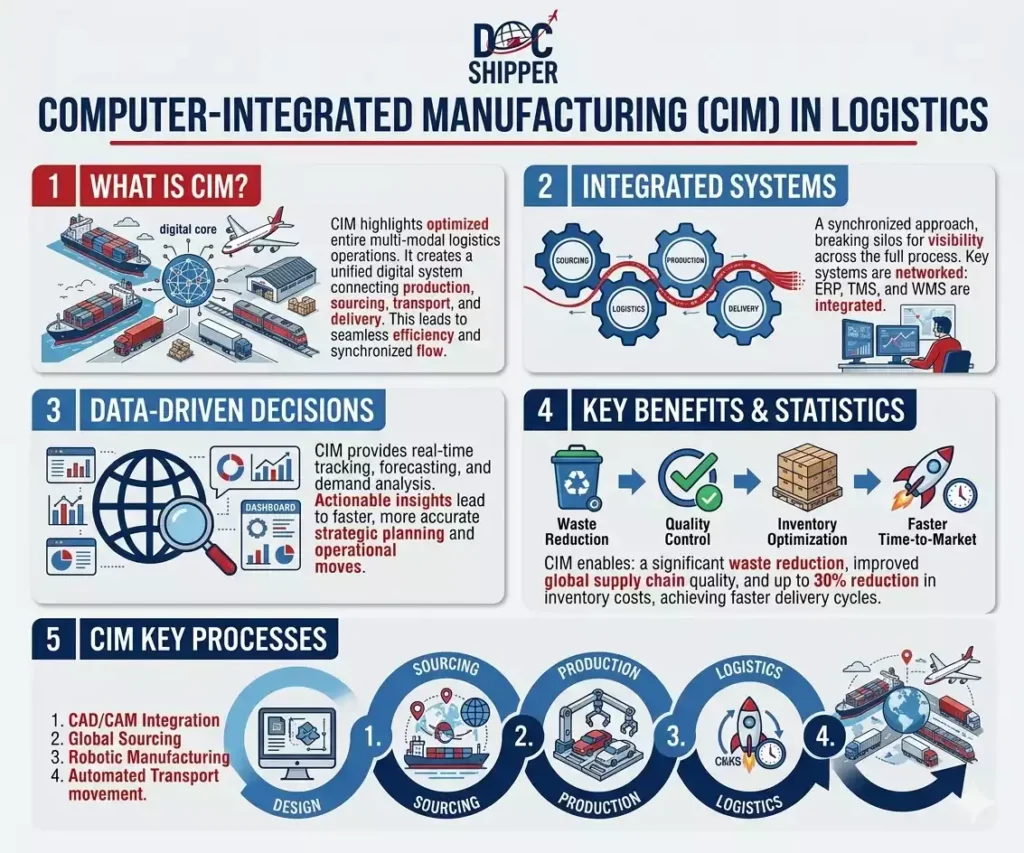
Computer-Integrated Manufacturing (CIM) is an automated production approach that integrates computer systems across design, planning, manufacturing, and distribution processes. This holistic framework enables real-time data exchange between CAD, CAM, ERP, and production systems to optimize efficiency, reduce errors, and accelerate time-to-market in modern supply chains.
Introduction
Many manufacturers struggle with disconnected systems where design teams, production floors, and logistics departments operate in silos. This fragmentation leads to data inconsistencies, production delays, and quality control issues that directly impact international shipment schedules.
CIM addresses these challenges by creating a unified digital ecosystem where all manufacturing operations communicate seamlessly. For companies engaged in global trade, this integration becomes critical when coordinating production timelines with customs clearance, freight booking, and delivery commitments.
- End-to-end automation: From initial design specifications to final quality inspection and packaging
- Real-time visibility: Live production status accessible to supply chain partners and freight forwarders
- Data-driven decisions: Predictive analytics for capacity planning and shipment scheduling
- Quality consistency: Automated inspection protocols that reduce customs rejection risks
- Rapid adaptation: Quick reconfiguration for different product specifications or order modifications
Technical Framework & System Integration
CIM architecture consists of interconnected layers that transform manufacturing from a manual process into an intelligent, self-optimizing system. Understanding these components is essential for logistics professionals coordinating with production facilities.
The design layer includes CAD (Computer-Aided Design) and CAE (Computer-Aided Engineering) systems that create digital product models. These specifications automatically feed into manufacturing systems, eliminating transcription errors that often delay export documentation preparation.
The planning layer encompasses MRP (Material Requirements Planning) and ERP (Enterprise Resource Planning) platforms. These systems calculate production schedules, material needs, and capacity constraints while simultaneously generating accurate lead times for freight forwarders and customers.
Manufacturing Execution Systems (MES) form the operational core, controlling robotics, CNC machines, and automated assembly lines. Real-time production data from MES enables precise shipment forecasting—critical when booking container space or coordinating just-in-time delivery.
The quality management layer uses automated inspection technologies including machine vision and IoT sensors. Continuous quality verification reduces the risk of non-conforming goods reaching international borders, where rejection can trigger costly storage fees and delayed shipments.
Supply chain integration connects CIM outputs directly to logistics platforms. At DocShipper, we leverage these data feeds to synchronize production completion with customs pre-clearance procedures, ensuring goods move immediately from factory floor to export channel without administrative delays.
According to the National Institute of Standards and Technology, properly implemented CIM systems can reduce manufacturing lead times by 30-50%, directly impacting supply chain responsiveness and customer satisfaction in international markets.
Implementation Examples & Performance Data
Examining real-world CIM deployments reveals measurable impacts on production efficiency and logistics coordination. These benchmarks help businesses evaluate potential ROI when considering system upgrades.
| Industry Sector | CIM Components | Lead Time Reduction | Quality Improvement |
|---|---|---|---|
| Automotive Parts | CAD/CAM + Robotics + MES | 42% faster turnaround | 98.7% first-pass yield |
| Electronics Assembly | ERP + Automated Testing + Vision Systems | 35% reduction in cycle time | Defect rate below 0.3% |
| Pharmaceutical Packaging | MES + Track-and-Trace + ERP | 28% faster batch completion | 100% serialization compliance |
| Aerospace Components | CAD/CAE + CNC + Quality Management | 50% reduction in engineering changes | Zero non-conformance reports |
Case Study: Electronics Manufacturer Export Optimization
A mid-sized electronics producer implemented full CIM integration connecting design, production, and logistics systems. Production completion data now automatically triggers customs documentation generation and freight booking through integrated platforms.
- Before CIM: 6-day average gap between production completion and shipment departure
- After CIM: 1.5-day average gap, with 89% of orders shipping within 24 hours of completion
- Documentation accuracy: Customs clearance delays reduced by 73% due to automated data validation
- Inventory costs: Finished goods storage reduced by $180,000 annually through faster turnover
- Customer satisfaction: On-time delivery performance improved from 82% to 96%
For international shipments, CIM’s production visibility enables proactive logistics planning. When DocShipper integrates with client CIM systems, we receive real-time production status updates that allow us to pre-position containers, complete customs pre-clearance, and coordinate final-mile delivery—eliminating the traditional waiting periods between manufacturing and shipping.
Cost-Benefit Analysis: A typical CIM implementation for a medium-scale manufacturer (annual revenue $50-100M) requires $2-4M capital investment. Payback periods average 18-24 months through combined savings in labor costs, reduced defects, lower inventory carrying costs, and faster cash conversion cycles from accelerated shipments.
Conclusion
Computer-Integrated Manufacturing represents the convergence of production technology and supply chain intelligence. For businesses engaged in international trade, CIM delivers the production predictability and data transparency that modern logistics demands.
Need assistance optimizing your manufacturing-to-shipment workflow? Contact DocShipper to discuss how we integrate with CIM systems for seamless export coordination.
📚 Quiz
Test Your Knowledge: Computer-Integrated Manufacturing (CIM)
1. What best defines Computer-Integrated Manufacturing (CIM)?
2. A common misconception about CIM is that it only automates the physical production floor. What does CIM actually integrate?
3. An electronics manufacturer has implemented full CIM integration. Which outcome best reflects the real-world logistics benefit of this system?
🎯 Your Result
📞 Free Quote in 24hFAQ | CIM (Computer-Integrated Manufacturing): Definition, Components & Real-World Applications
CIM integrates all manufacturing systems into a unified digital framework, whereas traditional automation focuses on isolated processes. CIM enables data flow from design through production to shipping, while conventional automation typically requires manual coordination between departments.
CIM systems automatically generate product specifications, quantities, and compliance data directly from production records. This eliminates manual data entry errors that commonly cause customs delays, ensuring commercial invoices, packing lists, and certificates of origin reflect actual manufactured goods.
Yes, though scaled appropriately. Small operations can implement modular CIM components—starting with ERP integration and automated quality control—rather than full-scale systems. Cloud-based CIM platforms now offer affordable subscription models suitable for businesses with annual revenues under $10 million.
Essential data includes production completion dates, finished goods quantities, pallet counts, gross weights, and quality certification status. This information enables forwarders to pre-book cargo space, prepare shipping documentation, and coordinate pickup schedules without production floor visits.
CIM typically reduces production lead times by 30-50% through optimized scheduling, reduced setup times, and elimination of manual coordination delays. For international orders, this compression allows manufacturers to accept orders closer to shipment dates while maintaining delivery commitments.
CIM systems contain sensitive product designs, production schedules, and customer data that require protection. Exporters should implement network segmentation, encrypted data transmission, and role-based access controls. Compliance with standards like ISO 27001 helps mitigate risks of intellectual property theft or production disruption.
CIM systems can embed compliance checks directly into production workflows. For pharmaceuticals, medical devices, or food products, automated quality systems generate batch records and certificates that customs authorities accept as proof of regulatory compliance, expediting clearance processes.
Full CIM deployment typically requires 12-24 months depending on facility size and existing automation levels. Phased implementations starting with ERP integration and expanding to manufacturing execution systems allow continued production during transition periods while delivering incremental benefits.
CIM excels in make-to-order environments by enabling rapid production reconfiguration. Systems can automatically adjust tooling, material requirements, and quality parameters based on specific order specifications, making customized production as efficient as standardized runs—critical for export markets requiring product variations.
Real-time production status allows logistics providers to synchronize transportation with actual manufacturing completion rather than estimated dates. This visibility reduces demurrage charges from early container positioning and eliminates rushed air freight costs from unexpected production delays.
CIM enables centralized visibility and control across geographically distributed facilities. Companies can balance production loads between plants, standardize quality protocols, and coordinate shipments from multiple origins to optimize freight consolidation and reduce overall logistics costs.
CIM's traceability features enable precise identification of affected products by production batch, date, and destination. This granular tracking allows targeted recalls rather than broad market withdrawals, minimizing costs and protecting brand reputation when products have been distributed across multiple countries.
Need Help with
Logistics or Sourcing ?
First, we secure the right products from the right suppliers at the right price by managing the sourcing process from start to finish. Then, we simplify your shipping experience - from pickup to final delivery - ensuring any product, anywhere, is delivered at highly competitive prices.


Fill the Form
Prefer email? Send us your inquiry, and we’ll get back to you as soon as possible.
Contact us




:%20Definition,%20Components%20&%20Real-World%20Applications)