


In short ⚡
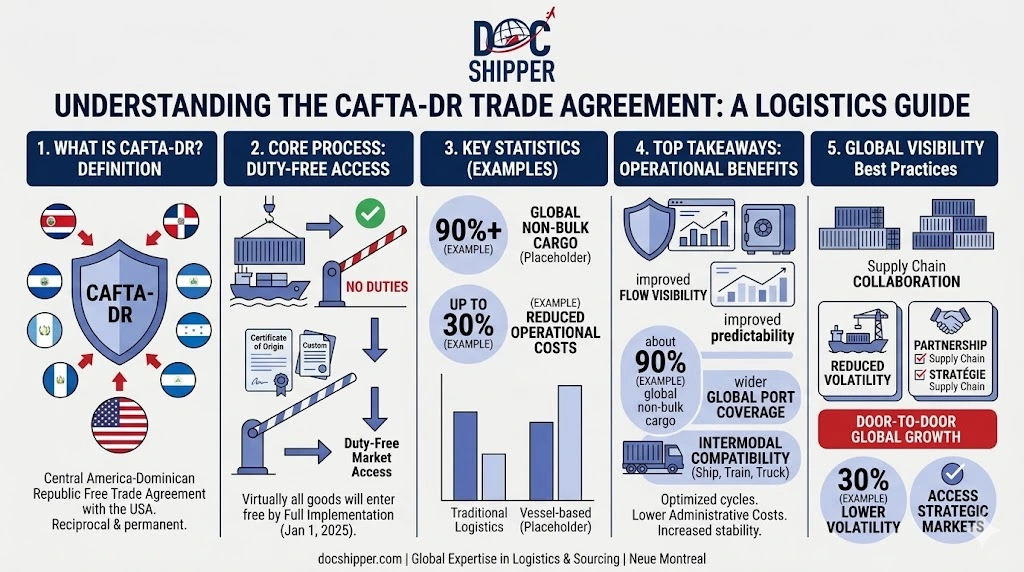
CAFTA-DR (Dominican Republic-Central American Free Trade Agreement) is a comprehensive trade agreement between the United States and six Central American nations: Costa Rica, El Salvador, Guatemala, Honduras, Nicaragua, and the Dominican Republic. Established in 2004, it eliminates tariffs on over 80% of traded goods, facilitates investment flows, and strengthens intellectual property protections across member countries.
Introduction
Many importers struggle to understand which preferential trade agreements apply to their Central American shipments. Confusion between CAFTA-DR and other regional agreements often leads to missed duty savings or compliance errors.
This agreement represents a critical framework for businesses engaged in North-South American trade. It creates predictable market access rules and reduces operational costs for companies sourcing from or selling to Central America.
Key characteristics of CAFTA-DR include:
- Tariff elimination: Immediate removal of duties on 80% of U.S. exports to the region
- Rules of Origin: Specific requirements determining product eligibility for preferential treatment
- Textile provisions: Special yarn-forward rules benefiting apparel manufacturers
- Services liberalization: Market access improvements in telecommunications, finance, and distribution
- Investment protections: Legal safeguards for cross-border business operations
Mechanisms & Legal Implications
CAFTA-DR operates through a complex framework of preferential tariff schedules that phase out duties over different timelines. While most industrial goods received immediate duty-free treatment, sensitive agricultural products follow gradual reduction schedules extending up to 20 years.
The agreement’s Rules of Origin determine whether a product qualifies for preferential treatment. Goods must be wholly obtained in member countries or undergo substantial transformation. For manufactured products, this typically requires a tariff classification change or specific regional value content thresholds.
A distinctive feature is the textile and apparel chapter, which requires most garments to be made from yarns and fabrics produced within CAFTA-DR or the United States. This “yarn forward” rule supports regional textile integration while protecting domestic fiber producers.
The agreement establishes customs procedures requiring importers to make written claims for preferential treatment and maintain documentation proving origin compliance for at least five years. Customs authorities may conduct origin verifications through questionnaires or facility visits.
Dispute resolution mechanisms provide structured processes for addressing trade conflicts. Panels of independent experts can issue binding decisions when countries disagree on agreement interpretation or implementation. According to the Office of the United States Trade Representative, this framework has successfully resolved multiple commercial disputes since implementation.
At DocShipper, we systematically verify CAFTA-DR origin documentation and ensure proper tariff classifications to maximize your duty savings while maintaining full customs compliance.
Trade Data & Concrete Examples
CAFTA-DR has generated measurable economic impacts since its implementation. Understanding these patterns helps businesses identify opportunities and benchmark their regional trade strategies.
| Country | Year Entered Force | Top U.S. Export Categories | Duty Savings (Annual) |
|---|---|---|---|
| El Salvador | 2006 | Textiles, Machinery, Plastics | $180 million |
| Guatemala | 2006 | Petroleum, Cereals, Machinery | $220 million |
| Honduras | 2006 | Apparel, Electrical Equipment | $165 million |
| Nicaragua | 2006 | Machinery, Textiles, Vehicles | $95 million |
| Dominican Republic | 2007 | Petroleum, Machinery, Food | $310 million |
| Costa Rica | 2009 | Electronics, Medical Devices | $275 million |
Practical Case Study: A U.S. electronics manufacturer sources components from Costa Rica valued at $2 million annually. Under MFN (Most Favored Nation) tariffs, these imports would incur duties averaging 3.5%, totaling $70,000 yearly. By properly claiming CAFTA-DR preferential treatment and maintaining compliant origin documentation, the company eliminates these duties entirely, directly improving profit margins.
Key operational benefits observed by businesses utilizing CAFTA-DR:
- Reduced landed costs: Average duty savings of 4-8% on qualifying goods
- Supply chain flexibility: Ability to source regionally without tariff penalties
- Competitive advantage: Lower input costs versus non-preferential suppliers
- Simplified procedures: Streamlined customs processing for certified traders
- Investment security: Legal protections encouraging long-term regional partnerships
The textile sector demonstrates particularly strong growth. Honduras and El Salvador have become major apparel exporters to the U.S., with combined shipments exceeding $4 billion annually under CAFTA-DR preferences.
Conclusion
CAFTA-DR represents a strategic tool for businesses engaged in Central American trade, offering substantial duty savings and operational advantages when properly leveraged. Understanding its origin requirements and documentation standards is essential for compliance and cost optimization.
Need expert guidance on CAFTA-DR compliance or want to maximize your duty savings? Contact DocShipper for specialized support tailored to your supply chain.
📚 Quiz
Test Your Knowledge: CAFTA-DR
Q1 — What is CAFTA-DR?
Q2 — Under CAFTA-DR's "yarn-forward" rule, which of the following statements is correct?
Q3 — A U.S. importer sources $500,000 worth of electronic components from Costa Rica but does not file a CAFTA-DR preferential treatment claim. What is the most likely outcome?
🎯 Your Result
📞 Free Quote in 24hFAQ | CAFTA-DR: Definition, Member Countries & Trade Benefits Explained
The agreement includes the United States, Costa Rica, El Salvador, Guatemala, Honduras, Nicaragua, and the Dominican Republic. These seven nations form the complete membership of CAFTA-DR.
Importers must make a written claim on the customs entry documentation and possess a valid Certificate of Origin or equivalent proof that goods meet Rules of Origin requirements. Documentation must be maintained for five years.
For textiles and apparel to qualify for duty-free treatment, they must be made from yarns and fabrics produced in CAFTA-DR member countries or the United States. This rule promotes regional textile integration.
Yes, materials and production processes from any member country can be cumulated to meet origin requirements. This flexibility supports regional supply chain integration and manufacturing collaboration.
Over 80% of U.S. exports to CAFTA-DR countries received immediate duty-free access upon implementation. Remaining products follow phased reduction schedules based on sensitivity classifications.
Yes, the agreement includes comprehensive chapters on services liberalization, investment protections, and intellectual property rights. These provisions extend beyond traditional goods trade to facilitate broader economic integration.
Both importers and exporters must maintain all documentation supporting origin claims for at least five years from the date of importation. This enables customs authorities to conduct post-entry verifications.
Products failing to meet CAFTA-DR Rules of Origin will be subject to standard MFN tariff rates. Importers may face duty assessments, penalties, and interest if false origin claims are discovered during verification.
Yes, CAFTA-DR allows producer or exporter certification rather than requiring government-issued certificates. The certifying party assumes responsibility for accuracy and must support claims with detailed production records.
Yes, most products may contain up to 10% non-originating materials by value and still qualify as originating. This tolerance facilitates compliance for goods incorporating minor third-country components.
The agreement eliminates tariffs on most agricultural products through immediate or phased reductions. Sensitive items like sugar, dairy, and certain meats follow longer transition periods to protect domestic producers.
The agreement establishes formal consultation procedures and independent arbitration panels to resolve trade disputes. These mechanisms provide structured processes for addressing disagreements on implementation or interpretation.
Need Help with
Logistics or Sourcing ?
First, we secure the right products from the right suppliers at the right price by managing the sourcing process from start to finish. Then, we simplify your shipping experience - from pickup to final delivery - ensuring any product, anywhere, is delivered at highly competitive prices.


Fill the Form
Prefer email? Send us your inquiry, and we’ll get back to you as soon as possible.
Contact us




