


In short ⚡
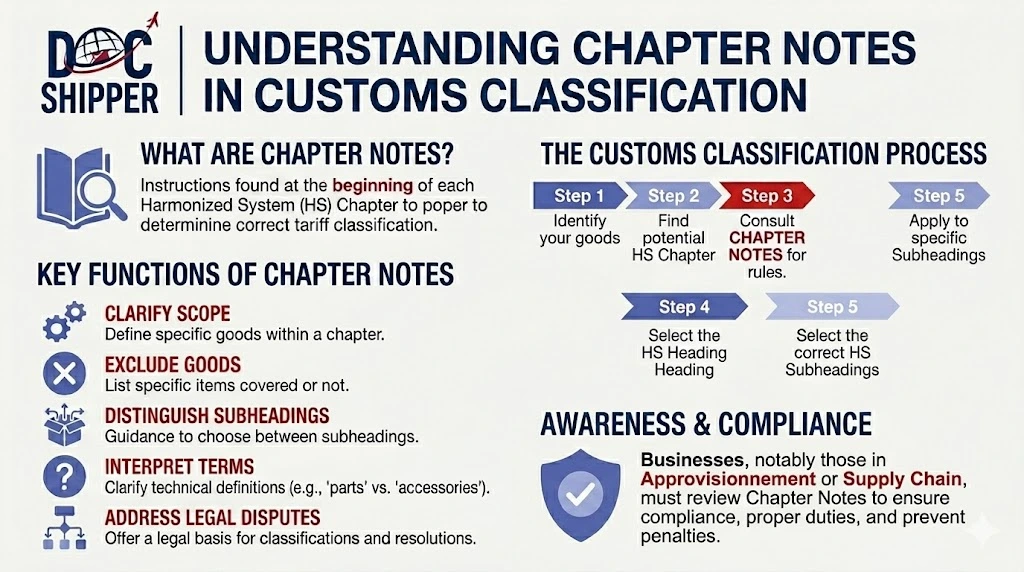
Chapter Notes are official interpretative texts published within the Harmonized System (HS) that provide binding guidance on classifying goods under specific HS chapters. These notes clarify scope, exclusions, and technical definitions, ensuring uniform tariff classification across all signatory countries and preventing customs disputes.
Introduction
Customs classification errors cost businesses millions annually in penalties, delays, and overpaid duties. The root cause? Misunderstanding or overlooking Chapter Notes—the foundational rules that govern how products are categorized under the Harmonized System.
In international trade, Chapter Notes function as the legal backbone of tariff classification. They define what belongs in each HS chapter and what doesn’t. Without mastering these notes, even experienced importers risk misclassifying goods, triggering audits or shipment holds.
- Legal precedence: Chapter Notes override general classification logic when conflicts arise
- Binding interpretation: Customs authorities worldwide apply these notes uniformly
- Scope definition: They explicitly list included and excluded product categories
- Technical clarification: Notes resolve ambiguities in heading descriptions
- Cross-chapter guidance: They prevent overlapping classifications between chapters
Technical Framework & Legal Authority
Chapter Notes appear at the beginning of each HS chapter in the official World Customs Organization nomenclature. They carry the same legal weight as the chapter headings themselves, meaning compliance is mandatory for all 159 HS Convention signatories.
These notes operate on three hierarchical levels. Section Notes apply to multiple chapters within a section. Chapter Notes govern individual chapters. Subheading Notes refine classification at the six-digit level. When contradictions occur, the more specific note prevails.
The General Interpretative Rules (GIR) work alongside Chapter Notes. GIR 1 states that classification is determined by heading texts and relevant Section/Chapter Notes. This means you cannot classify a product correctly without consulting the applicable notes first.
Exclusion clauses represent the most critical function. For example, Chapter 94 (Furniture) Note 2 explicitly excludes lamps, even if furniture-like, redirecting them to Chapter 85. Ignoring this exclusion would result in incorrect duty calculations and potential penalties.
Composition thresholds often appear in notes. Chapter 71 (Precious Metals) specifies minimum metal content percentages required for classification. Products below these thresholds fall into different chapters, dramatically affecting duty rates.
At DocShipper, we systematically cross-reference Chapter Notes during classification reviews, ensuring your goods are declared under the correct HS code from the outset. This prevents costly reclassifications at destination ports.
Practical Applications & Classification Examples
Understanding Chapter Notes in theory differs vastly from applying them to real shipments. Consider a common scenario: classifying a wooden chair with built-in LED lighting. Does it belong in Chapter 44 (Wood Products), Chapter 94 (Furniture), or Chapter 85 (Electrical Equipment)?
Chapter 94 Note 2 clarifies that furniture remains in Chapter 94 even when incorporating lighting, provided the lighting is subordinate to the furniture function. The chair’s primary purpose is seating, not illumination. Without this note, classification becomes arbitrary.
| Product | Initial Assumption | Applicable Chapter Note | Correct Chapter |
|---|---|---|---|
| Plastic toy car with battery | Chapter 85 (Electrical) | Chapter 95 Note 1(m) | Chapter 95 (Toys) |
| Stainless steel cutlery set | Chapter 72 (Iron/Steel) | Chapter 82 Note 1(b) | Chapter 82 (Tools) |
| Leather wallet with metal frame | Chapter 83 (Metal Articles) | Chapter 42 Note 2(a) | Chapter 42 (Leather Goods) |
| Wooden jewelry box with velvet lining | Chapter 44 (Wood) | Chapter 71 Note 11 | Chapter 71 (Jewelry Boxes) |
Use Case: Pharmaceutical Classification
A company imports vitamin supplements in blister packs. Chapter 30 (Pharmaceutical Products) Note 1(a) states that products presented in measured doses or retail packaging for therapeutic use classify as medicaments. However, Chapter 21 Note 1(a) covers food supplements not meeting medicinal criteria. The determining factor? Whether the product makes therapeutic claims on its labeling. This single distinction changes duty rates from 0% to 6.5% in many jurisdictions.
Composite goods present the greatest challenge. Chapter Note applications become critical when products contain multiple materials. The essential character rule (GIR 3b) often requires consulting Chapter Notes to determine which component defines classification. A laptop bag with padded straps might seem like textile (Chapter 63), but Chapter 42 Note 2(ij) specifically includes such items when designed for specific articles.
DocShipper’s classification specialists maintain updated databases of Chapter Notes across all active HS versions, ensuring your products are classified according to the exact regulations applicable in your destination country.
Conclusion
Chapter Notes represent the difference between compliant, cost-effective customs clearance and expensive classification errors. Mastering these interpretative texts is non-negotiable for any business engaged in international trade.
Need expert guidance on HS classification and Chapter Note interpretation? Contact DocShipper for a comprehensive compliance review of your product catalog.
📚 Quizz
Test Your Knowledge: Chapter Notes
1. What is the primary purpose of Chapter Notes in the Harmonized System?
2. When a Chapter Note contradicts a heading description in the HS nomenclature, which takes precedence?
3. A company imports a battery-powered plastic toy car. A customs agent initially assumes it belongs in Chapter 85 (Electrical Equipment). Based on Chapter Notes, what is the correct classification?
🎯 Your Result
📞 Free Quote in 24hFAQ | Chapter Notes: Definition, Purpose & Practical Applications in Customs
Yes. Chapter Notes carry the same legal authority as HS headings under the Harmonized System Convention. Customs authorities worldwide must apply them when determining tariff classification.
Chapter Notes take precedence. The General Interpretative Rules explicitly state that classification is determined first by heading texts and relevant Section/Chapter Notes, with notes overriding general descriptions.
Yes. The World Customs Organization updates Chapter Notes every five years alongside HS revisions. Always verify which HS edition applies to your destination country.
No. Attempting classification without consulting applicable Chapter Notes almost guarantees errors, especially for composite goods, textiles, chemicals, and machinery.
The World Customs Organization publishes complete Chapter Notes in the official HS nomenclature. Many national customs websites also provide localized versions with additional explanatory notes.
Yes. Section Notes govern multiple chapters and must be consulted alongside Chapter Notes. When conflicts arise, the more specific note (usually Chapter Note) prevails.
Subheading Notes provide additional guidance at the six-digit level within a chapter. They refine classification but cannot contradict Chapter Notes or Section Notes.
Potentially. Correct application of Chapter Notes may reveal your product qualifies for a lower-duty classification than initially assumed, particularly for composite goods or articles with multiple possible chapters.
Exclusion clauses explicitly list products that do not belong in a chapter, even if they seem to match heading descriptions. These prevent overlapping classifications between chapters.
While not always required in the declaration itself, customs authorities expect importers to have consulted relevant Chapter Notes. Documentation supporting your classification should reference applicable notes.
Correct HS classification via Chapter Notes is essential for claiming preferential tariff treatment under FTAs. Misclassification can invalidate certificates of origin and preferential duty claims.
While interpretation should be uniform under the HS Convention, minor variations occur. The WCO publishes Classification Opinions to resolve disputes and ensure consistent application globally.
Need Help with
Logistics or Sourcing ?
First, we secure the right products from the right suppliers at the right price by managing the sourcing process from start to finish. Then, we simplify your shipping experience - from pickup to final delivery - ensuring any product, anywhere, is delivered at highly competitive prices.


Fill the Form
Prefer email? Send us your inquiry, and we’ll get back to you as soon as possible.
Contact us




