


In short ⚡
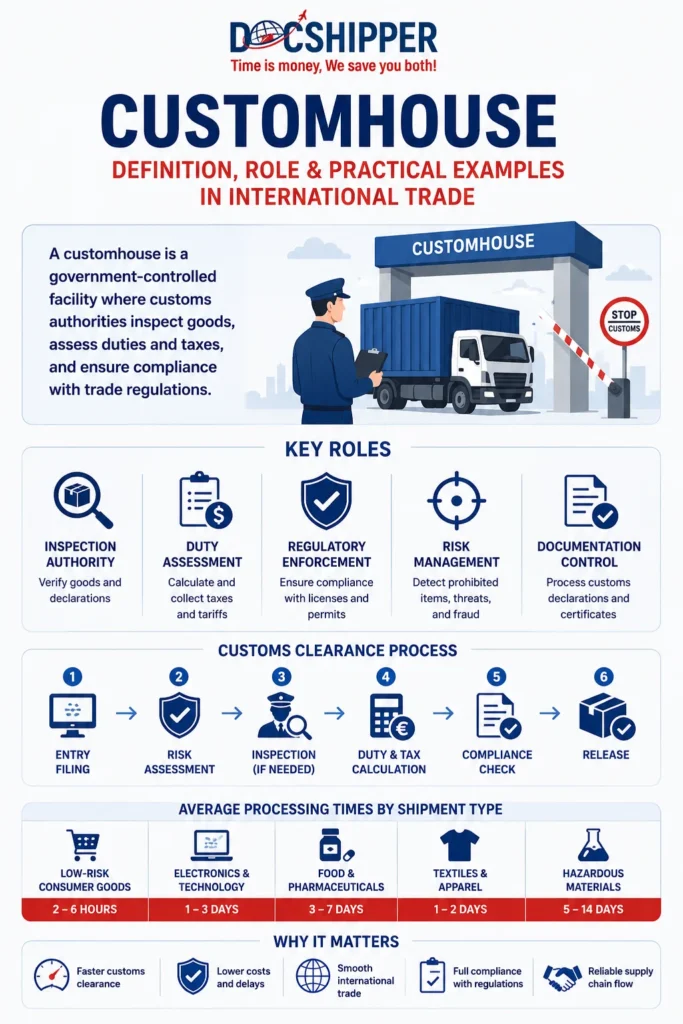
A customhouse is a government-controlled facility where customs authorities inspect imported and exported goods, assess duties and taxes, and ensure compliance with trade regulations. It serves as the official checkpoint for all cross-border commercial shipments entering or leaving a country's territory.
Introduction
Many importers confuse customhouses with freight terminals or warehouses. This misunderstanding leads to costly delays and compliance issues. Understanding what happens inside a customhouse is critical for smooth international operations.
The customhouse represents the government’s enforcement point for trade policy. Every commercial shipment crossing borders must pass through this checkpoint. Without proper documentation and compliance, goods remain stuck in limbo.
Key characteristics of customhouse operations include:
- Inspection authority: Physical examination of goods to verify declarations
- Duty assessment: Calculation and collection of import taxes and tariffs
- Regulatory enforcement: Verification of licenses, permits, and compliance certificates
- Risk management: Screening for prohibited items, security threats, and fraud
- Documentation control: Processing of customs declarations, invoices, and certificates of origin
Customhouse Operations & Regulatory Expertise
The customhouse functions as the legal gateway between international commerce and domestic markets. Customs officers stationed at these facilities hold legal authority to detain, inspect, or release shipments based on compliance criteria.
The clearance process begins when a shipment arrives at the port of entry. Importers or their customs brokers submit entry documents electronically. The customs system assigns a risk score determining whether physical inspection is required.
Modern customhouses operate under the Revised Kyoto Convention, an international framework standardizing customs procedures. This treaty, administered by the World Customs Organization, promotes predictable and transparent processing. According to WCO guidelines, member countries must implement risk-based inspections rather than examining every shipment.
Bonded warehouses within or adjacent to customhouses allow temporary storage of goods before duty payment. This arrangement provides flexibility for importers needing time to arrange financing or find buyers. Goods can remain in bond for months without triggering duty obligations.
The Harmonized System (HS) code classification determines applicable duty rates. Customs officers verify that declared codes match actual goods. Misclassification—whether intentional or accidental—results in penalties, seizures, or criminal prosecution.
At DocShipper, we coordinate directly with customhouse authorities to expedite clearance. Our customs specialists pre-screen documentation to eliminate common rejection causes before submission.
Practical Examples & Processing Data
Understanding customhouse operations becomes clearer through real-world scenarios. Processing times and requirements vary significantly based on shipment characteristics and destination country regulations.
Comparative Processing Times by Shipment Type
| Shipment Type | Average Processing Time | Inspection Rate | Common Delays |
|---|---|---|---|
| Low-risk consumer goods | 2-6 hours | 5-10% | Missing commercial invoices |
| Electronics & technology | 1-3 days | 25-35% | Certification verification |
| Food & pharmaceuticals | 3-7 days | 80-95% | Laboratory testing requirements |
| Textiles & apparel | 1-2 days | 15-20% | Country of origin disputes |
| Hazardous materials | 5-14 days | 100% | Safety compliance documentation |
Use Case: Electronics Import Scenario
A European retailer imports 500 laptops from China valued at €250,000. The shipment arrives at Hamburg customhouse. Here’s the processing breakdown:
- Entry filing: Customs broker submits declaration with HS code 8471.30 (portable computers)
- Duty calculation: 0% tariff under EU-China trade agreement, but 19% VAT applies (€47,500)
- Document verification: Customs requests CE marking certificates and supplier invoices
- Physical inspection: Random selection triggers examination of 10% of units (50 laptops)
- Release authorization: After 48 hours and payment of VAT, goods cleared for domestic distribution
Cost Impact Analysis
Customhouse delays generate measurable financial consequences. For time-sensitive shipments, each day of detention costs:
- Storage fees: €15-50 per pallet per day at port facilities
- Demurrage charges: €100-300 per container per day after free time expires
- Inventory carrying costs: 0.5-1% of goods value per month tied up in customs
- Lost sales opportunity: Varies by product seasonality and market demand
- Expedited shipping costs: 200-400% premium for air freight to recover schedule
Conclusion
The customhouse serves as the critical control point where international commerce meets national sovereignty. Efficient navigation of customs procedures requires accurate documentation, proper classification, and proactive compliance management.
Need expert guidance through customs clearance? Contact DocShipper for comprehensive support at every customhouse worldwide.
📚 Quiz
Test Your Knowledge: Customhouse
1. What is the primary function of a customhouse in international trade?
2. A common misconception is that all shipments are physically inspected at the customhouse. What does modern customs practice actually require?
3. A European retailer imports 500 laptops from China. At the Hamburg customhouse, the customs broker declares HS code 8471.30. What is the most likely consequence if the wrong HS code is used — even accidentally?
🎯 Your Result
📞 Free Quote in 24hFAQ | Customhouse: Definition, Role & Practical Examples in International Trade
The terms are often used interchangeably, but traditionally "customhouse" refers to the physical facility at ports, while "customs office" can describe any location where customs officials work, including inland checkpoints or administrative centers.
Yes, but access requires advance coordination with customs authorities and your broker. You must present proper identification and may need to schedule appointments during specific inspection hours at the facility.
Most countries allow 15-30 days of free storage. After this period, goods may be auctioned, destroyed, or transferred to general order warehouses with accumulating storage fees until cleared or abandoned.
No. Modern customs systems use risk-based targeting. Only 5-15% of shipments undergo physical examination in most developed countries, though high-risk categories like food, pharmaceuticals, and electronics face higher inspection rates.
Prohibited goods are immediately seized. Authorities may impose fines, pursue criminal charges, or simply destroy the items. The entire shipment may be held pending investigation, even if only part violates regulations.
Payment methods vary by country. Some customhouses accept direct payment via electronic transfer or certified check. Others require payment through registered customs brokers or designated bank accounts before releasing goods.
The port of entry determines the customhouse. For ocean freight, it's the discharge port. For air cargo, it's the destination airport. Your freight forwarder or carrier will specify the exact facility location.
Not always. Customhouses typically operate during standard business hours (8 AM-5 PM weekdays), while ports may run 24/7. After-hours customs clearance requires special arrangements and often incurs overtime fees.
Essential documents include commercial invoice, packing list, bill of lading or airway bill, certificate of origin, and product-specific permits or licenses. Requirements vary based on commodity type and destination country regulations.
Yes. If customs suspects undervaluation, officers can adjust the declared value based on comparable transaction data, published price lists, or independent appraisals. This increases duty liability and may trigger penalty assessments.
A customhouse broker is a licensed professional who handles customs formalities on behalf of importers. While not legally required in all countries, brokers significantly reduce clearance time and compliance errors for complex shipments.
Most customs authorities provide online tracking systems using entry numbers or bill of lading references. Your customs broker receives real-time status updates and can communicate progress throughout the clearance process.
Need Help with
Logistics or Sourcing ?
First, we secure the right products from the right suppliers at the right price by managing the sourcing process from start to finish. Then, we simplify your shipping experience - from pickup to final delivery - ensuring any product, anywhere, is delivered at highly competitive prices.


Fill the Form
Prefer email? Send us your inquiry, and we’ll get back to you as soon as possible.
Contact us




