


In short ⚡
Deadweight tonnage (DWT) is the total weight a vessel can safely carry, including cargo, fuel, crew, provisions, and ballast water. It represents the difference between a ship's displacement when fully loaded and when empty, serving as a critical metric for determining cargo capacity and vessel efficiency in maritime logistics.Introduction
Shippers frequently confuse vessel capacity measurements, leading to costly miscalculations in freight planning. Understanding deadweight tonnage prevents booking errors and optimizes container allocation strategies.
In international shipping, DWT determines what a vessel can physically transport. This measurement directly impacts freight rates, route planning, and cargo distribution across global supply chains.
- Cargo capacity indicator: Shows maximum transportable weight including all consumables
- Vessel classification metric: Categorizes ships by size (Handysize, Panamax, Capesize)
- Charter rate determinant: Influences pricing structures in bulk shipping contracts
- Port compatibility factor: Determines which harbors can accommodate specific vessels
- Fuel efficiency benchmark: Relates to operational costs per ton-mile transported
Understanding DWT: Technical & Operational Aspects
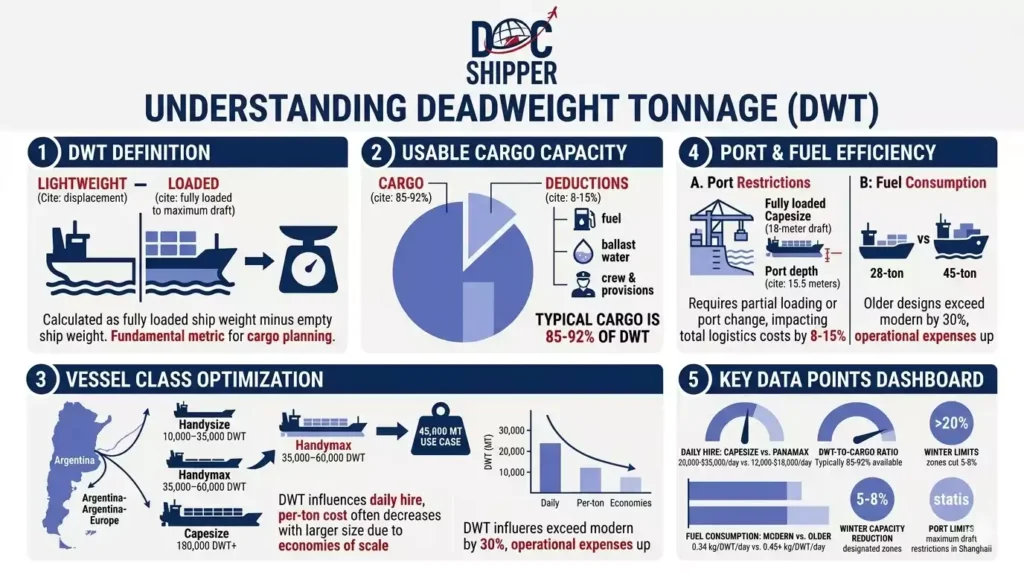
The deadweight tonnage calculation subtracts a ship’s lightweight (empty displacement) from its loaded displacement. This figure includes cargo, bunker fuel, lubricating oils, ballast water, fresh water, provisions, passengers, and crew with their effects.
Vessel owners use DWT to determine commercial viability. A container ship with 50,000 DWT can theoretically carry that weight, but actual cargo capacity depends on volume constraints and stability requirements. At DocShipper, we analyze both weight and cubic capacity to optimize container bookings and prevent costly space wastage.
Different vessel types exhibit distinct DWT-to-length ratios. Bulk carriers maximize deadweight relative to size, while container ships prioritize volume. Tankers balance liquid cargo density with structural limitations defined by international maritime conventions.
The International Maritime Organization (IMO) mandates that vessels display their DWT alongside gross tonnage. This regulatory requirement ensures port authorities can assess berth suitability and draft restrictions. Compliance documentation must reflect accurate DWT figures to avoid detention or fines.
Seasonal variations affect usable deadweight capacity. Summer load lines permit maximum DWT utilization, while winter marks reduce allowable cargo by 5-8% in certain maritime zones. Tropical fresh water routes impose additional restrictions based on water density differences.
For comprehensive guidance on maritime regulations, consult the International Maritime Organization official resources.
Practical Applications & Comparative Data
Vessel classification by DWT categories standardizes industry communication. Understanding these segments helps shippers select appropriate tonnage for specific cargo volumes and route requirements.
| Vessel Class | DWT Range | Typical Cargo | Route Examples |
|---|---|---|---|
| Handysize | 10,000 – 35,000 DWT | Grain, steel, forest products | Regional coastal trades |
| Handymax | 35,000 – 60,000 DWT | Coal, fertilizer, minor bulks | Trans-Atlantic, intra-Asian |
| Panamax | 60,000 – 80,000 DWT | Grain, coal, containers | Panama Canal transits |
| Capesize | 80,000 – 200,000+ DWT | Iron ore, coal (major bulks) | Brazil-China, Australia-Asia |
| VLCC | 200,000 – 320,000 DWT | Crude oil | Middle East-Asia, West Africa-US |
Use Case: A European importer needs to transport 45,000 metric tons of wheat from Argentina. A Handymax vessel (50,000 DWT) provides optimal capacity. After deducting 3,000 tons for fuel and 2,000 tons for ballast water, the usable cargo capacity reaches 45,000 tons—matching requirements precisely while maintaining cost efficiency.
Charter rate correlation: DWT directly influences daily hire costs. A 75,000 DWT Panamax bulk carrier commands $12,000-$18,000 per day, while a 180,000 DWT Capesize vessel ranges from $20,000-$35,000 daily. Per-ton transportation costs often decrease with larger DWT due to economies of scale.
Port draft limitations: Shanghai’s maximum draft of 15.5 meters restricts fully loaded Capesize vessels (18-meter draft when carrying 200,000 DWT). Shippers must calculate partial loading scenarios or select alternative ports with deeper channels, impacting total logistics costs by 8-15%.
Fuel consumption efficiency: Modern 82,000 DWT Kamsarmax vessels consume approximately 28 tons of fuel daily at 14 knots, translating to 0.34 kg per DWT per day. Older designs exceed 0.45 kg per DWT daily, increasing operational expenses by 30% over identical routes.
Container ship DWT application: A 14,000 TEU container vessel with 165,000 DWT can theoretically load 165,000 metric tons. However, container weight averages 12-14 tons per TEU, meaning volume constraints limit actual cargo to 168,000-196,000 tons—exceeding DWT. Proper load planning prevents structural stress and ensures compliance with stability regulations.
Conclusion
Deadweight tonnage serves as the fundamental metric for cargo capacity planning in maritime logistics. Accurate DWT understanding prevents booking errors, optimizes freight costs, and ensures regulatory compliance across international shipping lanes.
Need expert guidance on vessel selection or cargo optimization? Contact DocShipper for tailored logistics solutions.
📚 Quiz
Test Your Knowledge: Deadweight Tonnage (DWT)
Q1 — What does Deadweight Tonnage (DWT) actually measure?
Q2 — A shipper books a vessel rated at 50,000 DWT and assumes all 50,000 tons are available for cargo. Is this correct?
Q3 — A European importer needs to ship 45,000 metric tons of wheat from Argentina. After accounting for 5,000 tons of fuel and ballast water, which vessel class is the most appropriate choice?
🎯 Your Result
📞 Free Quote in 24hFAQ | Deadweight Tonnage (DWT): Definition, Calculation & Practical Examples
Deadweight tonnage measures weight capacity (cargo plus consumables), while gross tonnage represents total internal volume. GT is a volumetric measurement used for port fees and regulations, not cargo capacity.
Larger DWT vessels offer lower per-ton transportation costs due to economies of scale. However, port restrictions and cargo volume may necessitate smaller vessels despite higher unit costs.
Rarely. Fuel, ballast water, provisions, and crew weight reduce available cargo capacity. Typically, 85-92% of DWT remains for actual cargo depending on voyage length and route.
Containers occupy significant volume relative to weight. A ship reaches cubic capacity before weight limits, meaning actual loaded weight often falls below maximum DWT.
DWT equals the difference between a ship's displacement at maximum draft (fully loaded) and its lightweight displacement (empty). This calculation occurs during initial sea trials and periodic surveys.
Ultra Large Crude Carriers (ULCCs) reach 550,000 DWT. The Seawise Giant (now scrapped) held the record at 564,763 DWT. Modern VLCCs typically range from 300,000 to 320,000 DWT.
DWT includes total transportable weight: containers (tare weight), cargo inside containers, fuel, water, provisions, and crew. The container structure itself counts toward DWT limits.
Summer marks permit maximum DWT utilization. Winter marks reduce capacity by 5-8% in designated zones. Tropical fresh water routes impose additional restrictions due to lower water density.
Higher cargo loads increase draft (depth below waterline). Maximum DWT corresponds to the vessel's maximum permissible draft, which varies by season and water salinity per load line regulations.
No. DWT is determined by hull design and structural capacity. Modifications would require complete recertification and often prove economically unviable compared to chartering larger tonnage.
Ballast water maintains stability when cargo holds are partially empty. Required ballast volume reduces available DWT for cargo, particularly on return voyages or when carrying low-density goods.
DWT provides standardized capacity measurement for contract negotiations. It establishes cargo quantity expectations, freight rate calculations, and laytime allowances in bulk shipping agreements.
Need Help with
Logistics or Sourcing ?
First, we secure the right products from the right suppliers at the right price by managing the sourcing process from start to finish. Then, we simplify your shipping experience - from pickup to final delivery - ensuring any product, anywhere, is delivered at highly competitive prices.


Fill the Form
Prefer email? Send us your inquiry, and we’ll get back to you as soon as possible.
Contact us




:%20Definition,%20Calculation%20&%20Practical%20Examples)