


In short ⚡
A distribution warehouse is a strategic storage facility designed to receive, store, and dispatch goods to retail locations, end customers, or other distribution points. Unlike long-term storage warehouses, distribution centers prioritize rapid inventory turnover, order fulfillment, and cross-docking operations to optimize supply chain velocity and reduce delivery times.
Introduction
Many businesses struggle to distinguish between traditional warehouses and distribution centers, leading to inefficient inventory management and delayed deliveries. This confusion can cost companies thousands in storage fees and lost sales opportunities.
In international trade and e-commerce, the distribution warehouse serves as the critical link between manufacturers and final customers. It transforms static inventory into dynamic flow, ensuring products reach their destination quickly and cost-effectively.
- Rapid throughput: Goods typically remain 24-72 hours versus weeks in traditional warehouses
- Strategic location: Positioned near major transportation hubs or consumer markets
- Advanced technology: Automated systems for sorting, picking, and tracking inventory
- Cross-docking capabilities: Direct transfer from inbound to outbound without storage
- Multi-channel fulfillment: Supports B2B, B2C, and omnichannel distribution strategies
In-Depth Analysis & Expertise
Distribution warehouses operate on fundamentally different principles than conventional storage facilities. Their architecture prioritizes flow efficiency over storage capacity, with wide aisles, multiple loading docks, and sophisticated material handling systems.
The operational model revolves around three core activities: receiving bulk shipments from manufacturers, breaking down pallets into smaller units (pick-and-pack), and consolidating orders for final delivery. This process requires precise inventory management systems that track every item in real-time.
From a regulatory perspective, distribution warehouses must comply with specific zoning laws, safety standards, and customs regulations when handling international goods. The European Union’s Union Customs Code (available at EU Taxation & Customs) defines special procedures for customs warehouses that temporarily store imported goods before duty payment.
Technology integration distinguishes modern distribution centers from traditional warehouses. Warehouse Management Systems (WMS) coordinate everything from receiving schedules to shipping routes, while automated guided vehicles (AGVs) and robotics handle repetitive tasks with minimal human intervention.
The labor structure reflects operational intensity. Distribution warehouses employ shift workers to maintain 24/7 operations during peak seasons, with specialized roles including receiving clerks, order pickers, quality controllers, and shipping coordinators. At DocShipper, we ensure our partner distribution centers maintain these operational standards to guarantee seamless order fulfillment for our clients’ international shipments.
Concrete Examples & Data
Understanding distribution warehouse performance requires examining real-world metrics and operational scenarios. Industry benchmarks provide valuable context for evaluating efficiency.
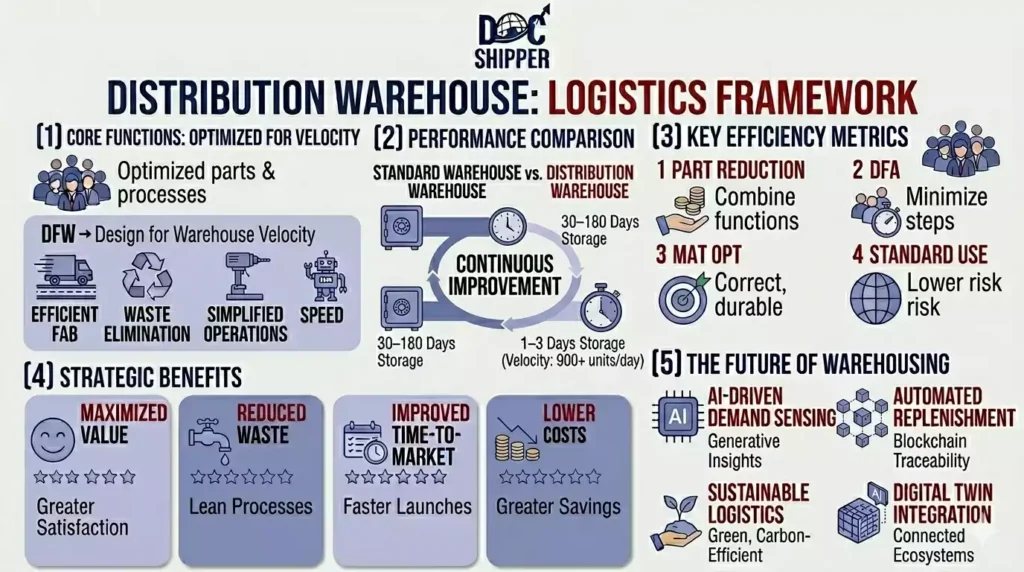
Comparative Analysis: Traditional Warehouse vs. Distribution Center
| Criterion | Traditional Warehouse | Distribution Warehouse |
|---|---|---|
| Average Storage Duration | 30-180 days | 1-3 days |
| Inventory Turnover Rate | 4-6 times/year | 12-30 times/year |
| Operating Hours | 8-12 hours/day | 16-24 hours/day |
| Automation Level | Low to Medium | Medium to High |
| Primary Function | Long-term storage | Rapid distribution |
Use Case: E-commerce Fulfillment Scenario
Consider an electronics retailer importing 50,000 smartphones from China to serve European markets. The distribution strategy unfolds as follows:
- Day 1 (08:00): Container arrives at Rotterdam distribution center; customs clearance completed within 4 hours
- Day 1 (14:00): Goods unloaded, scanned into WMS; inventory allocated to pre-existing orders (60% of stock)
- Day 1 (18:00): First wave of orders picked, packed, and labeled for next-day delivery across Netherlands, Belgium, Germany
- Day 2 (06:00): Remaining 40% allocated to retail stores and regional distribution points
- Day 3 (12:00): Entire shipment dispatched; warehouse space freed for next incoming container
Cost efficiency: This rapid turnover reduces storage costs by 70% compared to holding inventory for 30 days. The company pays approximately €0.15 per unit for 3 days versus €2.50 per unit for monthly storage.
Key performance indicators for this operation include: order accuracy rate (99.8%), on-time shipment rate (98.5%), and average order processing time (4.2 hours from receipt to dispatch). These metrics demonstrate the operational excellence required in modern distribution warehousing.
Conclusion
Distribution warehouses represent the evolution of logistics infrastructure, transforming static storage into dynamic fulfillment engines. Their strategic importance in global supply chains continues to grow as e-commerce and just-in-time delivery expectations reshape consumer behavior.
Need expert guidance on optimizing your distribution strategy or selecting the right warehouse partner? Contact DocShipper for customized logistics solutions tailored to your international trade requirements.
📚 Quiz
Test Your Knowledge: Distribution Warehouse
Q1 — What is the primary purpose of a distribution warehouse?
Q2 — A logistics manager claims that a distribution warehouse and a traditional warehouse are essentially the same because both store inventory. Is this correct?
Q3 — An electronics retailer imports 50,000 smartphones from China to Rotterdam. By Day 3, the entire shipment has been dispatched and warehouse space is freed. Which distribution warehouse technique made this rapid clearance possible?
🎯 Your Result
📞 Free Quote in 24hFAQ | Distribution Warehouse: Definition, Functions & Concrete Examples
A warehouse focuses on long-term storage, while a distribution center prioritizes rapid inventory turnover and order fulfillment, typically holding goods for 1-3 days versus weeks or months.
Costs vary by location and services but typically range from €5-15 per pallet per day, or €0.10-0.30 per cubic meter daily. High-tech automated facilities command premium rates of €20-30 per pallet daily.
Core systems include Warehouse Management Software (WMS), barcode/RFID tracking, automated conveyor systems, and increasingly, robotics for picking and sorting operations to maximize throughput efficiency.
Yes, through third-party logistics (3PL) providers offering shared warehouse space and fulfillment services. Minimum volumes typically start at 50-100 orders monthly, making it accessible for growing e-commerce businesses.
Cross-docking transfers goods directly from inbound to outbound trucks without intermediate storage, reducing handling time to under 24 hours. This technique is ideal for high-demand products and perishable goods.
Reverse logistics processes inspect returned items, update inventory systems, and either restock sellable products, redirect to refurbishment centers, or dispose of damaged goods according to company policies.
Proximity to major highways, ports, airports, and target markets; labor availability; real estate costs; and local regulations. Strategic placement can reduce delivery times by 30-50% and transportation costs by 15-25%.
Requirements depend on stored goods. Bonded warehouses need customs authorization for duty-deferred storage. Facilities handling hazardous materials, pharmaceuticals, or food products require specific certifications and inspections.
Regional distribution centers range from 50,000 to 200,000 square feet, while national hubs exceed 500,000 square feet. E-commerce giants operate mega-facilities of 1+ million square feet with 30-foot ceiling heights.
Key metrics include order accuracy rate (target: 99.5%+), inventory turnover ratio, average order cycle time, dock-to-stock time, and cost per order processed. Advanced facilities track these in real-time dashboards.
Comprehensive coverage includes property insurance, general liability, cargo insurance, workers' compensation, and errors and omissions insurance. Coverage limits typically range from €1-10 million depending on inventory value.
Yes, bonded distribution warehouses can receive imported goods before customs duties are paid, allowing companies to defer taxes until products are sold. This improves cash flow for international traders significantly.
Need Help with
Logistics or Sourcing ?
First, we secure the right products from the right suppliers at the right price by managing the sourcing process from start to finish. Then, we simplify your shipping experience - from pickup to final delivery - ensuring any product, anywhere, is delivered at highly competitive prices.


Fill the Form
Prefer email? Send us your inquiry, and we’ll get back to you as soon as possible.
Contact us




