


In short ⚡
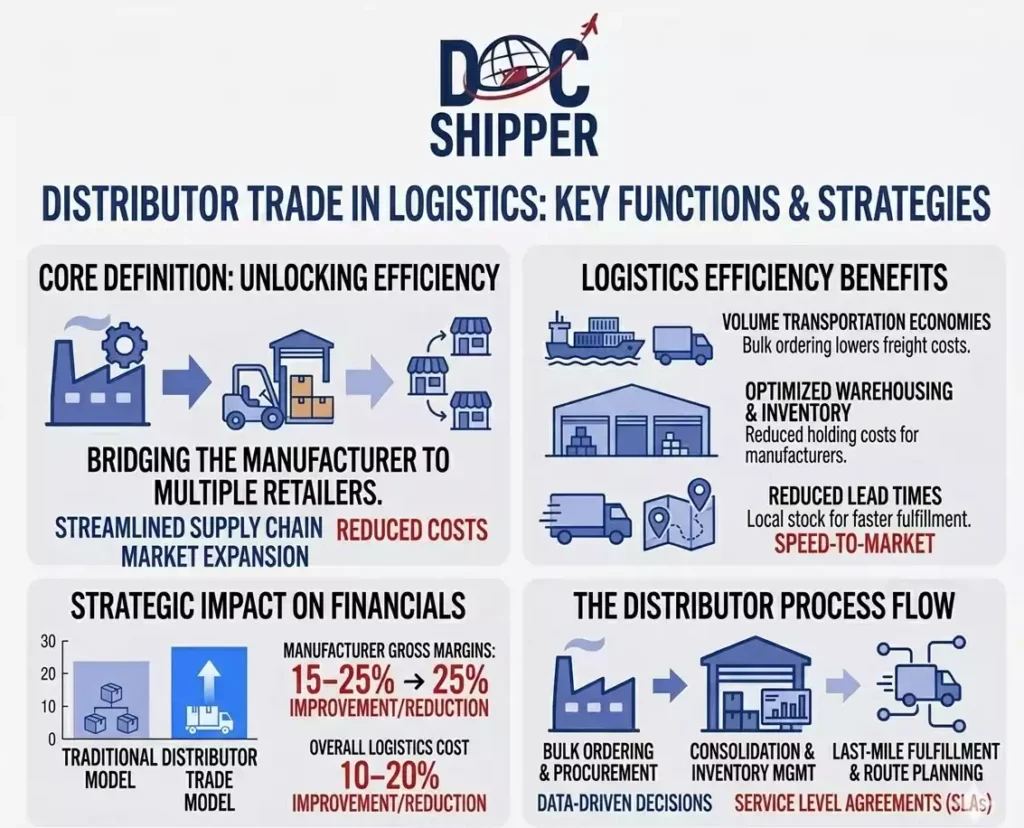
A distributor is an independent business entity that purchases goods from manufacturers or suppliers and resells them to retailers or end customers within a specific territory. Unlike agents, distributors take ownership of inventory, assume commercial risk, and operate under their own brand while representing supplier products in local markets.
Introduction
Many companies expanding internationally confuse distributors with sales agents or direct retailers. This confusion leads to misaligned contracts, unexpected costs, and market entry failures.
In global supply chains, distributors serve as critical intermediaries who bridge manufacturers and local markets. They provide market access, regulatory compliance, and customer service infrastructure that foreign suppliers cannot efficiently maintain themselves.
Key characteristics of distribution relationships include:
- Inventory ownership: Distributors purchase and stock products at their own financial risk
- Territorial exclusivity: Contracts typically grant exclusive rights within defined geographic zones
- Price autonomy: Distributors set their own retail margins beyond supplier wholesale prices
- Marketing responsibility: Local promotion, branding, and customer acquisition fall to the distributor
- After-sales support: Warranty claims, returns, and technical assistance managed locally
Understanding Distribution Models & Legal Framework
Distribution agreements create independent commercial relationships distinct from employment or agency. The distributor operates as a separate legal entity, purchasing goods outright and reselling them for profit. This structure transfers significant commercial risk from manufacturer to distributor.
Two primary models dominate international trade: exclusive distribution grants sole rights within a territory, preventing the supplier from appointing competitors or selling directly. Non-exclusive distribution allows multiple distributors in the same region, creating competition but reducing individual distributor commitment.
Legal frameworks vary significantly by jurisdiction. The European Union enforces vertical restraint regulations under competition law, limiting certain exclusivity clauses and price-fixing arrangements. The EU Vertical Block Exemption Regulation provides safe harbor for agreements meeting specific criteria regarding market share and restrictive clauses.
Contract termination presents particular challenges. Many jurisdictions grant distributor protection rights including mandatory notice periods, compensation for goodwill, and inventory buyback obligations. French commercial law, for example, requires indemnification for established customer relationships even when contracts expire naturally.
At DocShipper, we structure distribution agreements that balance territorial protection with compliance requirements, ensuring our clients avoid costly legal disputes when entering new markets.
Performance metrics in distribution contracts typically include minimum purchase obligations, requiring distributors to order specified volumes annually. Failure triggers contract termination rights or territory reduction. These clauses protect suppliers from inactive partners blocking market access.
Distribution Strategies & Market Data
Distribution economics vary dramatically across product categories and regions. Consumer electronics distributors typically operate on 8-15% gross margins, while pharmaceutical distributors may accept 3-5% due to high volume and regulatory barriers limiting competition.
Consider this comparative analysis of distribution models:
| Distribution Type | Inventory Risk | Typical Margin | Market Control | Best For |
|---|---|---|---|---|
| Exclusive Distributor | High (full ownership) | 25-40% | Distributor-led | Premium brands, new markets |
| Selective Distributor | Medium (shared territory) | 15-25% | Balanced | Mid-market products |
| Non-Exclusive Distributor | Low (competitive pricing) | 8-15% | Supplier-led | Commodity goods, mass market |
| Master Distributor | Very High (multi-tier) | 30-50% | Distributor-controlled | Complex markets, B2B systems |
Real-world case: A German industrial equipment manufacturer appointed an exclusive distributor in Southeast Asia with a 5-year contract requiring €2M minimum annual purchases. Year one achieved €2.4M, but year two dropped to €1.6M due to economic downturn. The contract’s force majeure clause didn’t cover market conditions, triggering termination rights. The distributor negotiated a territory reduction to Vietnam and Thailand only, surrendering Indonesia and Malaysia to new partners.
Market penetration data shows exclusive distributors achieve 60-70% faster market entry compared to non-exclusive models, but require 40% higher initial investment in inventory and marketing. Multi-brand distributors spread risk across product lines but dedicate fewer resources to individual suppliers.
Geographic considerations impact distribution success significantly. Emerging markets favor master distributor structures where a primary distributor manages sub-distributors across regions. Developed markets increasingly use hybrid models combining direct B2B sales with distributor-managed retail channels.
Digital transformation reshapes traditional distribution. E-commerce platforms create channel conflict when manufacturers sell directly online while distributors maintain physical retail presence. Modern contracts address this through price parity clauses and defined online/offline territories.
Conclusion
Distributor relationships form the backbone of international market expansion, balancing local expertise with supplier brand control. Success requires carefully structured agreements addressing inventory risk, territorial rights, and performance obligations.
Need expert guidance on distributor selection or contract negotiation for your international expansion? Contact DocShipper for tailored logistics and commercial solutions.
📚 Quiz
Test Your Knowledge: Distributor
Q1 — Which statement best defines a distributor in international trade?
Q2 — A supplier signs a distribution agreement for Southeast Asia. The distributor misses its minimum annual purchase target due to a regional economic downturn. What is the most likely contractual consequence?
Q3 — A manufacturer wants to enter a complex emerging market with multiple regional sub-distributors managed by a single primary partner. Which distribution model best fits this scenario?
🎯 Your Result
📞 Free Quote in 24hFAQ | Distributor: Definition, Role & Concrete Examples in International Trade
Distributors purchase goods and resell them at their own risk, earning profit through markup. Agents facilitate sales on behalf of suppliers without taking ownership, earning commission on transactions they arrange.
Initial terms typically range from 2-5 years, balancing distributor investment security with supplier flexibility. Shorter terms suit test markets; longer terms reward established relationships with proven performance.
Termination rights depend on contract terms and local law. Many jurisdictions require just cause, reasonable notice, and compensation for goodwill even when contracts include at-will termination clauses.
A contractual requirement specifying the minimum value or volume of goods a distributor must purchase annually. Failure to meet targets may trigger territory reduction or contract termination.
Typically yes, when purchasing on DDP (Delivered Duty Paid) terms. However, many international distribution agreements use EXW or FOB terms, making distributors responsible for all import costs and procedures.
Exclusive territories grant one distributor sole rights to sell within defined geographic boundaries. Suppliers cannot appoint competitors or sell directly in that zone, protecting distributor investment.
A master distributor purchases from manufacturers and supplies sub-distributors or retailers across a large region. They manage multi-tier distribution networks, particularly common in complex or emerging markets.
Unless contracts include exclusivity clauses prohibiting competitive products, distributors may carry multiple brands. Non-compete clauses must comply with competition law, particularly in the EU.
Ownership depends on contractual terms and data protection regulations. Distributors typically control customer relationships, but suppliers may require shared access to sales data and customer information.
Contract terms should specify buyback obligations, sell-off periods, or inventory return procedures. Many jurisdictions impose statutory buyback requirements protecting distributors from inventory losses.
Contracts define responsibility for warranty claims, technical support, and product returns. Distributors typically handle first-line support, with suppliers covering manufacturing defects and replacement parts.
Suppliers may suggest retail prices but cannot legally enforce resale price maintenance in most jurisdictions. Marketing guidelines are permitted if they don't unreasonably restrict distributor commercial freedom.
Need Help with
Logistics or Sourcing ?
First, we secure the right products from the right suppliers at the right price by managing the sourcing process from start to finish. Then, we simplify your shipping experience - from pickup to final delivery - ensuring any product, anywhere, is delivered at highly competitive prices.


Fill the Form
Prefer email? Send us your inquiry, and we’ll get back to you as soon as possible.
Contact us




