


In short ⚡
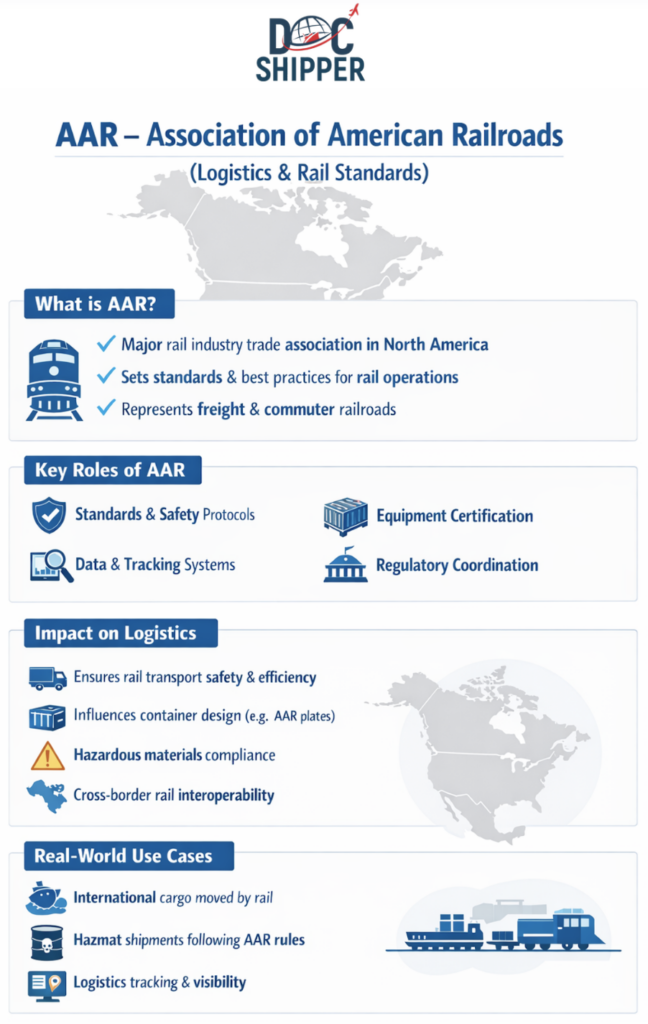
The Association of American Railroads (AAR) is the leading trade organization representing major freight railroads in North America. Founded in 1934, it develops technical standards, safety protocols, and regulatory frameworks that govern rail transport operations, equipment specifications, and intermodal logistics across the continent.
Introduction
International shippers frequently encounter AAR specifications when transporting goods via rail through North America. Many logistics professionals struggle to understand why certain container types require AAR certification or how these standards impact cross-border freight movements.
The AAR plays a critical role in ensuring interoperability, safety, and efficiency across North American rail networks. Its standards directly affect container design, hazardous materials handling, and equipment interchange between rail carriers.
Key aspects of AAR influence on logistics:
- Equipment certification: Containers and chassis must meet AAR specifications for rail transport
- Safety regulations: Hazmat classifications and tank car standards prevent accidents
- Interoperability standards: Uniform systems enable seamless equipment exchange between carriers
- Data systems: Electronic tracking protocols facilitate real-time shipment visibility
- Maintenance protocols: Inspection standards ensure equipment reliability and longevity
Technical Standards & Industry Governance
The AAR functions as the primary standards-setting body for North American rail freight. Its Manual of Standards and Recommended Practices contains over 300 specifications covering everything from wheel profiles to electronic data interchange formats.
One of the most critical AAR functions involves equipment certification. Intermodal containers used in rail transport must display AAR plate markings confirming structural integrity for stacking and dynamic loading. Without this certification, containers cannot legally move on Class I railroad networks.
The organization’s hazardous materials regulations complement federal Department of Transportation rules. AAR Circular OT-55 establishes tank car specifications for chemicals, petroleum products, and compressed gases. These standards have evolved significantly following high-profile derailments, with enhanced requirements for thermal protection and pressure relief systems.
AAR’s Umler system serves as the industry’s equipment registry, tracking ownership, specifications, and maintenance history for over 1.6 million freight cars. This database enables automated billing, routing decisions, and regulatory compliance verification. At DocShipper, we verify Umler data when coordinating rail segments to ensure equipment compatibility and proper documentation.
The interchange rules governed by AAR Field Manual of the AAR Interchange Rules establish liability frameworks when equipment moves between different rail carriers. These provisions determine responsibility for damage, loss, and maintenance costs—critical considerations for international shippers using multiple rail operators.
For authoritative regulatory context, consult the official AAR website and the Federal Railroad Administration’s coordination with industry standards.
Practical Applications & Compliance Requirements
Understanding AAR standards translates into tangible operational requirements for international logistics. The practical implications affect container selection, routing options, and documentation processes.
Container Certification Example: A European manufacturer shipping machinery to Chicago via ocean to Los Angeles, then rail to final destination, must use AAR-certified containers. Standard ISO containers require AAR plate M-930 certification confirming they can withstand 60,000-pound stacking loads typical in double-stack trains. Non-certified units face rejection at rail terminals, causing costly delays and transloading expenses.
Hazmat Classification Impact: Chemical shippers must navigate both UN/DOT classifications and AAR tank car specifications. A shipment of corrosive liquids requires DOT-111 or AAR-compliant DOT-117 tank cars depending on vapor pressure and corrosivity. The enhanced DOT-117 standard, developed after AAR safety recommendations, adds approximately 15-20% to transportation costs but reduces accident risk by 80% according to industry data.
| AAR Standard | Application | Compliance Cost | Non-Compliance Risk |
|---|---|---|---|
| M-930 (Container) | Intermodal box certification | $500-1,200 per unit | Terminal rejection, transloading fees |
| M-1003 (Chassis) | Container chassis specs | $8,000-12,000 per chassis | Equipment interchange denial |
| Circular OT-55 | Tank car specifications | $150,000-250,000 per car | Shipment refusal, regulatory fines |
| S-2043 (AEI Tags) | Automatic equipment ID | $15-25 per tag | Tracking failures, billing errors |
| Field Manual Rules | Interchange procedures | Operational compliance | Liability disputes, damage claims |
Cross-Border Considerations: Mexican and Canadian rail operators adhere to AAR standards through reciprocal agreements, enabling seamless North American rail movements. However, equipment originating outside NAFTA regions requires additional certification. At DocShipper, we coordinate pre-shipment inspections to verify AAR compliance before goods leave origin ports, preventing expensive terminal holds.
Data Integration Requirements: AAR’s Electronic Data Interchange (EDI) standards mandate specific message formats for waybills, arrival notices, and equipment status updates. Shippers must implement AAR-compliant EDI systems or work through freight forwarders with integrated platforms. Non-compliance results in manual processing delays averaging 24-48 hours per shipment.
Key compliance metrics from 2023 industry data:
- 98.7% of Class I railroad equipment meets current AAR standards
- Container certification adds 3-5 days to equipment procurement timelines
- AAR-compliant hazmat cars reduce incident rates to 0.003 per million car-miles
- EDI integration cuts shipment processing time by 40% versus paper documentation
- Interchange rule violations cost carriers an average of $2,800 per occurrence
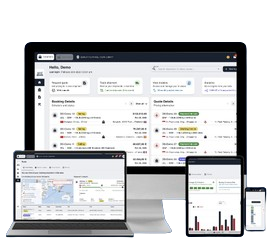
DocShipper Platform
One platform. Your entire supply chain
Sourcing, freight, customs & documents — all centralised, all visible, 24/7.
Conclusion
AAR standards form the operational backbone of North American rail logistics, directly impacting equipment specifications, safety protocols, and cross-border freight efficiency. Understanding these requirements prevents costly delays and ensures regulatory compliance.
Need expert guidance navigating AAR requirements for your shipments? Contact DocShipper for comprehensive rail logistics support across North America.
📚 Quiz
Test Your Knowledge: AAR (Association of American Railroads)
Q1 — What is the primary role of the Association of American Railroads (AAR)?
Q2 — A European shipper sends an ISO container by ocean to Los Angeles, then by rail to Chicago. Does the container need AAR certification?
Q3 — A chemical shipper needs to transport corrosive liquids by rail in the US. Which statement correctly describes the AAR's impact on this shipment?
🎯 Your Result
📞 Free Quote in 24hFAQ | AAR (Association of American Railroads): Definition, Role & Key Standards
AAR certification confirms containers meet structural standards for rail transport, including stacking loads up to 60,000 pounds. Certification is displayed via AAR plate M-930 markings and is mandatory for intermodal rail movements in North America.
Yes, if containers will move via rail in the US, Canada, or Mexico. Standard ISO containers require additional AAR certification beyond basic CSC approval. European or Asian containers without AAR plates face terminal rejection.
Initial certification typically requires 3-5 business days for inspection and plate issuance. Manufacturers building AAR-compliant containers from design phase can obtain certification simultaneously with production, adding minimal delay.
Umler is the centralized equipment registry tracking specifications, ownership, and maintenance for all North American freight cars. It enables automated routing, billing, and compliance verification across rail networks.
While AAR is a private trade organization, its standards are incorporated into railroad operating agreements and federal regulations. Carriers contractually require AAR compliance, making standards effectively mandatory for commercial rail transport.
Non-compliant equipment is rejected at interchange points or terminals. Shippers face transloading costs, storage fees, and schedule delays. Repeated violations can result in carrier service restrictions.
Enhanced tank car specifications (DOT-117) mandated after AAR safety reviews increase per-car costs by $50,000-80,000 versus older standards. This translates to 15-20% higher freight rates for hazardous liquids.
If the routing includes rail segments, AAR certification is required. Truck-only or ocean-only movements don't require AAR approval, but mixed-mode shipments through North America mandate compliance.
OT-55 establishes tank car specifications for hazardous materials transport by rail. It defines construction standards, safety systems, and testing requirements for cars carrying chemicals, petroleum, and compressed gases.
Yes, through reciprocal agreements. Mexican rail operators (Ferromex, KCSM) and Canadian carriers (CN, CP) adhere to AAR specifications, enabling seamless cross-border equipment interchange and unified safety protocols.
AAR reviews standards annually, with major revisions occurring every 3-5 years based on safety data and technological advances. Recent updates focused on tank car enhancements and electronic tracking systems.
AAR-certified intermodal containers cost $500-1,200 more than basic ISO units. Specialized equipment like tank cars or heavy-duty flatcars can carry premiums of $50,000-100,000 for enhanced AAR specifications.
Need Help with
Logistics or Sourcing ?
First, we secure the right products from the right suppliers at the right price by managing the sourcing process from start to finish. Then, we simplify your shipping experience - from pickup to final delivery - ensuring any product, anywhere, is delivered at highly competitive prices.


Fill the Form
Prefer email? Send us your inquiry, and we’ll get back to you as soon as possible.
Contact us



:%20Definition%20&%20Standards%20in%202026)