



In short ⚡
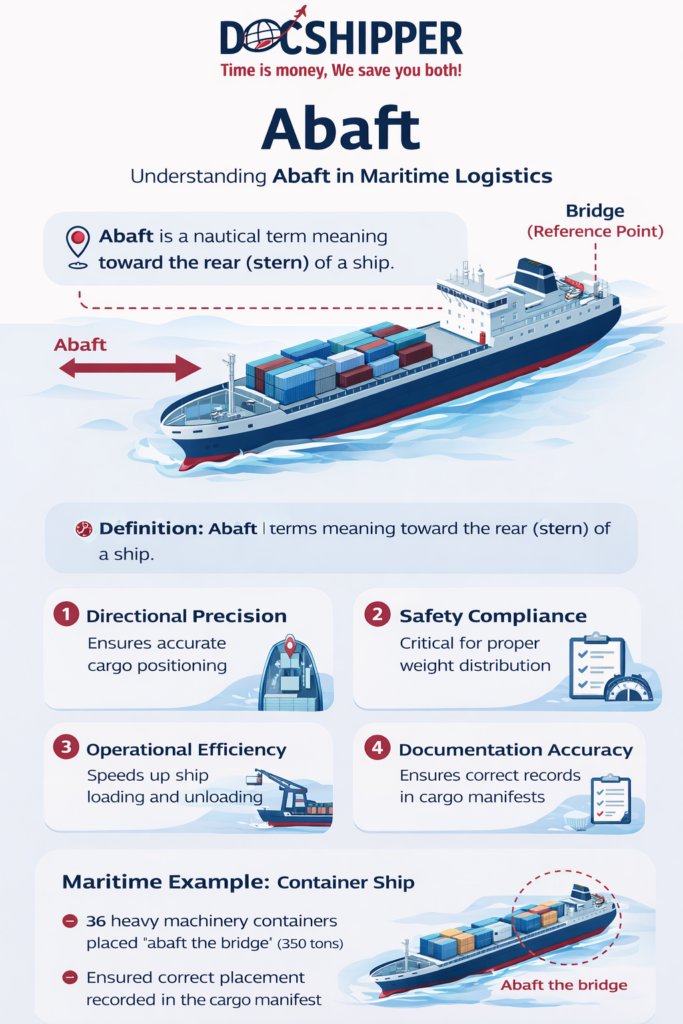
Abaft is a nautical term indicating a position toward or at the rear (stern) of a vessel. In shipping and maritime logistics, it describes the location of cargo, equipment, or crew quarters situated behind a reference point on the ship's longitudinal axis.Introduction
Confusion between directional terms on vessels causes communication breakdowns during cargo operations. When loading instructions specify “abaft the bridge,” misinterpretation can lead to improper weight distribution and vessel instability.
Understanding abaft is essential for freight forwarders, ship operators, and logistics coordinators managing international cargo. This directional reference ensures precise communication during loading plans, safety inspections, and cargo documentation.
- Directional precision: Eliminates ambiguity in vessel positioning instructions
- Safety compliance: Critical for proper weight distribution and stability calculations
- Operational efficiency: Streamlines communication between shore staff and crew
- Documentation accuracy: Ensures correct cargo location recording in manifests
- Industry standardization: Universal maritime terminology recognized globally
Technical Understanding & Maritime Context
The term abaft derives from Old English and Middle Dutch maritime vocabulary, establishing a standardized directional system on vessels. Unlike land-based directions, ships use fixed reference points relative to the vessel’s structure rather than compass bearings.
Positional relationships define abaft in relation to other nautical terms. Forward of a reference point is “forward” or “fore,” while abaft indicates the opposite direction. The midship section divides the vessel, with everything behind it considered abaft of midships.
Cargo stowage planning requires precise abaft references. Container vessels designate bay positions using numerical systems where higher bay numbers typically indicate more abaft locations. This systematic approach prevents loading errors that could compromise vessel trim.
Regulatory frameworks established by the International Maritime Organization (IMO) incorporate directional terminology in safety protocols. The IMO Safety Regulations reference vessel sections using standardized terms including abaft for inspection procedures and emergency response protocols.
Weight distribution calculations depend on accurate abaft positioning. Naval architects compute longitudinal centers of gravity using distances from the midship reference point. Cargo placed too far abaft can cause stern trim, affecting propeller efficiency and fuel consumption.
At DocShipper, we verify cargo positioning instructions against vessel stowage plans to ensure compliance with stability requirements, preventing costly repositioning delays at loading ports.
Practical Applications & Operational Examples
Real-world shipping operations demonstrate the critical importance of understanding abaft positioning. Container vessels, bulk carriers, and tankers all utilize this terminology in daily operations.
Comparative Positioning Table
| Reference Point | Abaft Position | Typical Cargo Type | Operational Consideration |
|---|---|---|---|
| Bridge | Aft deck area | Heavy machinery, vehicles | Requires stern trim monitoring |
| Midships | Aft cargo holds | General containers, bulk goods | Optimal for balanced loading |
| Engine room | Stern section | Fuel tanks, ballast water | Critical for propulsion efficiency |
| Accommodation block | Poop deck | Light stores, safety equipment | Easy crew access required |
Case Study: Container Vessel Loading
A 4,500 TEU container vessel loading at Shanghai Port received instructions to place 40 refrigerated containers “abaft the accommodation block.” The cargo planner calculated:
- Position: Bays 82-86 (stern section, approximately 180 meters abaft the bow)
- Weight impact: 800 metric tons concentrated in aft holds
- Trim adjustment: Required 1,200 tons ballast water forward to maintain optimal trim
- Power consumption: Reefer containers positioned near generator room reduced cable runs by 35%
- Stability margin: Maintained 15% above minimum regulatory requirements
This strategic abaft positioning reduced fuel consumption by 3.2% during the 14-day voyage to Rotterdam, demonstrating how proper directional understanding translates into operational savings.
DocShipper Platform
Cut logistics costs. Not corners.
See exactly where your logistics costs are bleeding — and how to fix it. Book your expert demo.

Conclusion
Mastering abaft terminology ensures precise communication in maritime logistics, preventing costly errors in cargo positioning and vessel stability. This fundamental directional reference underpins safe and efficient shipping operations worldwide.
Need expert guidance on cargo positioning and shipping documentation? Contact DocShipper for comprehensive logistics support tailored to your international freight requirements.
📚 Quizz
Test Your Knowledge: Abaft
Q1 — What does the nautical term "abaft" indicate on a vessel?
Q2 — A cargo planner says a container is "abaft the bridge." Does this necessarily mean the container is in the aft section of the ship?
Q3 — A 4,500 TEU container vessel loads 800 metric tons of refrigerated cargo abaft the accommodation block. What is the most likely operational consequence if no corrective action is taken?
🎯 Your Result
📞 Free Quote in 24hFAQ | Abaft: Definition, Usage & Practical Examples in Shipping
The opposite of abaft is "forward" or "fore," indicating a position toward the bow (front) of the vessel. These terms work as directional pairs in maritime navigation and cargo operations.
"Aft" refers to the rear section of the ship itself, while "abaft" describes a relative position behind a reference point. You can be abaft the bridge while still in the forward section of the vessel.
Proper abaft cargo placement affects vessel trim, fuel efficiency, and stability. Incorrect positioning can cause stern-heavy conditions, increasing drag and fuel consumption by 5-8% on long voyages.
Yes, abaft is standardized terminology in international maritime operations. Port operators, ship crews, naval architects, and freight forwarders use this term for precise communication across language barriers.
Ship plans use longitudinal reference systems with frame numbers or station markers. Abaft positions show higher numbers moving toward the stern, typically measured from the forward perpendicular.
Yes, cargo damage claims may reference abaft positioning in incident reports. Incorrect stowage documentation using improper directional terms can complicate liability determinations during insurance investigations.
Maritime professionals measure abaft distances in meters or feet from reference points, or using frame numbers specific to vessel construction plans. Container bays use numerical systems indicating relative abaft positions.
No, aviation uses "aft" rather than "abaft." Aircraft cargo positioning employs station numbers and zones, but the relative directional concept remains similar to maritime applications.
Ballast tanks located abaft compensate for forward cargo weight. Operators adjust abaft ballast levels to maintain proper trim, especially when loading heavy cargo in forward holds.
Maritime academies include directional terminology in basic seamanship courses. The Standards of Training, Certification and Watchkeeping (STCW) convention requires proficiency in nautical terminology including abaft references.
No, GPS provides absolute geographic positions while abaft describes relative vessel locations. Both systems serve different purposes—GPS for navigation, abaft for onboard operational communication.
Port state control inspections reference abaft locations when documenting deficiencies or safety equipment positions. Inspection reports use standardized directional terms to ensure clarity across international regulatory bodies.
Need Help with
Logistics or Sourcing ?
First, we secure the right products from the right suppliers at the right price by managing the sourcing process from start to finish. Then, we simplify your shipping experience - from pickup to final delivery - ensuring any product, anywhere, is delivered at highly competitive prices.


Fill the Form
Prefer email? Send us your inquiry, and we’ll get back to you as soon as possible.
Contact us


