


In short ⚡
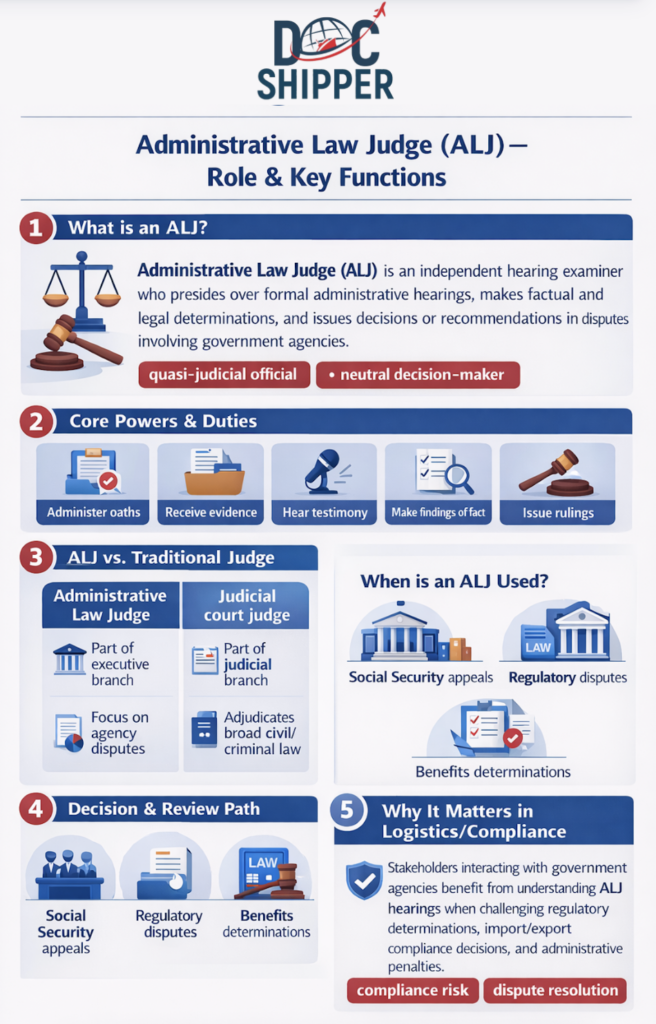
An Administrative Law Judge (ALJ) is an independent judicial officer who presides over administrative hearings and disputes between government agencies and private parties. ALJs resolve cases involving regulatory compliance, import/export violations, customs penalties, and trade enforcement without requiring full federal court proceedings, ensuring faster and specialized resolution of complex logistical disputes.Introduction
When importers face customs penalties, classification disputes, or regulatory violations, many assume they must immediately enter federal court. This misconception costs time and resources. In reality, Administrative Law Judges provide a specialized, efficient alternative for resolving trade-related conflicts before they escalate to litigation.
In international logistics, ALJs play a critical role in maintaining compliance and fairness. They adjudicate disputes involving U.S. Customs and Border Protection (CBP), the International Trade Commission (ITC), and other regulatory bodies. Understanding their function is essential for any business engaged in cross-border operations.
- Independent decision-makers: ALJs operate separately from the agencies involved in disputes
- Specialized expertise: They possess deep knowledge of trade law, customs regulations, and administrative procedures
- Binding authority: ALJ decisions can be enforced unless appealed to higher administrative or judicial bodies
- Cost-effective resolution: Administrative hearings typically cost less than federal court litigation
- Faster proceedings: Cases are resolved in months rather than years compared to traditional court systems
ALJ Authority & Jurisdiction in Trade
Administrative Law Judges derive their authority from the Administrative Procedure Act (APA) of 1946, which established standardized procedures for federal agency decision-making. In trade contexts, ALJs are appointed by agencies such as the Department of Commerce, the ITC, and the Social Security Administration, though their independence is protected by law.
The appointment process ensures impartiality. ALJs are selected through merit-based examinations administered by the Office of Personnel Management. Once appointed, they cannot be removed except for good cause, guaranteeing their independence from agency pressure. This structure is crucial when importers challenge agency decisions regarding tariff classifications, antidumping duties, or countervailing measures.
In customs penalty cases, ALJs conduct formal hearings where both CBP and the importer present evidence. The judge evaluates whether violations occurred, determines appropriate penalties, and issues written decisions. These proceedings follow strict evidentiary rules similar to federal courts but with more flexibility in procedural matters. According to the U.S. Customs and Border Protection, ALJ hearings resolve approximately 70% of contested penalty cases without further appeal.
Jurisdictional scope varies by agency. For trade matters, ALJs handle classification disputes, valuation disagreements, country of origin determinations, and intellectual property violations at the border. They also adjudicate cases involving export control violations under the International Traffic in Arms Regulations (ITAR) and the Export Administration Regulations (EAR).
The appeals process provides multiple layers of review. Parties dissatisfied with an ALJ decision can appeal to the agency head or designated review board. For customs matters, appeals proceed to the Court of International Trade, then potentially to the Court of Appeals for the Federal Circuit. This structured review process balances finality with the opportunity for correction of errors.
At DocShipper, we regularly prepare documentation and evidence packages for ALJ hearings, ensuring our clients present the strongest possible case when facing customs disputes or regulatory challenges.
Practical Cases & Data
Understanding how ALJs function in real scenarios clarifies their importance in international trade. The following examples demonstrate typical cases and their outcomes.
Case Study: Tariff Classification Dispute
A U.S. electronics importer received a penalty of $180,000 from CBP for alleged misclassification of LED components. The importer classified the goods under HTS 8541.41 (light-emitting diodes), while CBP argued they should be classified under HTS 8543.70 (electrical machines with specific functions), carrying a higher duty rate.
The importer requested an ALJ hearing. During the proceeding, both parties presented technical specifications, expert testimony, and precedent cases. The ALJ determined that the components’ primary function aligned with the importer’s original classification. The penalty was reduced to $12,000 for procedural documentation errors, saving the company $168,000 and preserving their import privileges.
Comparative Data: ALJ vs. Federal Court
| Factor | ALJ Hearing | Federal Court |
|---|---|---|
| Average Duration | 6-12 months | 18-36 months |
| Legal Costs | $15,000-$50,000 | $75,000-$300,000+ |
| Judge Expertise | Specialized in trade/customs | General legal knowledge |
| Success Rate (Importer) | 42-48% | 35-40% |
| Procedural Flexibility | Moderate to High | Low (Strict Rules) |
DocShipper Platform
Cut logistics costs. Not corners.
See exactly where your logistics costs are bleeding — and how to fix it. Book your expert demo.

Key Statistics from Recent Years
- Volume: Approximately 2,800 trade-related ALJ cases filed annually across federal agencies
- Resolution rate: 68% of cases settled before full hearing completion
- Penalty reductions: Average reduction of 55% in customs penalty cases that proceed to ALJ hearing
- Appeal rate: Only 22% of ALJ decisions are appealed to higher review bodies
- Affirmation rate: 73% of ALJ decisions are upheld on appeal, demonstrating their reliability
These figures illustrate that ALJ proceedings offer importers a realistic opportunity for favorable outcomes while maintaining procedural integrity and specialized expertise.
Conclusion
Administrative Law Judges serve as essential gatekeepers in international trade disputes, providing specialized, efficient, and fair resolution mechanisms. Their expertise and independence make them invaluable for importers navigating complex customs and regulatory challenges.
Need guidance on an upcoming ALJ hearing or customs dispute? Contact DocShipper for expert support in preparing your case and protecting your import operations.
📚 Quiz
Test Your Knowledge: Administrative Law Judge (ALJ)
Q1 — What is the primary role of an Administrative Law Judge (ALJ) in international trade?
Q2 — A common misconception about ALJ decisions is that they are non-binding advisory opinions. What is the truth?
Q3 — A U.S. importer receives a $200,000 customs penalty from CBP for a tariff classification dispute. What is the most appropriate first step to challenge this penalty efficiently?
🎯 Your Result
📞 Free Quote in 24hFAQ | Administrative Law Judge (ALJ): Definition, Role & Practical Examples
ALJs are appointed by federal agencies and specialize in administrative law, while federal judges are appointed by the President and confirmed by the Senate. ALJs handle regulatory disputes within their agency's jurisdiction, whereas federal judges hear broader civil and criminal cases.
Yes. You can typically appeal to the agency head or review board first, then to the appropriate federal court. For customs matters, appeals proceed to the Court of International Trade.
Most ALJ hearings conclude within 6-12 months from filing to decision. Complex cases involving extensive evidence or multiple parties may take longer, but they're still faster than federal litigation.
While not legally required, representation is strongly recommended. Trade law is complex, and experienced counsel significantly improves your chances of a favorable outcome. Many importers also engage customs brokers or consultants with ALJ experience.
ALJs adjudicate classification disputes, valuation disagreements, penalty assessments, country of origin determinations, antidumping and countervailing duty cases, and intellectual property violations at the border.
Yes, unless appealed and overturned. ALJ decisions have the force of law within the agency's jurisdiction and can be enforced through collection actions or other regulatory measures.
Legal fees typically range from $15,000 to $50,000, depending on case complexity. This is significantly less expensive than federal court litigation, which often exceeds $100,000.
Yes. ALJs have authority to reduce, eliminate, or uphold penalties based on evidence presented. They evaluate whether violations occurred, the importer's compliance history, and mitigating circumstances.
Importers achieve favorable outcomes (penalty reduction or elimination) in approximately 42-48% of cases that proceed to full hearing. Settlement rates are even higher when cases are resolved before final decision.
After receiving a penalty notice or adverse decision from the agency, you typically have 60 days to file a written request for hearing. The request must specify the issues in dispute and include supporting documentation.
Generally yes, though confidential business information can be protected through protective orders. Parties may request closed hearings for sensitive trade secrets or proprietary data.
You can present documentary evidence, expert testimony, witness statements, technical specifications, industry standards, and precedent cases. ALJs apply federal rules of evidence but with more flexibility than traditional courts.
Need Help with
Logistics or Sourcing ?
First, we secure the right products from the right suppliers at the right price by managing the sourcing process from start to finish. Then, we simplify your shipping experience - from pickup to final delivery - ensuring any product, anywhere, is delivered at highly competitive prices.


Fill the Form
Prefer email? Send us your inquiry, and we’ll get back to you as soon as possible.
Contact us



:%20Definition%20&%20Guide%20for%202026)