
In short ⚡
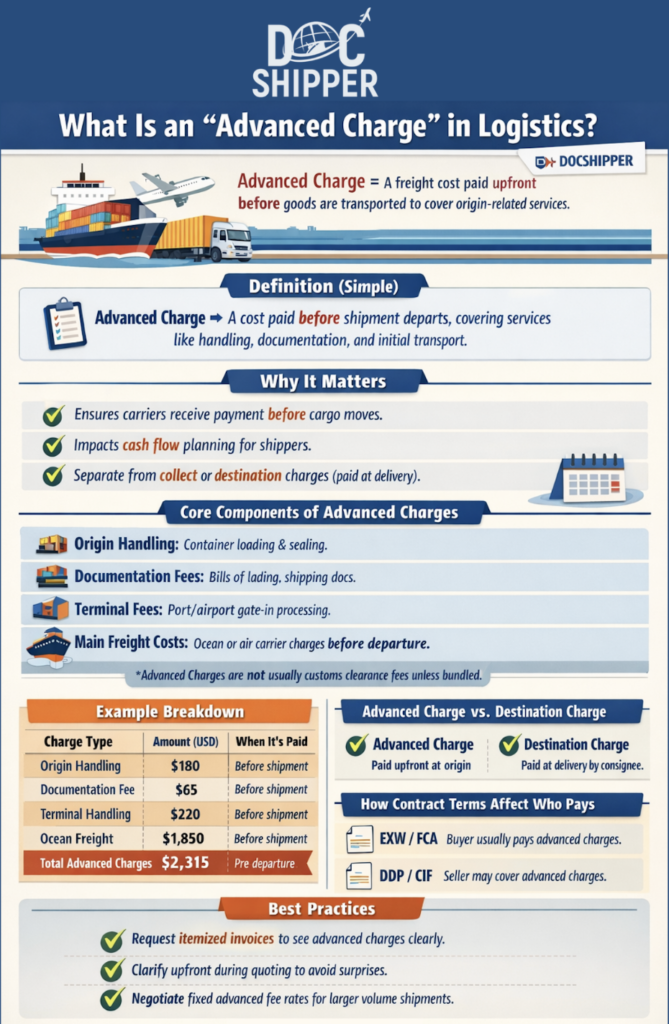
Advanced Charge is a freight cost paid by the shipper to the carrier before goods are transported, typically covering services rendered at origin. This prepayment mechanism ensures carriers receive compensation for handling, documentation, and initial transportation segments before the shipment reaches its final destination.
Introduction
Many importers struggle to understand why certain freight charges appear on their invoices before shipment departure. This confusion often leads to cash flow planning issues and unexpected budget overruns.
Advanced charges play a critical role in international logistics by establishing clear financial obligations between shippers and carriers. Understanding this payment structure prevents disputes and ensures smooth cargo movement across borders.
- Prepayment requirement: Settled before goods leave the origin port or warehouse
- Origin-based services: Covers loading, documentation, and initial handling
- Carrier protection: Guarantees compensation for services rendered upfront
- Invoice transparency: Appears separately from destination charges
- Cash flow impact: Requires budget allocation before shipment completion
In-Depth Analysis & Expertise
Advanced charges differ fundamentally from collect charges, which are paid at destination. This distinction affects contractual obligations between all parties in the supply chain. The shipper bears immediate financial responsibility, while the consignee receives goods without additional freight payment requirements.
From a legal standpoint, the Incoterms® rules directly influence who pays advanced charges. Under EXW or FCA terms, the buyer typically arranges transportation and covers these costs. Conversely, CIF or DDP terms place this burden on the seller. The International Chamber of Commerce provides authoritative guidance on these trade terms.
Carriers implement advanced charge structures to mitigate financial risk. By collecting payment before departure, they protect themselves against non-payment scenarios, particularly in volatile markets or with new customers. This practice also covers immediate operational costs like fuel, labor, and equipment positioning.
The invoice breakdown must clearly separate advanced charges from other fees. Transparency requirements vary by jurisdiction, but best practices demand itemized billing showing origin handling, documentation fees, and terminal charges as distinct line items.
At DocShipper, we systematically verify advanced charge calculations during quotation review to ensure our clients face no unexpected costs. Our freight audit process identifies discrepancies before payment authorization, protecting your budget integrity.
Practical Examples & Data
Understanding advanced charges becomes clearer through concrete scenarios. Consider a textile manufacturer shipping 20-foot containers from Shanghai to Hamburg. The freight forwarder presents a quote with distinct charge categories.
| Charge Type | Description | Amount (USD) | Payment Timing |
|---|---|---|---|
| Origin Handling | Container loading and sealing | $180 | Advanced |
| Documentation Fee | Bill of lading preparation | $65 | Advanced |
| Terminal Handling | Port gate-in processing | $220 | Advanced |
| Ocean Freight | Shanghai to Hamburg | $1,850 | Advanced |
| Destination Charges | Unloading and delivery | $420 | Collect |
| Total Advanced Charges | $2,315 | Due before departure |
In this scenario, the shipper must allocate $2,315 upfront, representing 84.6% of total freight costs. This proportion is typical for prepaid shipments under FOB terms, where the buyer controls the main carriage but the seller covers origin expenses.
Another common situation involves consolidation shipments. When multiple shippers share container space (LCL), advanced charges include proportional terminal fees, cargo handling, and documentation. A 5 cubic meter shipment in a shared container might incur $340 in advanced charges versus $180 for destination delivery.
Air freight presents different dynamics. Advanced charges typically constitute 90-95% of total costs because most handling occurs at origin airports. A 250kg electronics shipment from Hong Kong to Los Angeles might show $1,200 in advanced charges (screening, palletization, airline fees) against only $85 in destination handling.
Regional variations significantly impact charge structures. European Union ports often bundle more services into ocean freight rates, reducing separate advanced charges. Conversely, Asian ports frequently itemize each service, creating longer invoice line items but greater cost transparency.
DocShipper Platform
Cut logistics costs. Not corners.
See exactly where your logistics costs are bleeding — and how to fix it. Book your expert demo.

Conclusion
Advanced charges represent a fundamental payment mechanism in international shipping, ensuring carriers receive compensation for origin services before goods depart. Mastering this concept prevents budget surprises and strengthens negotiation positions with logistics providers.
Need assistance managing advanced charges in your supply chain? Contact DocShipper for expert freight audit and cost optimization services.
📚 Quiz
Test Your Knowledge: Advanced Charge
Q1 — What best defines an "Advanced Charge" in international freight?
Q2 — Under which Incoterms® does the seller bear all advanced charges, including origin handling and main carriage?
Q3 — A shipper receives a freight invoice showing $2,315 in advanced charges and $420 in destination charges. What does this mean in practice?
🎯 Your Result
📞 Free Quote in 24hFAQ | Advanced Charge: Definition, Calculation & Practical Examples
Advanced charges specifically cover origin services (handling, documentation, terminal fees), while prepaid freight refers to any transportation cost paid before shipment. Prepaid freight may include both origin and main carriage costs, making it a broader category.
Yes, particularly for high-volume shippers. Origin handling fees, documentation charges, and terminal costs often have negotiable margins. Long-term contracts typically secure better rates than spot shipments, reducing overall advanced charge burdens.
The seller bears all advanced charges under DDP (Delivered Duty Paid) terms. This includes origin handling, main carriage, and even destination charges, as the seller assumes complete transportation responsibility until goods reach the buyer's premises.
Refund policies vary by carrier and service contract. Documentation fees are typically non-refundable once processed. Handling and terminal charges may be partially refundable if cancellation occurs before physical cargo movement begins. Review your service agreement terms carefully.
They should appear as separate line items distinct from product costs. Proper documentation shows "Freight Charges - Prepaid" or "Advanced Transportation Costs" to maintain customs compliance and accurate landed cost calculations for duty assessment.
Not typically. Customs brokerage, duty payments, and import taxes are separate from freight advanced charges. However, some all-inclusive quotes may bundle these services. Always request itemized breakdowns to understand exactly what each charge covers.
Yes, letters of credit can cover advanced freight charges if properly structured. The LC terms must explicitly include transportation costs, and documentation requirements should specify freight invoices as acceptable presentation documents for payment release.
Carriers will delay shipment departure until payment clears. Extended delays may result in storage fees, container detention charges, or booking cancellation. Repeated late payments damage shipper creditworthiness and may require future cash-in-advance terms.
Yes, dangerous goods incur additional advanced charges for specialized handling, documentation verification, and compliance certification. Surcharges typically range from 15-40% above standard rates, depending on hazard classification and regulatory requirements.
Forwarders add service margins to carrier base rates, typically 10-25% depending on shipment complexity and service level. Transparent forwarders provide detailed cost breakdowns showing carrier charges separately from their handling fees and administrative markups.
Yes significantly. FCL (Full Container Load) advanced charges are fixed per container regardless of cargo volume. LCL (Less than Container Load) charges are calculated per cubic meter or weight, plus proportional shares of consolidation and deconsolidation fees.
Accounting treatment depends on jurisdiction and Incoterms. Under EXW or FCA, freight costs are separate from product value. Under CIF or CIP, advanced charges may be incorporated into landed cost for inventory valuation and tax reporting purposes. Consult your accountant for specific guidance.
Need Help with
Logistics or Sourcing ?
First, we secure the right products from the right suppliers at the right price by managing the sourcing process from start to finish. Then, we simplify your shipping experience - from pickup to final delivery - ensuring any product, anywhere, is delivered at highly competitive prices.


Fill the Form
Prefer email? Send us your inquiry, and we’ll get back to you as soon as possible.
Contact us