



In short ⚡
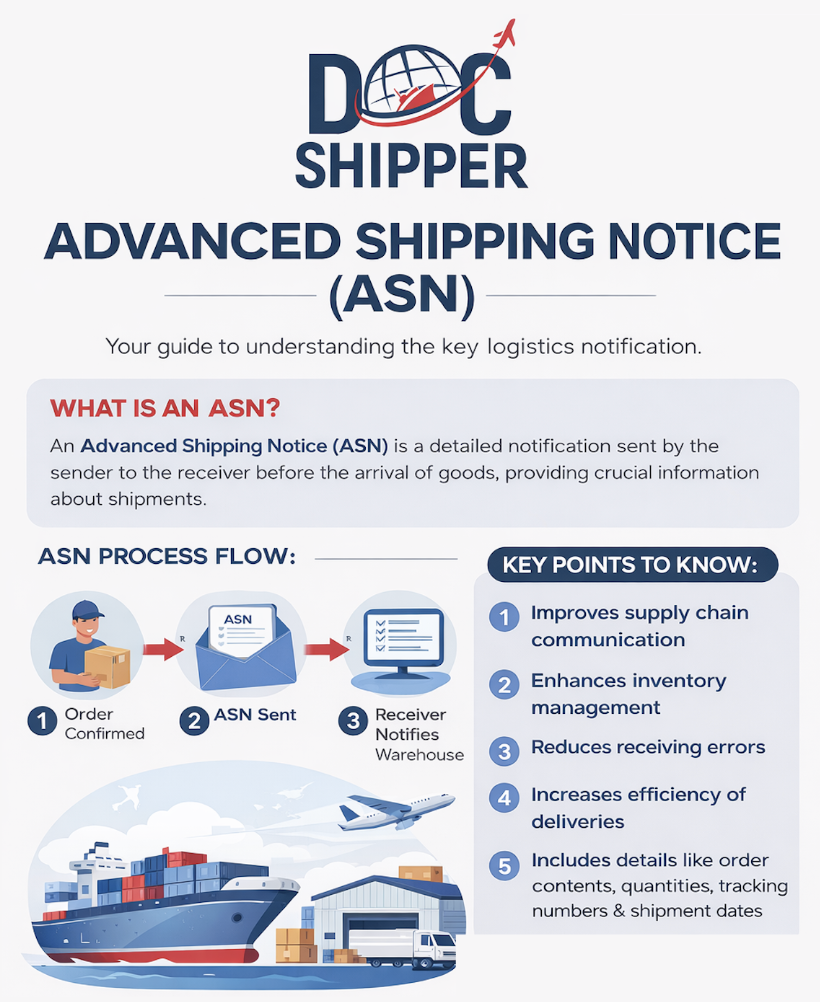
An Advanced Shipping Notice (ASN) is an electronic document sent by a supplier to notify the buyer about an upcoming shipment before it arrives. It contains detailed information about the goods being shipped, including product descriptions, quantities, packaging details, and expected delivery time, enabling better warehouse planning and inventory management.
Introduction
In international logistics, one of the most common challenges is the lack of visibility over incoming shipments. Warehouses receive containers without precise information, leading to delays, labor inefficiencies, and inventory discrepancies.
The Advanced Shipping Notice addresses this gap by providing advance notification of shipment contents and timing. This digital communication tool has become essential in modern supply chain operations, particularly for companies managing high-volume imports.
Key characteristics of an ASN include:
- Shipment identification: Unique reference numbers linking orders to deliveries
- Product details: Item codes, descriptions, quantities, and batch numbers
- Packaging information: Pallet counts, box dimensions, and weight specifications
- Delivery schedule: Expected arrival dates and carrier information
- Electronic transmission: Sent via EDI, API, or integrated logistics platforms
ASN Mechanisms & Technical Framework
The ASN operates within the broader ecosystem of Electronic Data Interchange (EDI), typically using the EDI 856 transaction set in North America or DESADV message in Europe. These standardized formats ensure compatibility across different systems and trading partners.
When a supplier prepares a shipment, the ASN is generated automatically through their warehouse management system. The document flows through the supply chain in real-time, allowing the receiving party to prepare accordingly. This transmission occurs hours or days before physical arrival, depending on transit time.
The hierarchical structure of an ASN mirrors the physical shipment organization. It begins with the shipment level (container or truck), breaks down into pallet or carton levels, and details individual items within each package. This granularity enables precise cross-docking and put-away strategies.
From a regulatory perspective, ASNs support customs compliance by providing advance cargo information. The U.S. Customs and Border Protection, for example, requires importers to submit cargo details before arrival through programs like the Importer Security Filing (ISF). An accurate ASN facilitates this process by containing the necessary data elements.
At DocShipper, we integrate ASN data into our customs clearance workflow to accelerate border processing and reduce detention risks for our clients.
The timing of ASN transmission varies by industry and agreement. Retailers often require ASNs 24-48 hours before delivery, while manufacturers may need longer lead times for production planning. The European Union’s logistics standards recommend transmission at the point of dispatch for optimal efficiency.
For more information on EDI standards, consult the GS1 organization, which maintains global supply chain communication protocols.
Practical Examples & Performance Data
The impact of ASN implementation can be measured through concrete operational improvements. Industry studies demonstrate significant efficiency gains when companies adopt this practice systematically.
Comparative Analysis: With vs. Without ASN
| Metric | Without ASN | With ASN | Improvement |
|---|---|---|---|
| Receiving time per container | 4-6 hours | 2-3 hours | 50% reduction |
| Inventory accuracy | 92-95% | 98-99% | +4% precision |
| Labor cost per shipment | $180-$250 | $90-$130 | 45% savings |
| Dock door utilization | 65-70% | 85-90% | +25% efficiency |
| Order fulfillment errors | 3-5% | 0.5-1% | 80% reduction |
Real-World Use Case: Electronics Importer
A European electronics distributor importing from Asia implemented ASN integration with their 3PL provider. Before implementation, each container required manual verification against purchase orders, taking an average of 5 hours per shipment.
After ASN adoption, the warehouse received detailed packing lists 48 hours before arrival. Staff pre-allocated storage locations and prepared picking routes. The result: receiving time dropped to 2.5 hours, and inventory was available for sale 24 hours faster.
The company processed 240 containers annually. The time savings translated to 600 labor hours recovered, equivalent to approximately €18,000 in annual cost reduction. Additionally, stockout incidents decreased by 35% due to improved inventory visibility.
DocShipper Platform
Optimize Your Global Logistics with Cutting-Edge Solutions
Enhance efficiency, cut costs, and gain 24/7 visibility 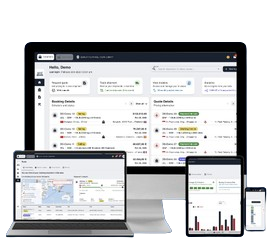 over your entire supply chain.
- Cut your shipping costs and maximize your margins
- Manage sourcing, freight, & customs on one platform
- Get real-time tracking and analytics
Key Implementation Factors
- System integration: WMS and ERP must support ASN data ingestion
- Supplier collaboration: Trading partners need technical capability and willingness
- Data accuracy: ASN information must match physical shipments within 98% tolerance
- Process alignment: Receiving procedures must adapt to leverage advance information
- Exception handling: Clear protocols for discrepancies between ASN and actual delivery
DocShipper coordinates ASN transmission between suppliers and clients, ensuring data accuracy and timely delivery notifications throughout the shipping process.
Conclusion
The Advanced Shipping Notice represents a fundamental shift from reactive to proactive logistics management. By providing detailed advance information, it enables warehouses to optimize labor, reduce costs, and improve customer service levels.
Need assistance implementing ASN processes in your supply chain? Contact DocShipper for expert guidance on logistics digitalization.
📚 Quiz
Test Your Knowledge: Advanced Shipping Notice (ASN)
Q1 — What is the primary purpose of an Advanced Shipping Notice (ASN)?
Q2 — A warehouse manager claims that an ASN is mandatory for customs clearance and replaces the Importer Security Filing (ISF). Is this correct?
Q3 — A European electronics distributor receives ASN data 48 hours before each container arrives. Which operational benefit best describes what they can achieve with this advance information?
🎯 Your Result
📞 Free Quote in 24hFAQ | Advanced Shipping Notice (ASN): Definition, Benefits & Practical Examples
An ASN typically contains shipment identification numbers, purchase order references, product SKUs, quantities, packaging details (pallets, cartons), weight and dimensions, carrier information, and expected delivery date. It may also include batch numbers and serial numbers for traceability.
A bill of lading is a legal document serving as a receipt and title for goods, while an ASN is an informational notice about shipment contents. The ASN is sent electronically before arrival, whereas the bill of lading accompanies the physical shipment.
The EDI 856 Ship Notice/Manifest is the standard transaction set for ASN in North America. In Europe, the equivalent is the DESADV (Despatch Advice) message within the EDIFACT standard.
Yes, many logistics platforms and supply chain portals offer web-based ASN submission for suppliers without EDI capability. Some buyers also accept ASN via email or XML files, though standardized EDI remains the most efficient method.
Industry best practice recommends sending the ASN 24-48 hours before delivery for domestic shipments, and 3-5 days for international shipments. The exact timing depends on the buyer's requirements and operational needs.
Discrepancies trigger exception handling processes. Receivers document variances, update inventory systems, and notify the supplier. Persistent inaccuracies may result in chargebacks or supplier performance penalties in retail environments.
ASN itself is not a customs document, but the information it contains supports mandatory filings like the Importer Security Filing (ISF) in the U.S. or Entry Summary Declarations in the EU. Accurate ASN data accelerates customs processing.
ASN enables pre-receiving activities such as labor scheduling, dock door assignment, storage location allocation, and cross-docking preparation. This advance planning reduces idle time and accelerates product availability.
Retail, automotive, electronics, pharmaceuticals, and food distribution industries see the greatest benefits due to high transaction volumes, strict inventory accuracy requirements, and time-sensitive product handling needs.
Yes, ASN supports partial shipments by referencing specific purchase order line items and quantities. Multiple ASNs can be issued for a single order, each detailing the contents of separate shipment legs.
Implementation costs vary based on existing system capabilities. EDI integration typically ranges from $5,000 to $25,000 for setup, plus ongoing transaction fees. Cloud-based solutions offer lower entry costs with subscription models starting around $200-$500 monthly.
ASN data automatically updates expected receipt quantities in inventory systems, triggering reorder calculations, production scheduling, and sales forecasting. This real-time visibility reduces safety stock requirements and improves working capital efficiency.
Need Help with
Logistics or Sourcing ?
First, we secure the right products from the right suppliers at the right price by managing the sourcing process from start to finish. Then, we simplify your shipping experience - from pickup to final delivery - ensuring any product, anywhere, is delivered at highly competitive prices.


Fill the Form
Prefer email? Send us your inquiry, and we’ll get back to you as soon as possible.
Contact us




:%20Definition%20&%20Guide%20en%202026)