In short ⚡
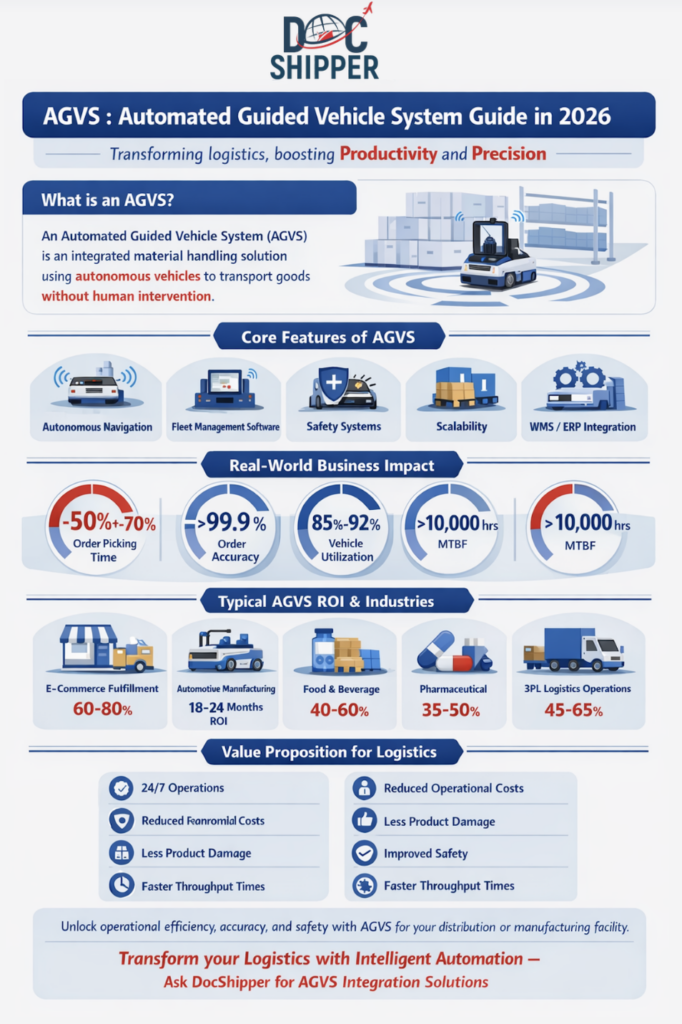
An Automated Guided Vehicle System (AGVS) is an integrated material handling solution comprising autonomous vehicles that transport goods within facilities without human intervention. These systems use sensors, software, and guidance technologies to navigate predefined routes, optimizing warehouse operations and manufacturing logistics through real-time coordination and safety protocols.
Introduction
Modern warehouses face mounting pressure: labor shortages, rising operational costs, and demands for 24/7 productivity. Traditional material handling creates bottlenecks that delay shipments and increase errors. This is where Automated Guided Vehicle Systems transform logistics operations.
AGVS technology has evolved from simple line-following carts to sophisticated fleets coordinating complex movements across multiple facilities. For international freight forwarders and manufacturers, these systems represent a critical infrastructure investment that directly impacts throughput, accuracy, and competitive positioning.
Key characteristics defining modern AGVS include:
- Autonomous navigation using laser, magnetic, or vision-based guidance systems
- Fleet management software coordinating multiple vehicles simultaneously
- Safety systems including obstacle detection, emergency stops, and zone restrictions
- Integration capabilities with WMS, ERP, and manufacturing execution systems
- Scalability allowing gradual expansion without operational disruption
Technical Components & Operational Expertise
An AGVS comprises three fundamental layers working in coordination. The vehicle layer includes the physical AGVs equipped with motors, batteries, sensors, and onboard computers. These vehicles range from unit load carriers transporting pallets to tugger trains pulling multiple carts through production areas.
The guidance technology determines how vehicles navigate. Magnetic tape guidance follows embedded floor strips, offering reliability at lower cost. Laser triangulation systems provide flexibility by calculating positions relative to reflective targets. Natural feature navigation represents the latest advancement, using cameras and AI to map environments without infrastructure modifications.
The control system architecture orchestrates all operations. A central traffic controller manages route assignments, prevents collisions, and optimizes fleet utilization. This software interfaces with warehouse management systems to receive transport orders and update inventory locations in real-time.
According to the Material Handling Institute, proper AGVS implementation requires thorough facility analysis. Floor conditions, ceiling height, traffic patterns, and existing infrastructure all impact system design. At DocShipper, we conduct comprehensive site assessments before recommending AGVS solutions, ensuring compatibility with your existing logistics operations.
Battery management directly affects operational continuity. Modern systems employ opportunity charging at strategic locations or automated battery swap stations. Lithium-ion batteries now dominate due to faster charging cycles and longer lifespans compared to traditional lead-acid alternatives.
Safety protocols meet stringent international standards. Multiple sensor layers create detection zones around each vehicle. When obstacles appear, AGVs slow down or stop automatically. Emergency stop buttons, audible warnings, and flashing lights ensure human workers can safely share spaces with autonomous equipment.
Practical Applications & Industry Data
Real-world AGVS deployments demonstrate measurable improvements across industries. The automotive sector pioneered adoption, with manufacturers like BMW operating fleets exceeding 100 vehicles per facility. These systems transport components between assembly stations with precision timing that synchronizes with production schedules.
E-commerce fulfillment centers represent explosive growth areas. Amazon’s acquisition of Kiva Systems transformed warehouse automation, with over 200,000 mobile robots now operating across their network. Independent studies show AGVS implementation reduces order picking time by 50-70% while improving accuracy rates above 99.9%.
| Industry Sector | Typical ROI Period | Productivity Gain | Primary Application |
|---|---|---|---|
| Automotive Manufacturing | 18-24 months | 40-60% | Line-side delivery |
| E-commerce Fulfillment | 12-18 months | 60-80% | Goods-to-person picking |
| Food & Beverage | 24-30 months | 30-45% | Pallet transport |
| Pharmaceutical | 20-26 months | 35-50% | Cleanroom material handling |
| Third-Party Logistics | 15-22 months | 45-65% | Cross-docking operations |
Cost analysis reveals compelling economics. Initial investment ranges from $25,000 for basic units to $150,000+ for specialized vehicles. However, labor savings accumulate rapidly. A single AGV replacing two-shift forklift operations saves approximately $80,000-$100,000 annually in wages and benefits.
Operational metrics from deployed systems show consistent patterns. Vehicle utilization rates typically reach 85-92% in optimized environments. Mean time between failures (MTBF) exceeds 10,000 hours for quality systems. Maintenance costs average 8-12% of initial purchase price annually.
A concrete scenario illustrates practical benefits: A 200,000 square foot distribution center handling 5,000 pallets daily implemented a 15-vehicle AGVS. Results after 12 months showed 58% reduction in product damage, 47% improvement in order accuracy, and elimination of 23 forklift-related safety incidents. The system paid for itself in 19 months through combined labor savings and efficiency gains.
DocShipper assists clients throughout AGVS implementation, from initial feasibility studies through system integration and staff training. Our experience across multiple industries ensures your automation investment delivers maximum return while maintaining operational continuity during transition periods.
DocShipper Platform
Cut logistics costs. Not corners.
See exactly where your logistics costs are bleeding — and how to fix it. Book your expert demo.

Conclusion
Automated Guided Vehicle Systems represent proven technology that transforms material handling from labor-intensive operations into precisely coordinated logistics networks. The combination of autonomous navigation, intelligent fleet management, and seamless system integration delivers measurable improvements in productivity, accuracy, and safety.
Need guidance on implementing AGVS in your facility? Contact DocShipper for expert consultation on warehouse automation solutions.
📚 Quiz
Automated Guided Vehicle System (AGVS)
1. What best defines an Automated Guided Vehicle System (AGVS)?
2. A warehouse manager claims that AGVs and AMRs are the same technology since both move autonomously. Is this correct?
3. A pharmaceutical company needs to automate material handling in a cleanroom environment with strict hygiene and precision requirements. Which outcome best reflects a realistic AGVS deployment in this context?
🎯 Your Result
📞 Free Quote in 24hFAQ | Automated Guided Vehicle System (AGVS): Definition, Applications & Concrete Examples
AGVs follow fixed paths using guidance infrastructure like magnetic tape or reflectors. Autonomous Mobile Robots (AMRs) use dynamic mapping and AI to navigate freely, adapting routes in real-time without physical guides.
Typical deployment spans 4-8 months including planning, infrastructure installation, vehicle commissioning, and staff training. Simple systems may launch in 8-12 weeks, while complex multi-building networks require 12+ months.
Yes, specialized cold-storage AGVs operate reliably in temperatures down to -30°C (-22°F). These units feature insulated electronics, heated batteries, and components rated for extreme conditions, commonly used in food distribution.
Regular maintenance includes battery checks, sensor cleaning, wheel inspections, and software updates. Most systems need 2-4 hours monthly preventive maintenance per vehicle. Predictive diagnostics alert operators before component failures occur.
Capacity varies by vehicle type and facility layout. Standard unit load AGVs typically complete 15-25 pallet moves per hour. Optimized systems with short travel distances and efficient loading zones achieve 30-40 moves hourly.
Modern AGVs incorporate multiple safety layers including laser scanners, proximity sensors, and emergency stop systems. They meet ISO 3691-4 safety standards and maintain excellent safety records when properly configured and maintained.
Yes, contemporary AGVS platforms offer standard APIs and protocols for WMS integration. They communicate bidirectionally, receiving transport orders and sending status updates, enabling real-time inventory visibility and task optimization.
Fleet management software automatically reroutes tasks to available vehicles. The disabled unit signals its status and location, allowing maintenance teams quick response. Redundancy planning ensures operations continue with minimal disruption.
Advanced traffic management algorithms predict conflicts and assign priority routing. Vehicles communicate positions continuously, negotiating right-of-way at intersections. The system balances workload distribution to prevent bottlenecks in high-traffic zones.
AGVs need relatively flat, smooth surfaces with minimal debris. Concrete floors should have less than 6mm variation per 3 meters. Expansion joints require proper treatment. Some systems tolerate moderate slopes up to 5 degrees.
Specialized outdoor AGVs handle yard operations, container transport, and inter-building logistics. These units feature weather-resistant enclosures, GPS navigation, and enhanced traction systems. They operate reliably in rain and moderate snow conditions.
Well-maintained AGVs operate effectively for 10-15 years. Control software receives updates throughout this period. Major components like batteries require replacement every 3-5 years. Progressive upgrades extend system relevance beyond initial deployment.
Need Help with
Logistics or Sourcing ?
First, we secure the right products from the right suppliers at the right price by managing the sourcing process from start to finish. Then, we simplify your shipping experience - from pickup to final delivery - ensuring any product, anywhere, is delivered at highly competitive prices.


Fill the Form
Prefer email? Send us your inquiry, and we’ll get back to you as soon as possible.
Contact us