


In short ⚡
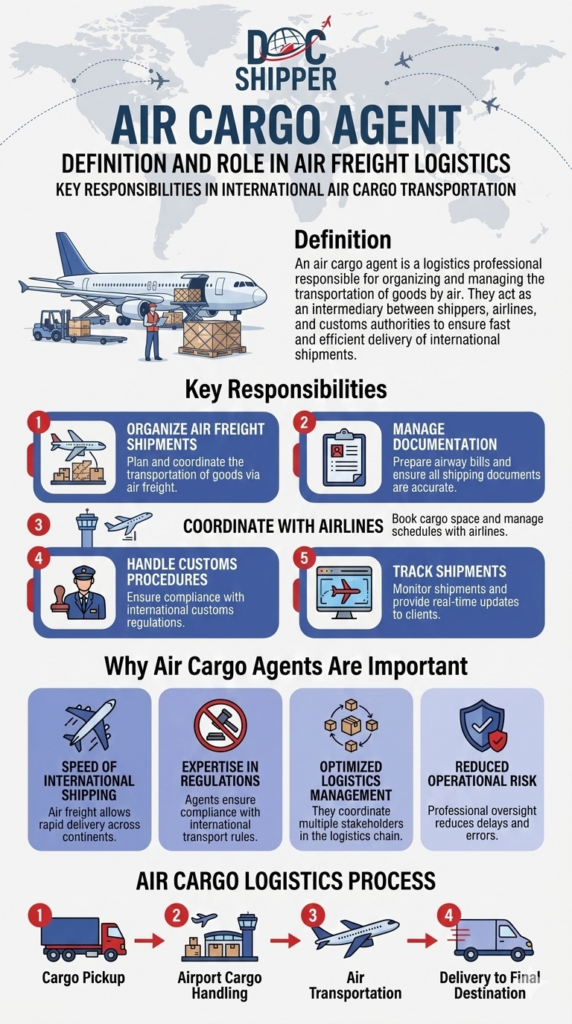
An Air Cargo Agent is a specialized logistics professional who handles the booking, documentation, and coordination of air freight shipments. They act as intermediaries between shippers, airlines, and consignees, ensuring cargo moves efficiently through the air transport network while managing customs compliance and regulatory requirements.
Introduction
Many businesses struggle with the complexity of air freight logistics. Missing documentation, incorrect tariff classifications, or poor carrier selection can delay shipments by days or weeks.
Air cargo agents solve these challenges by managing the entire air freight process. They navigate airline schedules, negotiate rates, prepare airway bills, and ensure compliance with international shipping regulations.
Their role is critical in global supply chains where speed matters:
- Documentation expertise: Prepare and verify all shipping documents including AWB, commercial invoices, and certificates of origin
- Carrier coordination: Select optimal airlines based on route, capacity, and transit time requirements
- Customs brokerage: Facilitate clearance procedures and regulatory compliance across jurisdictions
- Rate negotiation: Secure competitive freight rates through established airline relationships
- Problem resolution: Handle shipment delays, damage claims, and routing issues proactively
Expertise & Responsibilities
Air cargo agents operate within a highly regulated framework governed by IATA standards and national aviation authorities. Their primary responsibility is ensuring cargo moves legally and efficiently through air transport channels.
The IATA accreditation process requires agents to demonstrate financial stability, operational competence, and adherence to dangerous goods regulations. This certification allows them to issue Air Waybills (AWBs) on behalf of airlines. According to IATA’s Cargo Agent Standards, accredited agents must maintain strict compliance with cargo handling procedures.
Beyond basic documentation, agents provide strategic value through route optimization. They analyze multiple factors: direct versus connecting flights, airline reliability metrics, handling capabilities at transit airports, and seasonal capacity constraints. This expertise directly impacts delivery speed and cost efficiency.
The dangerous goods management function requires specialized training. Agents must classify hazardous materials according to IATA DGR guidelines, prepare proper declarations, and coordinate with airlines that have appropriate handling certifications. Errors in this area can result in shipment rejection or legal penalties.
At DocShipper, our air cargo specialists verify every AWB and regulatory document before flight departure, eliminating the risk of customs holds or return shipments that cost businesses thousands in delays.
Finally, agents manage insurance coordination and claims processing. They assess cargo value, recommend appropriate coverage levels, and handle damage documentation when issues occur during transit. This risk management role protects shippers from financial losses.
Practical Examples & Data
Understanding how air cargo agents function in real scenarios illustrates their operational impact. Consider these comparative data points and use cases:
| Service Component | Without Agent | With Agent |
|---|---|---|
| Documentation Time | 4-6 hours per shipment | 30-45 minutes |
| Freight Rate | Published tariff rates | 15-30% below published rates |
| Customs Clearance | 2-5 days average | Same-day to 24 hours |
| Error Rate | 12-18% document rejections | Less than 2% |
| Issue Resolution | Self-managed, variable timing | 24/7 support, 2-hour response |
Use Case: Electronics Manufacturer (Shenzhen to Frankfurt)
Scenario: A German retailer needs 500kg of smartphone components delivered within 72 hours for production line integration.
- Challenge: Standard shipping would take 6-8 days; lithium battery components require dangerous goods certification
- Agent solution: Secured space on direct Cathay Pacific flight; prepared IATA DGR documentation; coordinated pre-clearance with German customs
- Result: Delivery in 48 hours door-to-door; 22% cost savings versus express courier; zero compliance issues
- Cost breakdown: $3,850 total (freight $2,900 + documentation $450 + customs $500) versus $4,950 courier quote
- Time saved: 4 days faster than ocean freight alternative; production maintained on schedule
Industry data shows that 68% of air cargo shipments involve agent intermediation, according to IATA’s 2023 Air Cargo Market Analysis. This reflects the complexity of international air freight operations and the specialized knowledge required for efficient execution.
Conclusion
Air cargo agents deliver measurable value through expertise in documentation, carrier relationships, and regulatory compliance. Their role reduces costs, accelerates transit times, and minimizes shipment risks in complex international logistics.
Need expert air freight coordination for your shipments? Contact DocShipper for customized air cargo solutions that optimize your supply chain efficiency.
📚 Quiz
Test Your Knowledge: Air Cargo Agent
Q1 — What best describes the primary role of an Air Cargo Agent?
Q2 — A common misconception is that air cargo agents and freight forwarders are the same thing. What is the key difference?
Q3 — A German retailer needs 500kg of lithium battery components shipped from Shenzhen to Frankfurt within 72 hours. Which approach delivers the best outcome?
🎯 Your Result
📞 Free Quote in 24hFAQ | Air Cargo Agent: Definition, Role & Practical Examples
An air cargo agent specializes exclusively in air transport, while freight forwarders handle multiple transport modes (ocean, road, rail). Agents typically have direct IATA accreditation and deeper airline relationships for air-specific services.
For parcels under 50kg, express couriers (DHL, FedEx) often provide better value. Agents add significant value for shipments above 100kg where consolidated rates and custom routing options reduce costs substantially.
Agents typically charge either a flat fee per shipment ($50-$200) or a percentage of freight value (2-5%). Some use hybrid models combining both. Rates depend on shipment complexity, destination, and service level required.
Yes, but only if they hold IATA Dangerous Goods Regulation (DGR) certification. This specialized training covers classification, packaging, labeling, and documentation requirements for hazardous materials transport by air.
Standard documents include Air Waybill (AWB), commercial invoice, packing list, certificate of origin, and insurance certificates. For regulated goods, they also prepare phytosanitary certificates, export licenses, or dangerous goods declarations.
With proper documentation, agents can book space within 2-4 hours for next available flights. Same-day departures are possible for urgent shipments if cargo arrives at the airport before airline cut-off times (typically 4-6 hours before departure).
Agents arrange cargo insurance through specialized providers but don't underwrite policies themselves. They assess cargo value, recommend coverage levels, and facilitate claims processing if damage or loss occurs during transit.
Agents monitor flights in real-time and proactively rebook cargo on alternative flights when delays occur. They communicate status updates to shippers and coordinate with destination agents to minimize delivery impact.
Yes, consolidation is a core service. Agents combine multiple small shipments into single air freight consignments, reducing per-kilo costs by 30-50% compared to individual bookings while maintaining similar transit times.
Most agents coordinate customs clearance but work with licensed customs brokers for actual declaration filing. Full-service agents employ in-house brokers; others partner with specialists in destination countries to ensure compliant clearance.
Check IATA accreditation status through the IATA Agent Portal, verify business registration with national authorities, and request client references. Legitimate agents provide transparent pricing, insurance options, and clear service agreements.
Door-to-door transit averages 3-7 days depending on origin-destination pair. This includes pickup (1 day), export clearance (1 day), flight time (6-48 hours), import clearance (1-2 days), and final delivery (1 day).
Need Help with Logistics or Sourcing ?
First, we secure the right products from the right suppliers at the right price by managing the sourcing process from start to finish. Then, we simplify your shipping experience - from pickup to final delivery - ensuring any product, anywhere, is delivered at highly competitive prices.


Fill the Form
Prefer email? Send us your inquiry, and we’ll get back to you as soon as possible.
Contact us


