


In short ⚡
Alongside is a maritime term indicating a vessel's position directly next to a dock, wharf, or another ship. In international trade, this position determines when cargo transfer operations can begin and affects demurrage calculations, customs clearance timing, and liability transfer under Incoterms like FAS (Free Alongside Ship).Introduction
Confusion often arises between “alongside,” “berthed,” and “at port.” These distinctions matter critically in shipping contracts, as the moment a vessel is officially alongside triggers specific obligations for both seller and buyer.
In the logistics chain, the alongside position marks a pivotal operational milestone. It determines:
- Cargo transfer readiness — When loading or discharge operations can commence
- Cost allocation — Demurrage charges begin once the vessel is alongside and ready
- Risk transfer under FAS terms — Seller’s responsibility ends when goods are placed alongside the vessel
- Documentation timing — Bills of lading and mate’s receipts are issued based on this position
- Port efficiency metrics — Turnaround time calculations start from the alongside moment
Understanding this term prevents costly disputes and ensures smooth coordination between freight forwarders, port operators, and customs authorities.
Technical & Contractual Implications
The alongside position carries precise legal and operational meanings in maritime law and trade practice. When a vessel is declared alongside, it must meet specific criteria that vary by port regulations but generally include secure mooring and readiness to handle cargo.
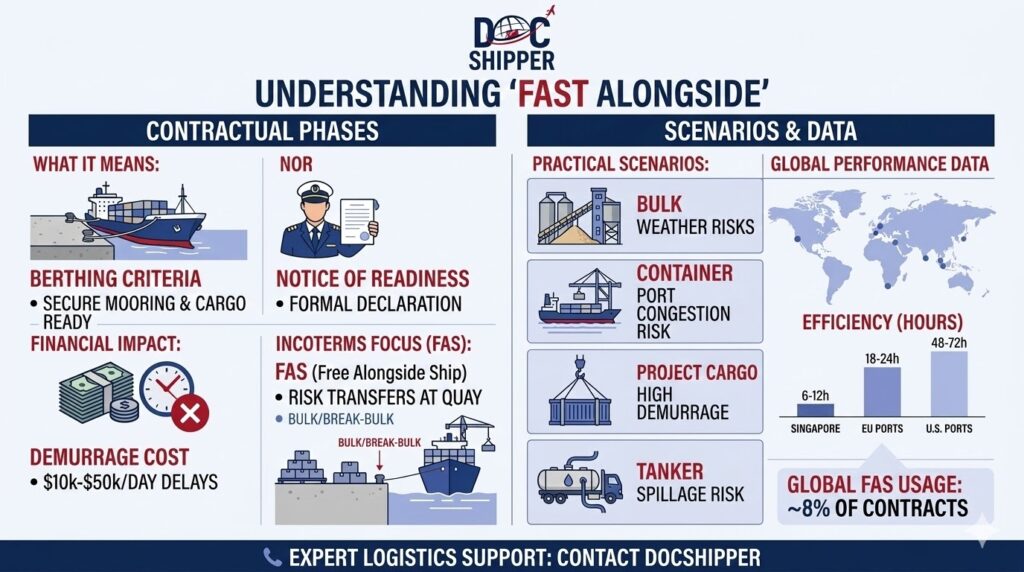
Notice of Readiness (NOR) is the formal declaration by the ship’s master that the vessel is alongside and prepared for cargo operations. This document triggers laytime calculations under charter party agreements. Delays in achieving alongside position can result in significant demurrage costs, typically ranging from $10,000 to $50,000 per day depending on vessel size.
Under FAS (Free Alongside Ship) Incoterms, the seller fulfills delivery obligations when goods are placed alongside the vessel at the named port. From that moment, all costs and risks transfer to the buyer. This differs fundamentally from FOB, where transfer occurs once goods cross the ship’s rail. According to ICC Incoterms® 2020, FAS is primarily used for bulk and break-bulk cargo rather than containerized freight.
Port operational protocols dictate that alongside positioning requires coordination between the harbor pilot, tugboats, and mooring teams. The vessel must maintain safe clearance from the quay—typically 0.5 to 1 meter—and secure with appropriate lines. Maritime authorities classify this as “fast alongside” when all lines are secured and the gangway is in place.
Liability considerations become critical during the alongside phase. The ship owner remains responsible for vessel safety, while the port authority manages quay-side infrastructure. Cargo damage occurring while goods are alongside but not yet loaded falls under complex jurisdictional rules governed by the Hague-Visby Rules or Hamburg Rules depending on the applicable convention.
At DocShipper, we coordinate closely with port agents to ensure precise timing of alongside positioning, minimizing demurrage exposure and ensuring compliance with both Incoterms obligations and local port regulations for our clients’ shipments.
Practical Scenarios & Data
Real-world application of the alongside concept varies significantly across cargo types, port infrastructure, and contractual arrangements. The following scenarios illustrate how alongside positioning affects operational and financial outcomes.
| Scenario | Alongside Criteria | Cost Impact | Risk Factor |
|---|---|---|---|
| Bulk Grain Export (FAS) | Vessel moored, conveyors positioned | Seller pays until alongside; buyer assumes costs after | Weather delays = buyer’s risk |
| Container Ship (FOB) | Berthed, cranes operational | Seller covers until containers cross ship’s rail | Port congestion = seller’s risk until loaded |
| Project Cargo (Heavy Lift) | Vessel secured, heavy-lift cranes ready | Demurrage $25,000–$75,000/day if delayed | Equipment failure = shared liability |
| Tanker (Liquid Bulk) | Moored, hoses connected, safety checks complete | Laytime starts immediately upon NOR acceptance | Spillage risk = strict port authority oversight |
Use Case: Automotive Parts Shipment from Germany to China
A manufacturer ships machinery components under FAS Hamburg terms. The vessel arrives and moors alongside Pier 7 at 08:00. The seller delivers goods to the quayside by 10:00, fulfilling FAS obligations. However, port congestion delays crane availability until 14:00. The buyer absorbs the four-hour delay cost ($2,400 in demurrage) because risk transferred at 10:00 when goods were placed alongside.
Port Efficiency Benchmark Data:
- Average alongside time in major EU ports: 18–24 hours from arrival to berth
- Singapore Port: 6–12 hours (highest efficiency globally)
- U.S. West Coast ports: 48–72 hours during peak congestion periods
- Demurrage costs: $15,000/day (Handysize) to $100,000/day (VLCC tankers)
- FAS usage rate: Approximately 8% of global trade contracts (primarily bulk commodities)
DocShipper’s port agency network monitors vessel movements in real-time, providing clients with precise alongside ETAs and coordinating cargo readiness to minimize laytime and demurrage exposure across 300+ global ports.
Conclusion
The alongside position represents a critical operational and contractual threshold in maritime logistics, directly impacting cost allocation, risk transfer, and cargo handling efficiency. Precise understanding of this term prevents disputes and optimizes supply chain performance.
Need expert guidance on Incoterms, port operations, or customs procedures? Contact DocShipper for comprehensive logistics support tailored to your shipping requirements.
📚 Quiz
Test Your Knowledge: Alongside
Q1 — What does "alongside" mean in a maritime shipping context?
Q2 — Under FAS (Free Alongside Ship) Incoterms, when exactly does risk transfer from the seller to the buyer?
Q3 — A manufacturer ships bulk grain under FAS terms. The vessel moors alongside at 08:00, but port congestion delays crane availability by 4 hours. Who bears the cost of this delay?
🎯 Your Result
📞 Free Quote in 24hFAQ | Alongside: Definition, Usage & Practical Examples in Shipping
"Alongside" means the vessel is positioned next to the dock and moored. "Berthed" indicates the vessel is fully secured with all operational equipment in place and ready for cargo operations. Berthed is the completion of the alongside maneuver.
Laytime begins when the vessel tenders Notice of Readiness (NOR) and the port authority accepts it, confirming the ship is alongside, secure, and ready for cargo operations. Acceptance typically occurs within 6–24 hours depending on port procedures.
FAS is rarely used for containers. It primarily applies to bulk, break-bulk, and project cargo where goods are placed on the quay alongside the vessel. For containers, FOB or FCA terms are standard practice.
Responsibility depends on the charter party terms. Typically, if congestion is beyond both parties' control, the charterer bears demurrage costs once NOR is tendered, even if the vessel is waiting at anchorage rather than physically alongside.
No. "Alongside" specifically means the vessel is moored directly adjacent to a berth or wharf. A vessel at anchor is "off port" or "at roads," not alongside. Some charter parties allow NOR at anchorage, but this must be explicitly stated.
The Notice of Readiness (NOR), port authority berthing confirmation, and pilot's report collectively document alongside status. These are essential for laytime calculations and resolving disputes over delivery timing under Incoterms.
From port arrival to alongside positioning: 2–6 hours in efficient ports (Singapore, Rotterdam), 12–48 hours in congested ports (Los Angeles, Felixstowe during peak seasons). Weather and tidal conditions can extend this significantly.
Yes. River barges and inland vessels also use "alongside" terminology when moored at river terminals or canal-side facilities. The operational and contractual principles remain consistent with ocean-going vessels.
Under FAS terms, once goods are placed alongside, the buyer bears risk. However, if damage occurs due to port operations or vessel negligence before loading commences, liability may fall on the port authority or carrier under applicable maritime law.
Customs inspections typically occur after cargo is loaded or discharged, not during alongside positioning. However, security or quarantine holds can prevent a vessel from achieving operational alongside status until clearances are obtained.
The bill of lading "shipped on board" date reflects when cargo crosses the ship's rail, not the alongside moment. However, for FAS shipments, the date goods are placed alongside may appear in supporting documentation like the dock receipt.
Yes. The International Ship and Port Facility Security (ISPS) Code and local port regulations mandate safety protocols including fire prevention, mooring standards, and access control during alongside operations. Non-compliance can delay cargo handling and incur penalties.
Need Help with Logistics or Sourcing ?
First, we secure the right products from the right suppliers at the right price by managing the sourcing process from start to finish. Then, we simplify your shipping experience - from pickup to final delivery - ensuring any product, anywhere, is delivered at highly competitive prices.


Fill the Form
Prefer email? Send us your inquiry, and we’ll get back to you as soon as possible.
Contact us


